Medical Design and Outsourcing

  • Home
  • Medical Device Business
    • Mergers & Acquisitions
    • Financial
    • Regulatory
  • Applications
    • Cardiovascular
    • Devices
    • Imaging
    • Implantables
    • Medical Equipment
    • Orthopedic
    • Surgical
  • Technologies
    • Supplies and Components Index
    • Contract Manufacturing
    • Components
    • Electronics
    • Extrusions
    • Materials
    • Motion Control
    • Prototyping
    • Pumps
    • Tubing
  • MedTech Resources
    • Medtech Events in 2026
    • The 2026 Medtech Big 100
    • Medical Device Handbook
    • MedTech 100 Index
    • Subscribe to Print Magazine
    • DeviceTalks
    • Digital Editions
    • eBooks
    • Educational Assets
    • Manufacturer Search
    • Podcasts
    • Webinars / Digital Events
    • Whitepapers
    • Voices
    • Views
    • Video
  • 2026 Leadership
    • 2025 Winners
    • 2024 Winners
    • 2023 Winners
    • 2022 Winners
    • 2021 Winners
  • Women in Medtech
  • Advertise
  • Subscribe

How Medtronic developed OmniaSecure, the world’s smallest defibrillation lead

December 5, 2025 By Jim Hammerand

After winning FDA approval for the right ventricle, Medtronic is aiming its OmniaSecure lead at the other side of the heart.

A photo of the Medtronic OmniaSecure defibrillation lead.

The Medtronic OmniaSecure lead is the world’s smallest defibrillation lead, with an outer diameter of 4.7 French (1.6 mm) [Image courtesy of Medtronic]

Though the Medtronic OmniaSecure is the world’s smallest defibrillation lead, the product development story isn’t one of miniaturization.

Instead, the world’s largest medical device company went in the opposite direction, scaling up one of its smallest products — the SelectSecure Model 3830 pacing lead — for a new purpose.

“Rather than try to downsize … we took that lead and upsized it, which is an innovative approach,” Medtronic VP and Defibrillation Solutions GM Trevor Cook said in a Medical Design & Outsourcing interview.

Medtronic won FDA approval of the technology in April 2025 for right ventricle (RV) pacing, sensing, cardioversion, and defibrillation with cardiac implantable electronic devices (CIEDs) for patients with life-threatening ventricular tachyarrhythmias or the risk of developing them.

The approval includes pediatric patients ages 12 and up (and weighing at least 30 kg) if their cardiac anatomy is conducive to RV coil placement.

A photo of the Medtronic SureScan 3830 pacing lead.

The Medtronic SelectSecure Model 3830 pacing lead [Image courtesy of Medtronic]

Pediatrics ” is not always easy, but definitely a really important area to continue to innovate in,” Cook said. “… Oftentimes, they will need a device for the duration of their life.”

Related: Why device developers shouldn’t pass over pediatrics

Used for two decades in patients, the 3830 is a catheter-delivered, lumenless lead with an outer diameter of 4.1 French, offering the reliability and size Medtronic needed to win that pediatric indication.

“It’s our most reliable lead from its base,” Cook said of the 3830 lead. “It’s also been used in conduction system pacing — that’s a hot area within pacing — and soon to be defibrillation.”

OmniaSecure’s design and features

The SelectSecure Model 3830 pacing lead is similar in appearance to the OmniaSecure defibrillation lead, but the new lead — Model 3930M — has a larger outer diameter of 4.7 French due to the additional insulation needed for defibrillation voltage.

A photo of a Medtronic Cobalt XT DR implant with SelectSecure and OmniaSecure leads.

A Medtronic Cobalt XT DR implantable cardioverter-defibrillator (ICD) with SelectSecure and OmniaSecure leads [Image courtesy of Medtronic]

Medtronic says OmniaSecure’s smaller profile compared to traditional defibrillation leads may reduce the potential for venous occlusion, tricuspid valve regurgitation or other complications.

The OmniaSecure lead’s inner insulation is ethylene tetrafluoroethylene (ETFE) around the conductor cable and then a layer of silicone, while the outer insulation is 55D polyurethane.

OmniaSecure also needed a new defibrillation coil that was as flexible as the lead and small enough to fit on it, but with enough surface area for effective defibrillation.

“Those three things around the coil were critically important and and required a lot of time,” Cook said.

A photo of the Medtronic OmniaSecure defibrillation lead's electrodes.

Medtronic’s OmniaSecure lead has two electrodes: the helix at the upper left of this image and the defibrillation coil at the bottom right. [Image courtesy of Medtronic]

The RV defibrillation coil along the length of the lead is made of platinum/iridium-clad tantalum and delivers energy for cardioversion and defibrillation.

The lead paces and senses between the defibrillation coil electrode and the helix electrode at the distal tip of the lead. That nonretractable helix is made of titanium nitride-coated platinum alloy and rotates with the lead for active fixation in the endocardium.

The distal tip also has a monolithic controlled release device for dexamethasone acetate steroid to reduce inflammation.

The conductor cable is made of MP35N, a nonmagnetic alloy of cobalt, nickel, chromium and molybdenum. That alloy is also used in the silver-cored conductor coil, which is insulated with SI (soluble imide) polyimide. Medtronic licenses that material from NASA for various leads due to its high resistance to heat, moisture and chemicals.
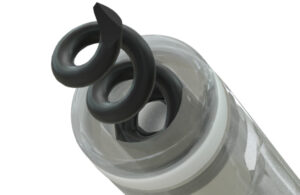
An image of the The distal end of Medtronic's OmniaSecure lead.

The close-up of the distal end of Medtronic’s OmniaSecure lead shows the helix used as an anchor and electrode, and a steroid-eluting ring to reduce inflammation. [Image courtesy of Medtronic]

Unlike larger catheter-delivered defibrillation leads, OmniaSecure has no stylet running through the middle of it for steering, using a cable throw instead for tensile strength, reliability and flexibility.

“It’s a much more simple construction that we feel provides benefits on the reliability side and even the procedural side as well,” Cook said.

Cardiac implant lead fractures are some of the most dangerous failures in medtech, and the longer lifespans of defibrillator patients and their implants makes durability even more of a challenge. The leads must flex with every single heartbeat over a patient’s lifetime.

“Making sure the lead can remain reliable through the duration of either the life of the patient or the life of the device is critically important,” Cook said.

“Not only did we look at 3830 and its reliability — the strength of reliability you get in a cable that runs through the entire lead — and the flexibility you get in a small diameter lead,” he later continued, “but we also looked at all the potential failure points from leads in the past and developed bench top testing and modeling … to run it through millions of cycles of test to make sure that we’re comfortable with it when it gets in vivo.”

MDO Min-Vasive Medtech: Download our free 72-page special report featuring interviews with minimally invasive device development experts and engineers at major OEMs and groundbreaking startups

What’s next for OmniaSecure

Medtronic is now investigating the use of the OmniaSecure lead in the left bundle branch (LBB) area for an expanded indication, which Cook called “a new frontier from a defibrillation standpoint.”

Medtronic said its LEADR LBBAP (Lead Evaluation for Defibrillation and Reliability in Left Bundle Branch Area Pacing) study is showing high defibrillation success when placed in the LBB area for patients indicated for an implantable cardioverter-defibrillator (ICD) or cardiac resynchronization therapy defibrillator (CRT-D).

“The left bundle branch area is emerging as an option for more physiologic pacing for patients who receive an ICD or CRT-D to treat dangerous heart rhythms,” cardiac electrophysiologist Dr. Pugazhendhi Vijayaraman said in a news release after presenting those late-breaking results at Heart Rhythm 2025. “The option to place a lead in the left bundle branch area may provide for physiologic pacing by engaging the heart’s natural conduction system. These positive preliminary results for the LEADR LBBAP study are encouraging and highlight the potential versatility of the OmniaSecure defibrillation lead.”

Advice for device developers

A photo of Medtronic VP and Defibrillation Solutions GM Trevor Cook.

Medtronic VP and Defibrillation Solutions GM Trevor Cook [Photo courtesy of Medtronic]

“Don’t think any idea is too big,” Cook said when asked for lessons from OmniaSecure’s development. “The marvels of innovation always seem to come together when you have partners like physicians and engineers, and then really good intentions in mind around, bringing an innovation to help patients.

“There are definitely curves in the road that you need to navigate and that requires a little resilience, but then you end up with something like this that we think is a big leap in innovation that brings a lot of benefit,” he later continued.  “Keep patients in line of sight and keep physician partners close to make sure you’ve got full visibility on all that you need to do and all that you can do.”

Related: Medtronic names its next-gen renal denervation catheter as it builds the RDN market

About The Author

Jim Hammerand

Jim Hammerand is the managing editor of Arrowfly's Medical Design & Outsourcing, where he leads coverage of medtech innovation, design, engineering and manufacturing. He also reports breaking news at Arrowfly's MassDevice and contributes to our DeviceTalks podcasts and live events. Hammerand has more than two decades of journalism experience spanning newspapers, magazines, websites, live events, radio and TV news. For nearly a decade, Hammerand reported and edited business news for American City Business Journals as a reporter and digital editor at the Minneapolis/St. Paul Business Journal and then as managing editor of the Puget Sound Business Journal in Seattle. He holds degrees in journalism and management from the University of Minnesota and has won journalism awards from the Society of Professional Journalists, American Society of Business Publication Editors, and Trade, Association, Business Publications International. Connect with him on LinkedIn or by email at [email protected].

Related Articles Read More >

A photo of Johns Hopkins researcher's mini robots in a phantom heart benchtop test.
Johns Hopkins researchers develop miniature magnetic drug delivery robots to target infections at the site
An image showing a three-dimensional (3D) model of a heart.
Mussallem CHD Alliance launches 3D cardiac modeling collaboration
The most innovative medical devices of 2026
An illustration showing Corcym's Memo 4D Curve's laser-cut nitinol core.
Laser-cut nitinol and a layered design let these cardiac implants flex
“mdo
EXPAND YOUR KNOWLEDGE AND STAY CONNECTED
Get the latest medical device business news, application and technology trends.

DeviceTalks Weekly

See More >

MDO Digital Edition

Digital Edition

Subscribe to Medical Design & Outsourcing. Bookmark, share and interact with the leading medical design engineering magazine today.

MEDTECH 100 INDEX

Medtech 100 logo
Market Summary > Current Price
The MedTech 100 is a financial index calculated using the BIG100 companies covered in Medical Design and Outsourcing.

New MedTech Resource

Medical Tubing

MassDevice

Mass Device

The Medical Device Business Journal. MassDevice is the leading medical device news business journal telling the stories of the devices that save lives.

Visit Website
MDO ad
Medical Design and Outsourcing
  • MassDevice
  • DeviceTalks
  • MedTech100 Index
  • Medical Tubing + Extrusion
  • Medical Design Sourcing
  • Drug Delivery Business News
  • Drug Discovery & Development
  • Pharmaceutical Processing World
  • R&D World
  • About Us/Contact
  • Advertise With Us
  • Subscribe to Print Magazine
  • Subscribe to our E-Newsletter
  • Listen to our Weekly Podcasts
  • Join our DeviceTalks Tuesdays Discussion

Copyright © 2026 Arrowfly, LLC. All Rights Reserved. The material on this site may not be reproduced, distributed, transmitted, cached or otherwise used, except with the prior written permission of Arrowfly LLC. Site Map | Privacy Policy | RSS

Search Medical Design & Outsourcing

  • Home
  • Medical Device Business
    • Mergers & Acquisitions
    • Financial
    • Regulatory
  • Applications
    • Cardiovascular
    • Devices
    • Imaging
    • Implantables
    • Medical Equipment
    • Orthopedic
    • Surgical
  • Technologies
    • Supplies and Components Index
    • Contract Manufacturing
    • Components
    • Electronics
    • Extrusions
    • Materials
    • Motion Control
    • Prototyping
    • Pumps
    • Tubing
  • MedTech Resources
    • Medtech Events in 2026
    • The 2026 Medtech Big 100
    • Medical Device Handbook
    • MedTech 100 Index
    • Subscribe to Print Magazine
    • DeviceTalks
    • Digital Editions
    • eBooks
    • Educational Assets
    • Manufacturer Search
    • Podcasts
    • Webinars / Digital Events
    • Whitepapers
    • Voices
    • Views
    • Video
  • 2026 Leadership
    • 2025 Winners
    • 2024 Winners
    • 2023 Winners
    • 2022 Winners
    • 2021 Winners
  • Women in Medtech
  • Advertise
  • Subscribe