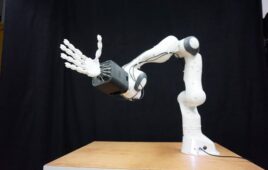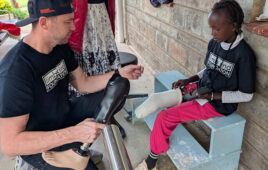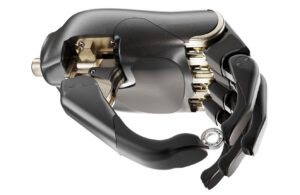
Metacarpal says its GEM prosthetic hand “automatically conforms fingers around any object for a secure, effortless hold.” [Image courtesy of Metacarpal]
“The prosthetics industry does not have a technology problem,” he said. “It has a trust problem. Users have been let down so many times that rebuilding that trust requires more than a better device. It requires honesty about what a device can and cannot do, a clinical process that sets users up for success, and a commitment to being there when something goes wrong.”
Mackie co-founded Edinburgh-based Metacarpal with James Swinburne in 2020 and launched in the U.S. and Canada in 2026. While Mackie said Metacarpal might not be “the most technologically impressive prosthetics company in the world,” he intends to make it the most reliable one.
“The one that users actually wear,” he continued. “If we get that right, the rest follows.”
In a Medical Design & Outsourcing interview, Mackie discussed Metacarpal’s GEM (which stands for “grasp every moment”) hand, the prosthetics industry and what’s ahead for both. The following has been lightly edited for space and clarity.
MDO: What’s special about Metacarpal’s GEM, and what technologies make it possible?

Metacarpal co-founder and CEO Fergal Mackie [Photo courtesy of Metacarpal]
“At the heart of the GEM is what we call Reactive Grasp Technology. It uses 13 engineered pulleys that allow each finger to move independently and conform around the shape of an object automatically. There are no motors driving that. It all happens mechanically. When the fingers meet resistance, they adapt, so you get full contact across all four fingers rather than just two pressure points. That’s what makes the grip feel natural.
“The control system works like a bicycle brake. A cable runs from the hand, up the arm, around the back, and connects to a harness on the opposite shoulder. When the user moves their shoulder, arm, or elbow, the cable tightens and closes the grip. The device provides immediate proprioceptive feedback through the harness system, letting users feel the force they are applying without visual confirmation. For users who work with their hands all day, that direct connection changes everything.
“The device weighs around one pound, is completely waterproof, needs no charging, and operates below 38 Newtons of force, which is under the threshold research shows prevents fatigue during all-day use for the average female. It can carry loads up to 110 pounds and push vertically up to 198 pounds. For a construction worker, a factory worker, or anyone in a physically demanding job, that reliability is the whole point. And because the leading cause of amputation is trauma: this is a large part of the patient population.”
The 2026 MDO Medtech Startups Special Report: Technical tips and actionable advice for device startups
What are the biggest trends in prosthetics? Where is this space headed?
Mackie: “The most significant shift I see is a growing recognition that complexity is not the same as progress. For years, the prosthetics industry measured advancement by adding more electronics, more sensors, more processing power. The assumption was that more technology meant better outcomes. The rejection data tells a different story. Traditional body-powered hands face rejection rates up to 87%, while body-powered hooks — which have barely changed in over a century — sit at just 26%. Users are voting with their behavior, and the industry is starting to pay attention.
“The second trend worth watching is the growing focus on clinical workflow integration. Prosthetists are stretched. They need devices that fit into their existing processes without requiring extensive retraining or lengthy calibration. Devices that demand less from the clinical team while delivering more to the patient will win. That is where we positioned the GEM from day one.
“There is also a quiet but meaningful resurgence of interest in body-powered solutions, particularly among military veterans, where 74% still prefer body-powered devices for their reliability and direct feedback. That preference has existed for decades. What is changing now is that engineers are finally starting to apply modern design thinking to that space rather than dismissing it in favor of electronics. That gap between what users actually prefer and what the industry has been building is exactly where Metacarpal operates.”
What sort of innovations are you looking for from outside your company to enable new and improved products in prosthetics?
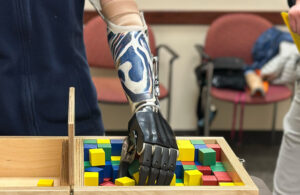
Metacarpal launched its GEM prosthetic hand in the U.S. in 2026. [Photo courtesy of Metacarpal]
“The harness is often seen as the less sexy part of a prosthesis, but if that isn’t comfy, no matter how much function the terminal device offers, the user simply won’t put up with it. I think there is a big scope for more research and development in this area.”
Can you offer any insight into R&D efforts you’re undertaking?
Mackie: “While it wouldn’t be wise to share any specifics, we are working on technology that opens up access to GEM even further so people with varied levels of amputations can get maximum benefit from the technology. Then taking on feedback from the field, we are able to make tweaks and add-ons to improve overall performance.
We’ll have more from this interview at Medical Design & Outsourcing soon. Make sure you don’t miss the next part by signing up for our free twice-weekly newsletter. (And if you’re a medical device industry professional, you’re likely eligible for a free subscription to our magazine online and by mail as well.)