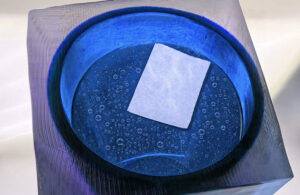
A piece of breathable hydrogel floats in water. [Photo courtesy of MIT]
Hydrogels are materials made of water and polymer that are used in medical patches and glues to dress wounds, attach implants and deliver medicines. Most hydrogels lack breathability, which causes them to trap moisture and sweat.
The new aerated hydrogel from MIT researchers contains a network of tunnels that allows air to pass through, reducing sweat build up. The researchers tested their hydrogel by using it to attach wireless heart monitors to volunteers who worked out regularly for ten days while wearing them. The volunteers showed no signs of skin irritation.
Additionally, in a side-by-side comparison during exercise, the heart monitors with the breathable hydrogel were better able to track ECG signals than those with traditional hydrogels.
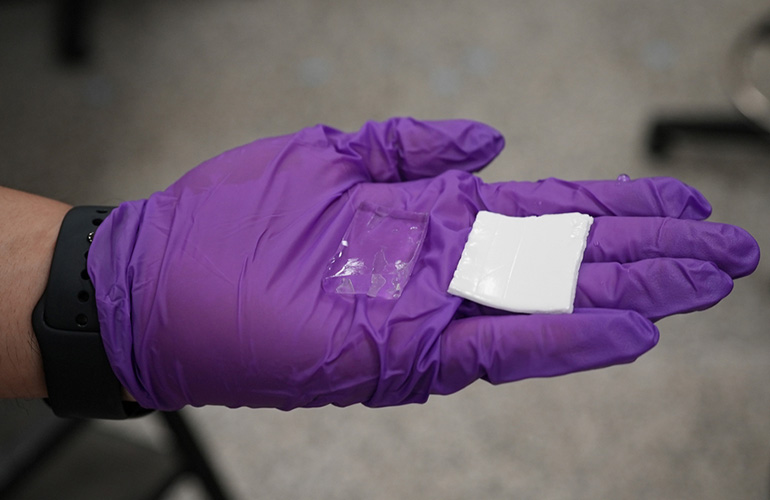
A traditional hydrogel (clear) compared with the new, breathable hydrogel (white). [Photo courtesy of MIT]
The researchers published the results in Nature, reporting that they were able to create the hydrogel while minimizing the amount of ingredients added to the material.
The researchers used phase separation, adding a small amount of hydrophobic silica aerogel particles to a conventional hydrogel recipe. The water molecules and silica particles separated, and the silica particles formed a network of thin tunnels that allow for air flow.
“It’s as if the particles formed a network of connected tunnels, like air-permeable highways within the hydrated hydrogel,” co-lead author Shucong Li said in a news release.