Medical Design and Outsourcing

  • Home
  • Medical Device Business
    • Mergers & Acquisitions
    • Financial
    • Regulatory
  • Applications
    • Cardiovascular
    • Devices
    • Imaging
    • Implantables
    • Medical Equipment
    • Orthopedic
    • Surgical
  • Technologies
    • Supplies and Components Index
    • Contract Manufacturing
    • Components
    • Electronics
    • Extrusions
    • Materials
    • Motion Control
    • Prototyping
    • Pumps
    • Tubing
  • MedTech Resources
    • Medtech Events in 2026
    • The 2025 Medtech Big 100
    • Medical Device Handbook
    • MedTech 100 Index
    • Subscribe to Print Magazine
    • DeviceTalks
    • Digital Editions
    • eBooks
    • Educational Assets
    • Manufacturer Search
    • Podcasts
    • Webinars / Digital Events
    • Whitepapers
    • Voices
    • Views
    • Video
  • 2026 Leadership
    • 2025 Winners
    • 2024 Winners
    • 2023 Winners
    • 2022 Winners
    • 2021 Winners
  • Women in Medtech
  • Advertise
  • Subscribe

MIT researchers develop injectable antenna that could power battery-free medical implants

November 13, 2025 By Sean Whooley

Tiny Injectable magnetoelectric antenna power source MIT Media Lab (1)

A tiny, injectable magnetoelectric antenna implanted deep in the brain can receive power from low-frequency external magnetic fields. [Image courtesy of MIT/Baju Joy]

Researchers at the Massachusetts Institute of Technology Media Lab say a tiny antenna that they developed could wirelessly power deep-tissue medical implants.

The antennas measure at about the size of a fine grain of sand, the researchers say. They believe they can inject the devices into the body to wirelessly power devices like pacemakers in cardiac patients and neuromodulators in people with epilepsy or Parkinson’s disease.

“This is the next major step in miniaturizing deep-tissue implants,” said Baju Joy, a PhD student in the MIT Media Lab’s Nano-Cybernetic Biotrek research group. “It enables battery-free implants that can be placed with a needle, instead of major surgery.”

The researchers published their findings in the October issue of IEEE Transactions on Antennas and Propagation. Joy was joined on the paper by lead author Yubin Cai, PhD student at the Media Lab, Benoît Desbiolles and Viktor Schell, former MIT postdocs, Shubham Yadav, an MIT PhD student in media arts and sciences, David Bono, an instructor in the MIT Department of Materials Science and Engineering and senior author Deblina Sarkar, the AT&T Career Development Associate Professor at the Media Lab and head of the Nano-Cybernetic Biotrek group.

Currently, deep-tissue implants receive power either from a surgically implanted battery in the body that requires periodic replacement, or with a surgically placed magnetic coil that can harvest power wirelessly. The coil only functions at high frequencies, the researchers say, which can cause tissue heating and limit the amount of power that’s delivered safely when miniaturized to sub-millimeter size.

To combat the size issue with these current options and the safety issue as well, the team sought to develop their antenna at ultra-small dimensions. At just 200 micrometers, the device operates at low frequencies (109 kHz). The researchers attribute this to a novel technology in which a magnetostrictive film, which deforms when a magnetic field is applied, is laminated with a piezoelectric film. This converts deformation to electric charge.

With alternating magnetic field application, magnetic domains within the magnetostrictive film contort it in the same way that a piece of fabric interwoven with pieces of metal would contort if subjected to. a strong magnet. The mechanical strain in the magnetostrictive layer causes the piezoelectric layer to generate electric charges across electrodes placed above and below. Joy says the team found a way to use the mechanical vibration to convert magnetic fields to electric fields.

According to Sarkar, the antenna delivers 4-5 times more power than implantable antennas of similar size that rely on metallic coils and operate in the GHz frequency range.

“Our technology has the potential to introduce a new avenue for minimally invasive bioelectric devices that can operate wirelessly deep within the human body,” Sarkar said.

Min-Vasive Medtech: Read more about minimally invasive devices and systems

The researchers liken the activation device to a rechargeable wireless cell phone charger. It’s small enough to be applied on the skin as a stick-on patch or slipped into a pocket close to the skin surface and still produce the magnetic field that activates the antenna. The team fabricated the antenna with the same technology as a microchip, so it can easily integrate with existing microelectronics.

Altogether, the system can be placed with a simple needle injection.

The researchers say they could easily scale antenna manufacturing and multiple offerings could be injected to treat large areas of the body. In addition to pacemakers and neuromodulation devices, they may look to apply their technology to glucose sensing.

“That’s just one example,” Joy said. “We can leverage all these other techniques that are also developed using the same fabrication methods, and then just integrate them easily to the antenna.”


About The Author

Avatar photo
Sean Whooley

Sean Whooley is an associate editor who mainly produces work for MassDevice, Medical Design & Outsourcing and Drug Delivery Business News. He received a bachelor's degree in multiplatform journalism from the University of Maryland, College Park. You can connect with him on LinkedIn or email him at [email protected].

Related Articles Read More >

A photo of the Paradromics Connexus brain-computer interface on a fingertip.
How Paradromics designed its Connexus brain-computer interface system
A photo of Forj Medical's Costa Rica manufacturing facility.
Forj Medical opens Costa Rica manufacturing site
Syensqo material supports modular sternal spacer for cardiothoracic care
An image of VahatiCor's A-Flux implant.
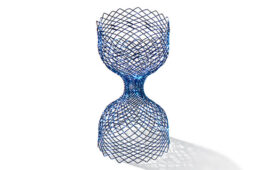
Nitinol outsourcing made VahatiCor’s new cardiac implant possible
“mdo
EXPAND YOUR KNOWLEDGE AND STAY CONNECTED
Get the latest medical device business news, application and technology trends.

DeviceTalks Weekly

See More >

MDO Digital Edition

Digital Edition

Subscribe to Medical Design & Outsourcing. Bookmark, share and interact with the leading medical design engineering magazine today.

MEDTECH 100 INDEX

Medtech 100 logo
Market Summary > Current Price
The MedTech 100 is a financial index calculated using the BIG100 companies covered in Medical Design and Outsourcing.

New MedTech Resource

Medical Tubing

MassDevice

Mass Device

The Medical Device Business Journal. MassDevice is the leading medical device news business journal telling the stories of the devices that save lives.

Visit Website
MDO ad
Medical Design and Outsourcing
  • MassDevice
  • DeviceTalks
  • MedTech100 Index
  • Medical Tubing + Extrusion
  • Medical Design Sourcing
  • Drug Delivery Business News
  • Drug Discovery & Development
  • Pharmaceutical Processing World
  • R&D World
  • About Us/Contact
  • Advertise With Us
  • Subscribe to Print Magazine
  • Subscribe to our E-Newsletter
  • Listen to our Weekly Podcasts
  • Join our DeviceTalks Tuesdays Discussion

Copyright © 2026 Arrowfly, LLC. All Rights Reserved. The material on this site may not be reproduced, distributed, transmitted, cached or otherwise used, except with the prior written permission of Arrowfly LLC. Site Map | Privacy Policy | RSS

Search Medical Design & Outsourcing

  • Home
  • Medical Device Business
    • Mergers & Acquisitions
    • Financial
    • Regulatory
  • Applications
    • Cardiovascular
    • Devices
    • Imaging
    • Implantables
    • Medical Equipment
    • Orthopedic
    • Surgical
  • Technologies
    • Supplies and Components Index
    • Contract Manufacturing
    • Components
    • Electronics
    • Extrusions
    • Materials
    • Motion Control
    • Prototyping
    • Pumps
    • Tubing
  • MedTech Resources
    • Medtech Events in 2026
    • The 2025 Medtech Big 100
    • Medical Device Handbook
    • MedTech 100 Index
    • Subscribe to Print Magazine
    • DeviceTalks
    • Digital Editions
    • eBooks
    • Educational Assets
    • Manufacturer Search
    • Podcasts
    • Webinars / Digital Events
    • Whitepapers
    • Voices
    • Views
    • Video
  • 2026 Leadership
    • 2025 Winners
    • 2024 Winners
    • 2023 Winners
    • 2022 Winners
    • 2021 Winners
  • Women in Medtech
  • Advertise
  • Subscribe