Medical Design and Outsourcing

  • Home
  • Medical Device Business
    • Mergers & Acquisitions
    • Financial
    • Regulatory
  • Applications
    • Cardiovascular
    • Devices
    • Imaging
    • Implantables
    • Medical Equipment
    • Orthopedic
    • Surgical
  • Technologies
    • Supplies and Components Index
    • Contract Manufacturing
    • Components
    • Electronics
    • Extrusions
    • Materials
    • Motion Control
    • Prototyping
    • Pumps
    • Tubing
  • MedTech Resources
    • Medtech Events in 2026
    • The 2026 Medtech Big 100
    • Medical Device Handbook
    • MedTech 100 Index
    • Subscribe to Print Magazine
    • DeviceTalks
    • Digital Editions
    • eBooks
    • Educational Assets
    • Manufacturer Search
    • Podcasts
    • Webinars / Digital Events
    • Whitepapers
    • Voices
    • Views
    • Video
  • 2026 Leadership
    • 2025 Winners
    • 2024 Winners
    • 2023 Winners
    • 2022 Winners
    • 2021 Winners
  • Women in Medtech
  • Advertise
  • Subscribe

MIT researchers develop an ingestible temperature sensor the size of a blueberry

June 24, 2026 By Skyler Rivera

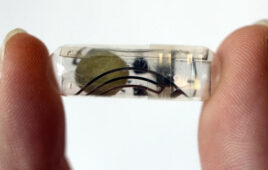
An image of MITS and its tiny chip.

MITS (left) has a temperature-sensing circuit that fits on a 1 mm² silicon chip (right). [Image courtesy of the MIT researchers]

Massachusetts Institute of Technology (MIT) researchers have developed a blueberry-sized ingestible sensor to continuously measure core body temperature and send temperature updates from the GI tract.

At 4 mm tall and 6 mm wide, the Miniaturized Ingestible Temperature Sensor (MITS) is smaller than existing temperature sensors, making it easier to swallow and reducing the risk of GI tract obstruction.

“A sensor like this gives us the ability to monitor infections and identify them early,” said Giovanni Traverso, co-author of the study and associate professor of mechanical engineering at MIT, in a news release. “That’s very relevant, particularly for at-risk populations like people who are immunosuppressed from chemotherapy treatments or immunosuppressive drugs.”

There are several ingestible temperature sensors already on the market, but most are the size of a multivitamin or larger. NASA partnered with Johns Hopkins University in the 1980s to develop the technology to monitor astronauts in space.

Larger sensors are challenging to swallow, increase the risk of GI tract obstruction and limit the technology’s use in pediatric populations, the study said. These sensors have complex temperature-sensing circuits inside them that require a great amount of power from batteries in the capsule.

MIT researchers wanted to design smaller sensors to accurately and safetly measure internal temperature.

“We want something that is so small that the risk of any blockage or obstruction is highly mitigated, and also so that it can be easily ingested,” Traverso said.

How MIT researchers shrank the sensor

First, the researchers reduced the size of the sensor’s main components: the temperature-sensing circuit, the battery and the antenna that transmits temperature data outside of the body.
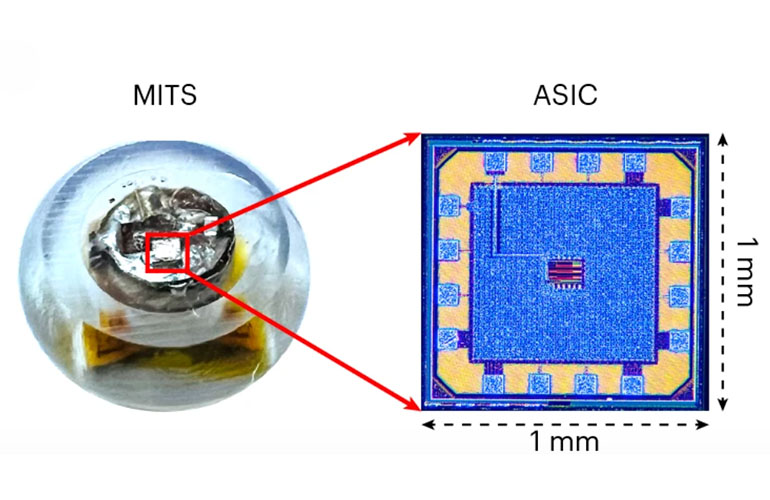
An image of MITS and its tiny chip.

A closer look at MITS (left) and the 1 mm² silicon chip (right). [Image courtesy of the MIT researchers]

They created a circuit that could fit on a 1 mm² silicon chip and designed an oscillator based on leakage current to reduce the chip’s power consumption. Frequency of the leakage current (the current that flows through the circuit when it’s off ) varied depending on the chip’s surrounding temperature.

The new circuit can detect temperature with an accuracy of 0.01° C and only requires about 10 nanowatts of power. It can be powered with a 1.55-volt coin cell battery, researchers said.

With smaller designs for the sensor’s circuitry and battery, the researchers then needed to develop a smaller antenna to communicate outside of the body.

“The new design further cuts energy consumption by using a communication strategy known as backscattering,” MIT said in the news release. “This approach allows most of the power requirements to be outsourced to an external antenna that is located outside the body, within a foot or two of the sensor.”
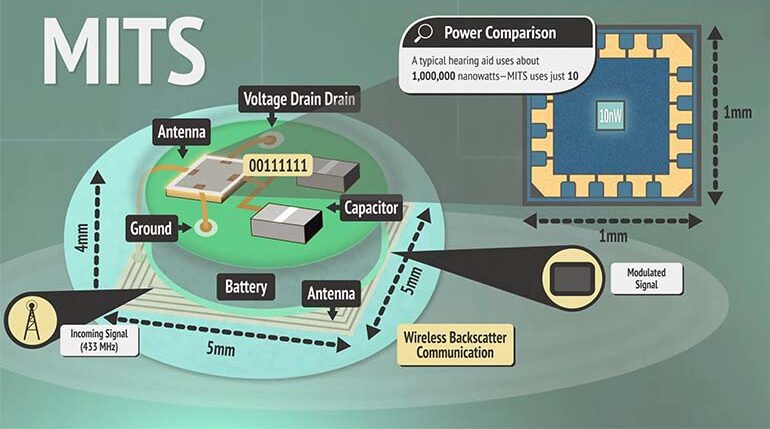
An illustration of MITS radio frequency capabilities.

The MITS circuit can detect temperature with an accuracy of 0.01° C [Illustration courtesy of MIT]

An external antenna emits an ultra-high-frequency radio wave that’s modulated by the tiny antenna inside the sensor, which then sends that modulated signal back to the external antenna. The external antenna calculates the temperature value by interpreting changes in the received radio wave, the researchers said. The internal antenna sends a temperature signal once every second, allowing for continuous monitoring.

“We combined all of these different pieces together — the silicon chip, the battery, and the antenna — and we made it into an ingestible capsule, which is the smallest ingestible capsule that we have seen for temperature-sensing paradigms,” said Saransh Sharma, MIT postdoc and lead author of the paper.

A range of applications, now and for the future

MIT’s researchers said MITS could be useful for several applications, including monitoring infections, observing patients during and after anesthesia, or at-home monitoring of fevers in children or core body temperature as a marker of ovulation or fertility purposes.

The researchers tested the sensor’s patient monitoring abilities with animals under anesthesia and found that the sensor worked properly and reported accurate temperatures.
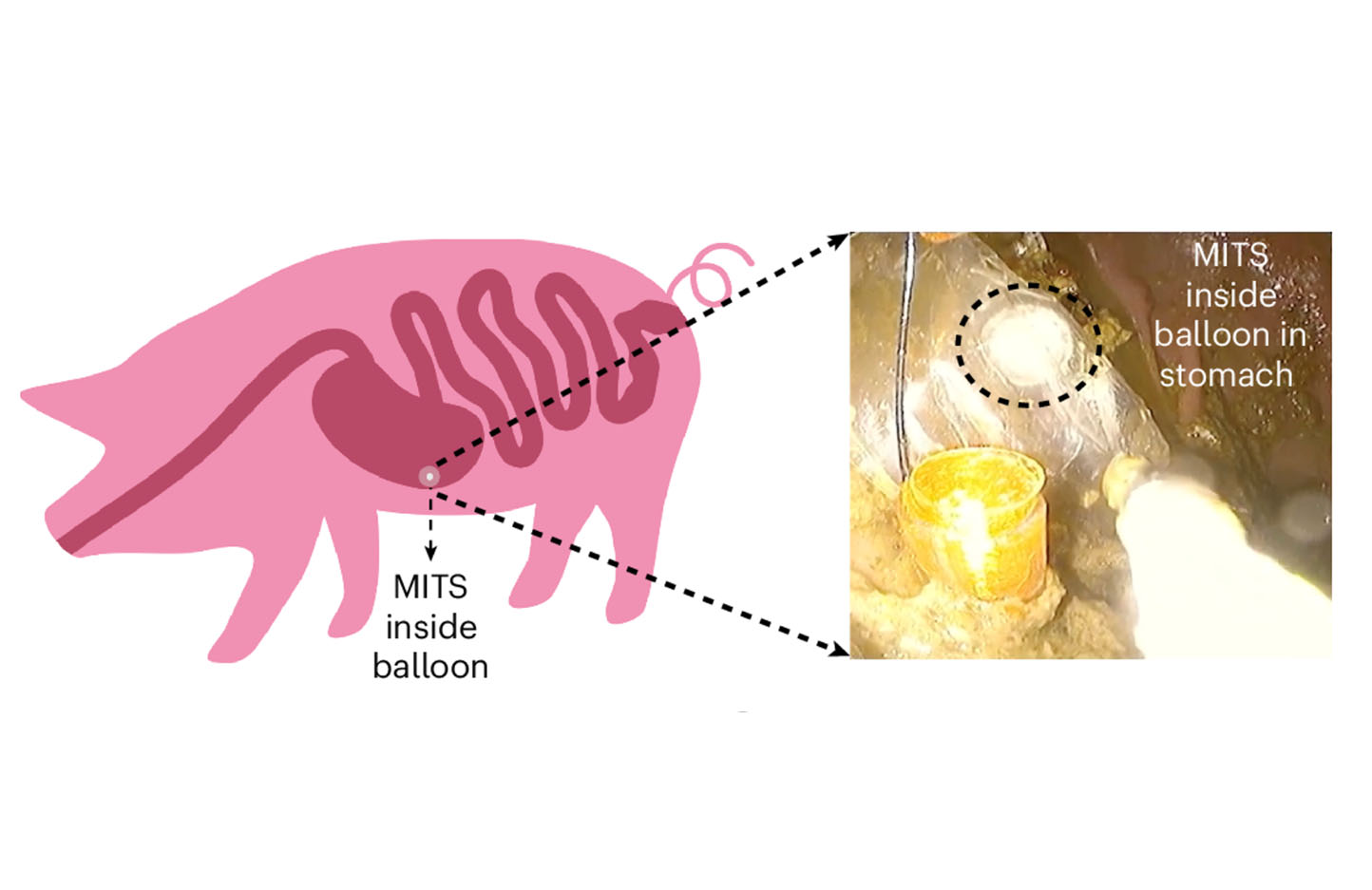
An image of MITS inside of a pig.

MITS worked properly and reported accurate temperature readings in porcine testing. [Image courtesy of MIT researchers]

“By tracking how quickly and how much the core temperature drops postanaesthesia, clinicians can tailor warming strategies, adjust anaesthetic depth if needed and optimize postoperative care to mitigate complications,” the study said.

If this tiny temperature-sensing technology proves effective for people in high-risk situations, Traverso said he believes these sensors could be widely used for anyone who needs temperature monitoring.

“I think this could replace all thermometers, because it’s the most accurate way of taking temperature,” he says. “If we have miniature systems that can be easily swallowed and give very accurate data that’s superior to the current data, I think it can be helpful in so many ways.”

Now, the MIT researchers are working on combining the temperature sensor with other sensors that could measure vital signs like heart rate. Since the sensor is so small, it could also be embedded in catheters, the researchers said, enabling temperature monitoring in vascular navigation without bulky probes.

MIT researchers hope to begin testing these sensors in clinical trials in the next few years.

About The Author

Skyler Rivera

Skyler Rivera is an associate editor at Arrowfly, covering medical device industry news and technology at MassDevice and Medical Design & Outsourcing. She began her career covering sports at The Athletic and MLB before transitioning to medical writing at Edwards Lifesciences. Based in Southern California, she holds a master's degree in science writing from Johns Hopkins University and a bachelor’s in broadcast journalism from Syracuse University. Connect with her on LinkedIn or email at [email protected].

Related Articles Read More >

Reconstructed 3D fluorescence image of the stained biohybrid mesh-tissue integration. The red, green, and blue colors correspond to the mesh, F-actin, and nuclei, respectively.
Researchers mesh electronics with human cells to develop living battery
The 1.84 volt paper battery (brown circle structure) was tested in pigs with a bioabsorbable radio-frequency identification (RFID) device.
MIT researchers develop bioresorbable batteries for ingestible medical devices
A clinician guides a needle and wire into the side of a patient's neck during a central venous catheter insertion.
New campaign targets fibrin sheath CVC complication
An illustration of HITMAN operating in glioblastoma cells.
MIT researchers develop injectable nanodevices that remotely kill brain tumor cells
“mdo
EXPAND YOUR KNOWLEDGE AND STAY CONNECTED
Get the latest medical device business news, application and technology trends.

DeviceTalks Weekly

See More >

MDO Digital Edition

Digital Edition

Subscribe to Medical Design & Outsourcing. Bookmark, share and interact with the leading medical design engineering magazine today.

MEDTECH 100 INDEX

Medtech 100 logo
Market Summary > Current Price
The MedTech 100 is a financial index calculated using the BIG100 companies covered in Medical Design and Outsourcing.

New MedTech Resource

Medical Tubing

MassDevice

Mass Device

The Medical Device Business Journal. MassDevice is the leading medical device news business journal telling the stories of the devices that save lives.

Visit Website
MDO ad
Medical Design and Outsourcing
  • MassDevice
  • DeviceTalks
  • MedTech100 Index
  • Medical Tubing + Extrusion
  • Medical Design Sourcing
  • Drug Delivery Business News
  • Drug Discovery & Development
  • Pharmaceutical Processing World
  • R&D World
  • About Us/Contact
  • Advertise With Us
  • Subscribe to Print Magazine
  • Subscribe to our E-Newsletter
  • Listen to our Weekly Podcasts
  • Join our DeviceTalks Tuesdays Discussion

Copyright © 2026 Arrowfly, LLC. All Rights Reserved. The material on this site may not be reproduced, distributed, transmitted, cached or otherwise used, except with the prior written permission of Arrowfly LLC. Site Map | Privacy Policy | RSS

Search Medical Design & Outsourcing

  • Home
  • Medical Device Business
    • Mergers & Acquisitions
    • Financial
    • Regulatory
  • Applications
    • Cardiovascular
    • Devices
    • Imaging
    • Implantables
    • Medical Equipment
    • Orthopedic
    • Surgical
  • Technologies
    • Supplies and Components Index
    • Contract Manufacturing
    • Components
    • Electronics
    • Extrusions
    • Materials
    • Motion Control
    • Prototyping
    • Pumps
    • Tubing
  • MedTech Resources
    • Medtech Events in 2026
    • The 2026 Medtech Big 100
    • Medical Device Handbook
    • MedTech 100 Index
    • Subscribe to Print Magazine
    • DeviceTalks
    • Digital Editions
    • eBooks
    • Educational Assets
    • Manufacturer Search
    • Podcasts
    • Webinars / Digital Events
    • Whitepapers
    • Voices
    • Views
    • Video
  • 2026 Leadership
    • 2025 Winners
    • 2024 Winners
    • 2023 Winners
    • 2022 Winners
    • 2021 Winners
  • Women in Medtech
  • Advertise
  • Subscribe