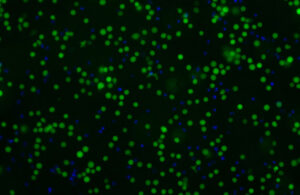
MIT researchers developed a method to protect CAR T cells (shown here in green) from cold damage. The blue dots in this image are nuclei stains. [Image courtesy of the researchers]
CAR (chimeric antigen receptor) T cells are typically treated with a cryoprotective chemical that is removed before treatment. .
“With this approach, you could theoretically just thaw the cells and then inject them, without any extra processing steps,” Ana Jaklenec, one of the lead authors of the study, said in a news release. “We think that could allow a lot more cancer treatment centers to be able to give CAR T-cell therapy.”
The paper, published in Trends in Biotechnology, shows that CAR T cells preserved with the antifreeze sugar had higher survival rates than those preserved with cryoprotective chemicals. The cells were also used to successfully treat non-Hodgkin lymphoma and glioblastoma in mice. The mice treated with the sugar-preserved cells had higher survival rates than mice treated with cells preserved with cryoprotective chemicals.
The researchers tested the method on mesenchymal stem cells, which also showed a higher survival rate.
Dimethyl sulfoxide (DMSO), the compound that is typically used to protect frozen CAR T cells, has to be removed before cells are transfused. However, many hospitals lack this capacity. Only about 5% of U.S. hospitals can generate and deliver CAR T cells to patients, according to MIT News. Additionally, removing DMSO can harm cells.
The researchers used trehalose and sucrose, which have previously been used to protect cells in cold temperatures. The sugars stabilize proteins, preventing them from unfolding due to cold stress, and block ice crystals from forming inside the cells.
To get the sugars inside the cells, the team used electroporation, which uses electrical pulses to cause temporary permeability in cell membranes, allowing the sugar molecules to pass through.
The researchers found that a small amount of DMSO was still necessary, but at a low enough dose that it could stay in the cells through injection rather than being stripped out first.
The researchers are now looking to partner with hospitals to explore integrating their technique into the processing of CAR T cells.
Previously: 5 technologies that are key to bringing CAR T-cell therapy closer to cancer patients