Medical Design and Outsourcing

  • Home
  • Medical Device Business
    • Mergers & Acquisitions
    • Financial
    • Regulatory
  • Applications
    • Cardiovascular
    • Devices
    • Imaging
    • Implantables
    • Medical Equipment
    • Orthopedic
    • Surgical
  • Technologies
    • Supplies and Components Index
    • Contract Manufacturing
    • Components
    • Electronics
    • Extrusions
    • Materials
    • Motion Control
    • Prototyping
    • Pumps
    • Tubing
  • MedTech Resources
    • Medtech Events in 2026
    • The 2026 Medtech Big 100
    • Medical Device Handbook
    • MedTech 100 Index
    • Subscribe to Print Magazine
    • DeviceTalks
    • Digital Editions
    • eBooks
    • Educational Assets
    • Manufacturer Search
    • Podcasts
    • Webinars / Digital Events
    • Whitepapers
    • Voices
    • Views
    • Video
  • 2026 Leadership
    • 2025 Winners
    • 2024 Winners
    • 2023 Winners
    • 2022 Winners
    • 2021 Winners
  • Women in Medtech
  • Advertise
  • Subscribe

Narrow wavelength of UV light safely kills drug-resistant bacteria

June 8, 2016 By Abigail Esposito

562ddd9d01b8e

A Columbia team found that a particular wavelength of UV light known as “far-UVC” is not only as effective as conventional germicidal UV light in killing MRSA, as shown in their previously published study, but also shows for the first time that, unlike conventional germicidal UV, far-UVC does not cause biological damage to exposed skin. Image credit: Lynn Greyling/public domain

Scientists from the Center for Radiological Research at Columbia University Medical Center have shown that a narrow wavelength of ultraviolet (UV) light safely killed drug-resistant MRSA bacteria in mice, demonstrating a potentially safe and cost-effective way to reduce surgical site infections, a major public health concern.

A paper just published by PLOS ONE describes how the Columbia team found that a particular wavelength of UV light known as “far-UVC” (in this instance, 207 nanometers) is not only as effective as conventional germicidal UV light in killing MRSA, as shown in their previously published study, but also shows for the first time that, unlike conventional germicidal UV, far-UVC does not cause biological damage to exposed skin.

“Our new findings show that far-UVC light has enormous potential for combating the deadly and costly scourge of drug-resistant surgical site infections,” said David J. Brenner, PhD, Higgins Professor of Radiation Biophysics, director of the Center for Radiological Research and the senior author of the paper.

“We’ve known for a long time that UV light has the potential to reduce surgical site infections, because UV can efficiently kill all bacteria, including drug-resistant bacteria and even so-called ‘superbugs.’ Unfortunately, it’s not possible to use conventional germicidal UV light when people are around because it’s a health hazard to patients and medical personnel. What we showed in our earlier work is that far-UVC light is as effective at killing MRSA as conventional germicidal UV light, and now with this new research, we have demonstrated that far-UVC kills bacteria but without risk of skin damage,” Brenner said.

Surgical site infections (SSI) continue to be a critical health care issue in the U.S. and worldwide. Patients who develop SSI have a mortality rate twice that of non-infected patients, and estimated annual healthcare costs in the U.S. due to SSI range from $3 to $10 billion USD.

The new idea behind Columbia’s use of far-UVC light is that that, unlike conventional germicidal UV, far-UVC cannot penetrate through the outer, dead layer of skin to reach live skin cells nor can it penetrate the outer layer of the eye. However, because bacteria and viruses are physically quite small, far-UVC light can penetrate and kill them. Columbia’s latest research was conducted on the skin hairless mice, which responds similarly to human skin when exposed to UV light.

“Our findings offer a potential practical pathway towards significantly reducing surgical site infection rates without risk to the health and safety of patients and medical personnel,” said Brenner. “One of our next steps is to explore direct studies in surgical settings, in larger animals and humans. From there we can investigate other new applications of these exciting findings, like killing airborne bacteria and viruses such as TB and influenza.”

Columbia University Medical Center
www.cumc.columbia.edu

Related Articles Read More >

An illustration showing Corcym's Memo 4D Curve's laser-cut nitinol core.
Laser-cut nitinol and a layered design let these cardiac implants flex
A close of of Medical 21's Maverics graft.
A surgeon’s prayer helped St. Jude Medical founder Manny Villafaña size his latest device
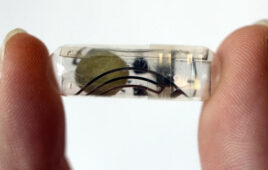
The 1.84 volt paper battery (brown circle structure) was tested in pigs with a bioabsorbable radio-frequency identification (RFID) device.
MIT researchers develop bioresorbable batteries for ingestible medical devices
Syensqo material supports modular sternal spacer for cardiothoracic care
“mdo
EXPAND YOUR KNOWLEDGE AND STAY CONNECTED
Get the latest medical device business news, application and technology trends.

DeviceTalks Weekly

See More >

MDO Digital Edition

Digital Edition

Subscribe to Medical Design & Outsourcing. Bookmark, share and interact with the leading medical design engineering magazine today.

MEDTECH 100 INDEX

Medtech 100 logo
Market Summary > Current Price
The MedTech 100 is a financial index calculated using the BIG100 companies covered in Medical Design and Outsourcing.

New MedTech Resource

Medical Tubing

MassDevice

Mass Device

The Medical Device Business Journal. MassDevice is the leading medical device news business journal telling the stories of the devices that save lives.

Visit Website
MDO ad
Medical Design and Outsourcing
  • MassDevice
  • DeviceTalks
  • MedTech100 Index
  • Medical Tubing + Extrusion
  • Medical Design Sourcing
  • Drug Delivery Business News
  • Drug Discovery & Development
  • Pharmaceutical Processing World
  • R&D World
  • About Us/Contact
  • Advertise With Us
  • Subscribe to Print Magazine
  • Subscribe to our E-Newsletter
  • Listen to our Weekly Podcasts
  • Join our DeviceTalks Tuesdays Discussion

Copyright © 2026 Arrowfly, LLC. All Rights Reserved. The material on this site may not be reproduced, distributed, transmitted, cached or otherwise used, except with the prior written permission of Arrowfly LLC. Site Map | Privacy Policy | RSS

Search Medical Design & Outsourcing

  • Home
  • Medical Device Business
    • Mergers & Acquisitions
    • Financial
    • Regulatory
  • Applications
    • Cardiovascular
    • Devices
    • Imaging
    • Implantables
    • Medical Equipment
    • Orthopedic
    • Surgical
  • Technologies
    • Supplies and Components Index
    • Contract Manufacturing
    • Components
    • Electronics
    • Extrusions
    • Materials
    • Motion Control
    • Prototyping
    • Pumps
    • Tubing
  • MedTech Resources
    • Medtech Events in 2026
    • The 2026 Medtech Big 100
    • Medical Device Handbook
    • MedTech 100 Index
    • Subscribe to Print Magazine
    • DeviceTalks
    • Digital Editions
    • eBooks
    • Educational Assets
    • Manufacturer Search
    • Podcasts
    • Webinars / Digital Events
    • Whitepapers
    • Voices
    • Views
    • Video
  • 2026 Leadership
    • 2025 Winners
    • 2024 Winners
    • 2023 Winners
    • 2022 Winners
    • 2021 Winners
  • Women in Medtech
  • Advertise
  • Subscribe