Medical Design and Outsourcing

  • Home
  • Medical Device Business
    • Mergers & Acquisitions
    • Financial
    • Regulatory
  • Applications
    • Cardiovascular
    • Devices
    • Imaging
    • Implantables
    • Medical Equipment
    • Orthopedic
    • Surgical
  • Technologies
    • Supplies and Components Index
    • Contract Manufacturing
    • Components
    • Electronics
    • Extrusions
    • Materials
    • Motion Control
    • Prototyping
    • Pumps
    • Tubing
  • MedTech Resources
    • Medtech Events in 2026
    • The 2026 Medtech Big 100
    • Medical Device Handbook
    • MedTech 100 Index
    • Subscribe to Print Magazine
    • DeviceTalks
    • Digital Editions
    • eBooks
    • Educational Assets
    • Manufacturer Search
    • Podcasts
    • Webinars / Digital Events
    • Whitepapers
    • Voices
    • Views
    • Video
  • 2026 Leadership
    • 2025 Winners
    • 2024 Winners
    • 2023 Winners
    • 2022 Winners
    • 2021 Winners
  • Women in Medtech
  • Advertise
  • Subscribe

Nature And Science Join Forces To Fight Surgical Infections

July 11, 2018 By University of Adelaide

South Australian researchers are embarking on a $20 million medical and manufacturing research project which could reduce the chance of infection after orthopaedic surgery, thanks to a little help from the humble dragonfly.

Working with leading surgeons and an Australian orthopaedic medical device company, researchers from the University of Adelaide and University of South Australia (UniSA) will use nano-modification technology based on the structure of the dragonfly wing, whose tiny spikes rip bacteria apart.

In a unique R&D and manufacturing environment, researchers are carrying out a range of groundbreaking experiments to test whether mimicking the nano-patterns of the dragonfly wing on orthopaedic implants can kill harmful bacteria that cause infections.

The four-year project, co-funded by Global Orthopaedic Technology and the Innovative Manufacturing Cooperative Research Centre (IMCRC), could give scientists and clinicians a critical breakthrough in their global fight against antibiotic resistant bacteria, and is intended to create new technologies and processes to benefit the wider manufacturing sector.

“This is amazing technology that that has the potential to improve the quality of life of millions of patients around the world,” UniSA Professor Krasimir Vasilev says. “The project is also a great example of transdisciplinary collaboration between scientists, clinicians and industry, transforming healthcare, manufacturing industry and the Australian economy.”

Leading scientists from the University of Adelaide and UniSA will combine their expertise to create titanium implants with the dragonfly wing surface while confirming their safety and testing their bacteria-killing properties in the University of Adelaide’s Centre for Orthopaedic and Trauma Research (COTR) and UniSA’s new Musculoskeletal Biotest Facility.
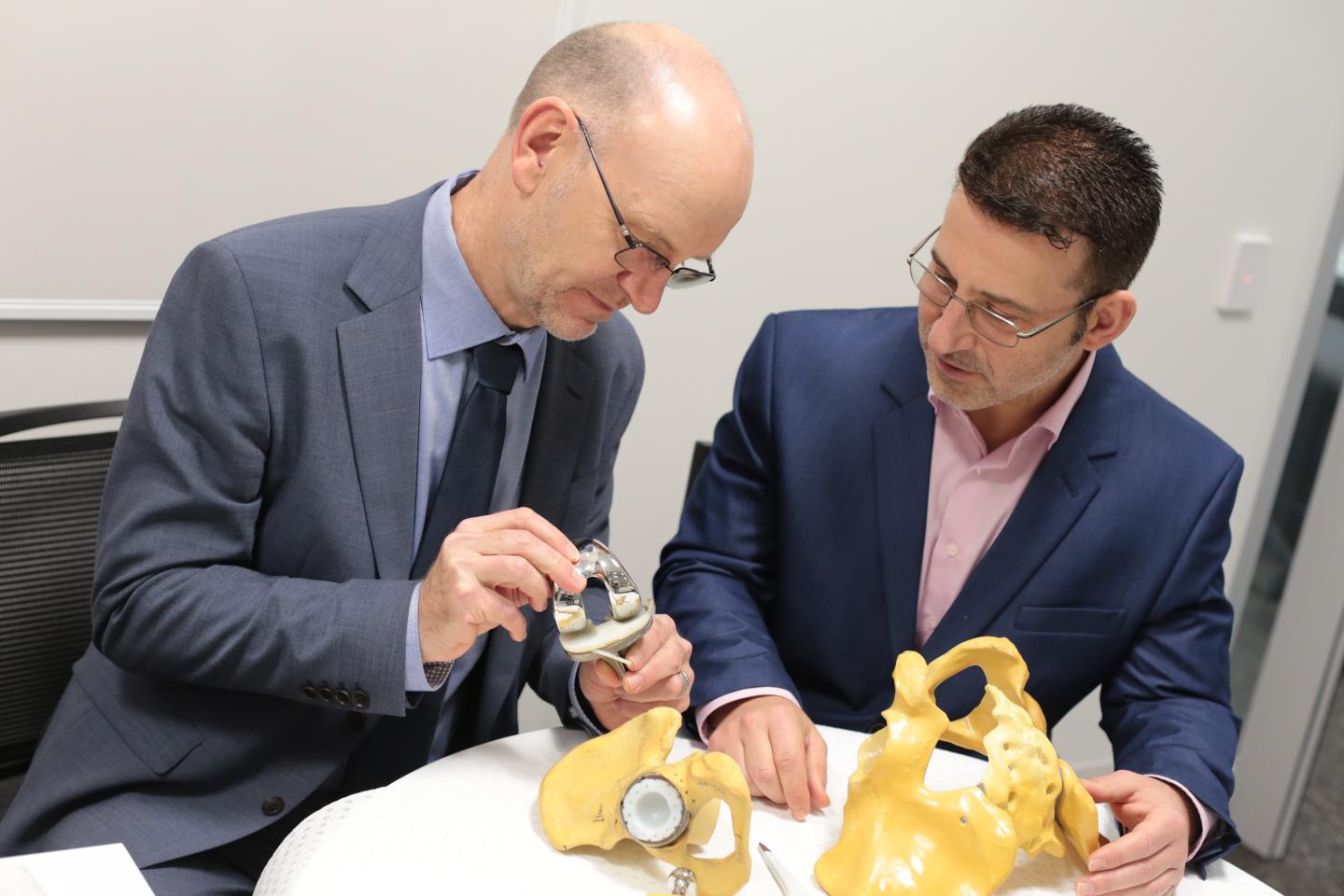
Professor Gerald Atkins, University of Adelaide (left) and Professor Krasimir Vasilev, University of South Australia, examine orthopaedic implants which will have the dragonfly wing-like surface. (Image credit: University of Adelaide)

“This research is a combination of cell biology and very clever nanomanufacturing techniques, driven by an unmet medical need,” says University of Adelaide leading orthopaedic researcher Professor Gerald Atkins, Scientific Director of COTR. “It is game-changing Australian technology.”

The bacteria-busting qualities of the dragonfly were first identified by Australian researchers who observed bacteria being killed on the insects’ wings, characterised by tiny spikes – nanopillars – which are about one thousandth of the thickness of a human hair.

Global Orthopaedic Technology is taking the technology a step further, partnering with “the best researchers in Australia” to commercialise the technology and tackle the growing epidemic of resistant bacteria and resulting infections.

David Chuter, IMCRC’s CEO and Managing Director, says this research project is reshaping not only the future of the medical device industry, but potentially other sectors.

“Due to the nature of the nano surface, which is independent of the chemistry and material properties of the substrate to which it is applied, the technology can potentially be used in other manufacturing processes across multiple industries, most notably the hospital supplies and equipment industry, the food industry, the marine industry, the building products industry, and the aeronautical industry,” says Chuter. “The new technology will open many doors, not just in the medical field, as antibacterial surfaces are also valuable in the food industry, for example – in fact, for any surfaces subject to high levels of bacteria.”

Global Orthopaedic Technology and IMCRC are each providing a $3 million cash investment as part of a total medical and manufacturing R&D investment of $20 million, with the additional funding provided through in-kind contributions from Global Orthopaedic Technology and both universities.


Related Articles Read More >

The most innovative medical devices of 2026
An illustration showing Corcym's Memo 4D Curve's laser-cut nitinol core.
Laser-cut nitinol and a layered design let these cardiac implants flex
A photo of J&J MedTech SVP and Global Head of Digital Shan Jegatheeswaran.
Where Johnson & Johnson sees opportunity in surgical intelligence
A close of of Medical 21's Maverics graft.
A surgeon’s prayer helped St. Jude Medical founder Manny Villafaña size his latest device
“mdo
EXPAND YOUR KNOWLEDGE AND STAY CONNECTED
Get the latest medical device business news, application and technology trends.

DeviceTalks Weekly

See More >

MDO Digital Edition

Digital Edition

Subscribe to Medical Design & Outsourcing. Bookmark, share and interact with the leading medical design engineering magazine today.

MEDTECH 100 INDEX

Medtech 100 logo
Market Summary > Current Price
The MedTech 100 is a financial index calculated using the BIG100 companies covered in Medical Design and Outsourcing.

New MedTech Resource

Medical Tubing

MassDevice

Mass Device

The Medical Device Business Journal. MassDevice is the leading medical device news business journal telling the stories of the devices that save lives.

Visit Website
MDO ad
Medical Design and Outsourcing
  • MassDevice
  • DeviceTalks
  • MedTech100 Index
  • Medical Tubing + Extrusion
  • Medical Design Sourcing
  • Drug Delivery Business News
  • Drug Discovery & Development
  • Pharmaceutical Processing World
  • R&D World
  • About Us/Contact
  • Advertise With Us
  • Subscribe to Print Magazine
  • Subscribe to our E-Newsletter
  • Listen to our Weekly Podcasts
  • Join our DeviceTalks Tuesdays Discussion

Copyright © 2026 Arrowfly, LLC. All Rights Reserved. The material on this site may not be reproduced, distributed, transmitted, cached or otherwise used, except with the prior written permission of Arrowfly LLC. Site Map | Privacy Policy | RSS

Search Medical Design & Outsourcing

  • Home
  • Medical Device Business
    • Mergers & Acquisitions
    • Financial
    • Regulatory
  • Applications
    • Cardiovascular
    • Devices
    • Imaging
    • Implantables
    • Medical Equipment
    • Orthopedic
    • Surgical
  • Technologies
    • Supplies and Components Index
    • Contract Manufacturing
    • Components
    • Electronics
    • Extrusions
    • Materials
    • Motion Control
    • Prototyping
    • Pumps
    • Tubing
  • MedTech Resources
    • Medtech Events in 2026
    • The 2026 Medtech Big 100
    • Medical Device Handbook
    • MedTech 100 Index
    • Subscribe to Print Magazine
    • DeviceTalks
    • Digital Editions
    • eBooks
    • Educational Assets
    • Manufacturer Search
    • Podcasts
    • Webinars / Digital Events
    • Whitepapers
    • Voices
    • Views
    • Video
  • 2026 Leadership
    • 2025 Winners
    • 2024 Winners
    • 2023 Winners
    • 2022 Winners
    • 2021 Winners
  • Women in Medtech
  • Advertise
  • Subscribe

