Medical Design and Outsourcing

  • Home
  • Medical Device Business
    • Mergers & Acquisitions
    • Financial
    • Regulatory
  • Applications
    • Cardiovascular
    • Devices
    • Imaging
    • Implantables
    • Medical Equipment
    • Orthopedic
    • Surgical
  • Technologies
    • Supplies and Components Index
    • Contract Manufacturing
    • Components
    • Electronics
    • Extrusions
    • Materials
    • Motion Control
    • Prototyping
    • Pumps
    • Tubing
  • MedTech Resources
    • Medtech Events in 2026
    • The 2026 Medtech Big 100
    • Medical Device Handbook
    • MedTech 100 Index
    • Subscribe to Print Magazine
    • DeviceTalks
    • Digital Editions
    • eBooks
    • Educational Assets
    • Manufacturer Search
    • Podcasts
    • Webinars / Digital Events
    • Whitepapers
    • Voices
    • Views
    • Video
  • 2026 Leadership
    • 2025 Winners
    • 2024 Winners
    • 2023 Winners
    • 2022 Winners
    • 2021 Winners
  • Women in Medtech
  • Advertisers
    • Advertise
    • PR Submissions
    • Eblast Submissions
  • Subscribe

New Ambulatory Monitoring Device Offers Window into Stomach’s Bioelectrical Activity

May 12, 2017 By New York Institute of Technology

The potentially debilitating condition known as gastroparesis, which results when stomach muscle contractions function abnormally, causing the stomach’s contents to empty too slowly, affects as many as five million Americans. Often the cause of the disease is unknown and the underlying bioelectrical activity that initiates and coordinates gastric contractions, known as slow waves, is not fully understood.

However, a first-of-its-kind portable wireless device developed by an NYIT-led research team can monitor stomach motility to enable physicians to measure and ultimately better understand slow wave activity.

(Credit: Pixabay)

Aydin Farajidavar, Ph.D., assistant professor of Electrical and Computer Engineering at New York Institute of Technology (NYIT) School of Engineering and Computing Sciences, today presented results captured from his study – the first portable wireless device developed and validated in clinical settings to document gastric contractions in patients suffering from gastroparesis. Farajidavar’s work, “A Novel System and Methodology for Continuous Ambulatory Monitoring of Gastric Slow Waves,” was selected as a Poster of Distinction for presentation during Digestive Disease Week 2017. Further, it was rated in the top 10 percent of all AGA (American Gastroenterological Association) abstracts selected for poster presentation at DDW, the world’s largest gathering of physicians, researchers, and industry in the fields of gastroenterology, hepatology, endoscopy, and gastrointestinal surgery.

“From an engineering perspective, we know that the wireless device works effectively; the system and methodology we developed enable physicians to document slow waves in patients with gastroparesis. The system can help us to better understand the effect of electrical stimulation on gastric contractions and to examine a variety of hypotheses about the gastric activity,” Farajidavar says.

This research project is part of an ongoing effort in NYIT School of Engineering and Computing Sciences’ Integrated Medical Systems laboratory to develop devices to better diagnose gastrointestinal disorders and diseases. The team’s developed system consists of a portable module that can wirelessly transmit data to a back-end receiver connected to a PC to display and store for off-line analysis. The device can also log data on a memory card for long-term monitoring. In addition to three NYIT graduate engineering students and a postdoctoral fellow, Farajidavar’s research team includes Thomas L. Abell, M.D. and Abigail Stocker, M.D., world-class gastroenterologists from University of Louisville Medical Center, which is participating in the National Institute of Diabetes and Digestive and Kidney Diseases-sponsored Gastroparesis Clinical Research Consortium.

Each patient in the study, registered at University of Louisville under the care of Drs. Abell and Stocker, received two temporary electrodes and leads via endoscopy prior to having a permanent stimulator. One of the leads connected to the gastric stimulator; the other was connected to the developed recording system. The gastric waves were recorded wirelessly for short periods of time (approximately 10 minutes) before and after turning on the stimulator. Then each patient received the developed portable module, set in data-logging mode. Patients returned approximately five days later; in most cases, signals were recorded and analyzed successfully in terms of frequency and amplitudes. The frequency, amplitude, and shape of the short waves varied between the patients, and for each patient, varied depending on fed- and fast-states.

“It is significant that the monitoring of the gastric activity was captured over the course of several days with patients in the trial utilizing portable devices. Now that activity in the stomach can be measured objectively, this ultimately could revolutionize how some digestive diseases can be diagnosed and treated,” Farajidavar says. “This result could not have happened without the close collaboration between the NYIT engineering team and the University of Louisville physician team, and the patients who volunteered to participate in this study. I am privileged to have such hard-working students and postdoctoral fellow in my lab at NYIT.”
Related Articles Read More >

An illustration showing the Autus size-adjustable heart valve being expanded years after implantation with a minimally invasive balloon catheter.
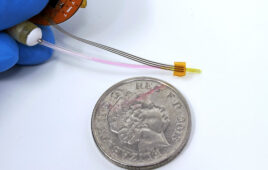
The first-of-its-kind Autus pediatric heart valve is designed for expansion and durability
The MIT researcher's implant, LUCID.
MIT researchers design implantable ultrasound-powered drug delivery device to minimize tumor recurrence
An image of the Teleflex Freesolve RMS resorbable magnesium scaffold.
Teleflex Interventional leader sees resorbables as ‘the next frontier’ of PCI
Feminai's breast sensor patch
AdvaMed and MedTech Innovator name 2026 prize winners and finalists
“mdo
EXPAND YOUR KNOWLEDGE AND STAY CONNECTED
Get the latest medical device business news, application and technology trends.

DeviceTalks Weekly

See More >

MDO Digital Edition

Digital Edition

Subscribe to Medical Design & Outsourcing. Bookmark, share and interact with the leading medical design engineering magazine today.

MEDTECH 100 INDEX

Medtech 100 logo
Market Summary > Current Price
The MedTech 100 is a financial index calculated using the BIG100 companies covered in Medical Design and Outsourcing.

New MedTech Resource

Medical Tubing

MassDevice

Mass Device

The Medical Device Business Journal. MassDevice is the leading medical device news business journal telling the stories of the devices that save lives.

Visit Website
MDO ad
Medical Design and Outsourcing
  • MassDevice
  • DeviceTalks
  • MedTech100 Index
  • Medical Tubing + Extrusion
  • Medical Design Sourcing
  • Drug Delivery Business News
  • Drug Discovery & Development
  • Pharmaceutical Processing World
  • R&D World
  • About Us/Contact
  • Advertise With Us
  • Subscribe to Print Magazine
  • Subscribe to our E-Newsletter
  • Listen to our Weekly Podcasts
  • Join our DeviceTalks Tuesdays Discussion

Copyright © 2026 Arrowfly, LLC. All Rights Reserved. The material on this site may not be reproduced, distributed, transmitted, cached or otherwise used, except with the prior written permission of Arrowfly LLC. Site Map | Privacy Policy | RSS

Search Medical Design & Outsourcing

  • Home
  • Medical Device Business
    • Mergers & Acquisitions
    • Financial
    • Regulatory
  • Applications
    • Cardiovascular
    • Devices
    • Imaging
    • Implantables
    • Medical Equipment
    • Orthopedic
    • Surgical
  • Technologies
    • Supplies and Components Index
    • Contract Manufacturing
    • Components
    • Electronics
    • Extrusions
    • Materials
    • Motion Control
    • Prototyping
    • Pumps
    • Tubing
  • MedTech Resources
    • Medtech Events in 2026
    • The 2026 Medtech Big 100
    • Medical Device Handbook
    • MedTech 100 Index
    • Subscribe to Print Magazine
    • DeviceTalks
    • Digital Editions
    • eBooks
    • Educational Assets
    • Manufacturer Search
    • Podcasts
    • Webinars / Digital Events
    • Whitepapers
    • Voices
    • Views
    • Video
  • 2026 Leadership
    • 2025 Winners
    • 2024 Winners
    • 2023 Winners
    • 2022 Winners
    • 2021 Winners
  • Women in Medtech
  • Advertisers
    • Advertise
    • PR Submissions
    • Eblast Submissions
  • Subscribe