Medical Design and Outsourcing

  • Home
  • Medical Device Business
    • Mergers & Acquisitions
    • Financial
    • Regulatory
  • Applications
    • Cardiovascular
    • Devices
    • Imaging
    • Implantables
    • Medical Equipment
    • Orthopedic
    • Surgical
  • Technologies
    • Supplies and Components Index
    • Contract Manufacturing
    • Components
    • Electronics
    • Extrusions
    • Materials
    • Motion Control
    • Prototyping
    • Pumps
    • Tubing
  • MedTech Resources
    • Medtech Events in 2026
    • The 2026 Medtech Big 100
    • Medical Device Handbook
    • MedTech 100 Index
    • Subscribe to Print Magazine
    • DeviceTalks
    • Digital Editions
    • eBooks
    • Educational Assets
    • Manufacturer Search
    • Podcasts
    • Webinars / Digital Events
    • Whitepapers
    • Voices
    • Views
    • Video
  • 2026 Leadership
    • 2025 Winners
    • 2024 Winners
    • 2023 Winners
    • 2022 Winners
    • 2021 Winners
  • Women in Medtech
  • Advertise
  • Subscribe

New Dye Allows Super-Imaging of Cells

April 12, 2017 By Phys.org

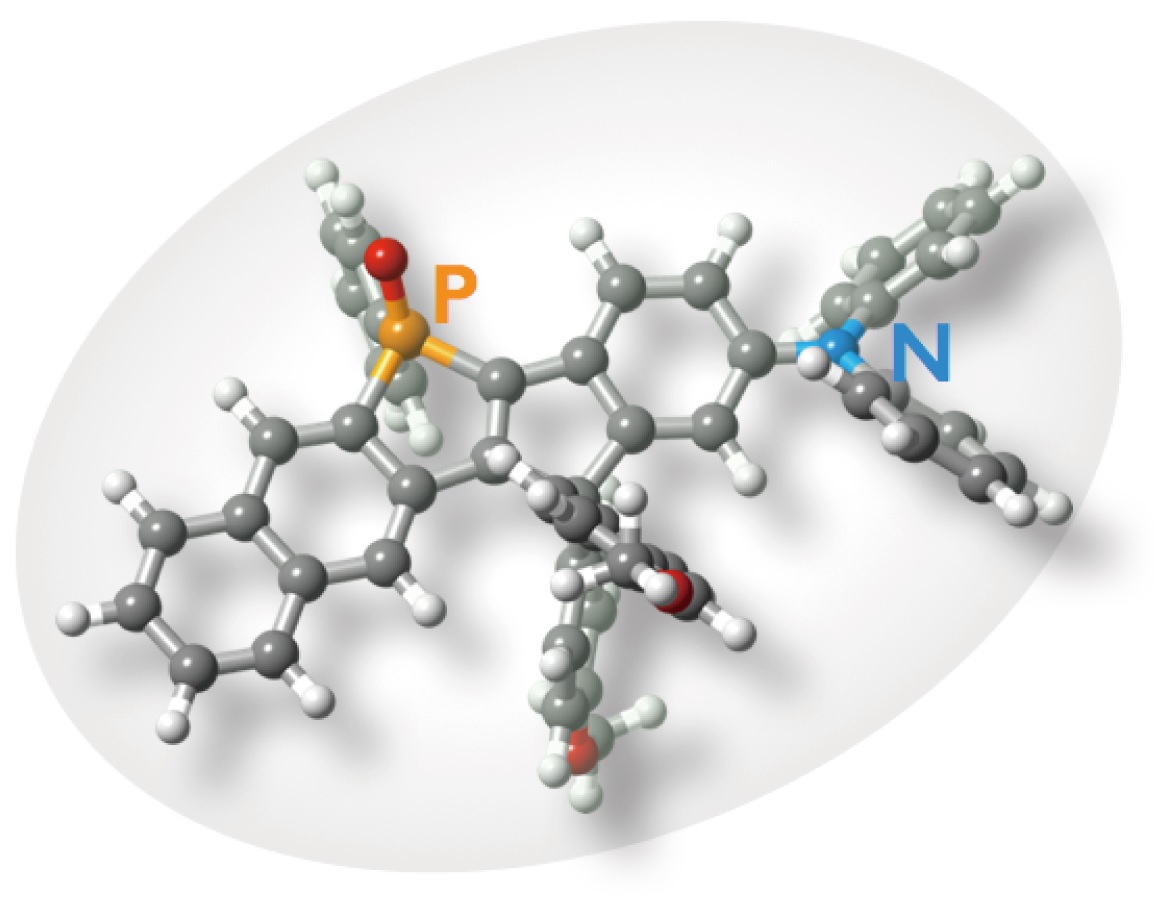
Molecular structure of C-Naphox. (Credit: Institute of Transformative Bio-Molecules (ITbM))

A new dye might allow researchers to view natural processes in extremely small components of living cells over a prolonged period of time; a previously unattainable feat.

Optical microscopy allows researchers to see and distinguish between objects that are about 200 nanometres (nm) apart. In comparison, a human hair is about 90,000 nm thick. Unfortunately, most objects of interest in biology, such as organelles in cells and proteins, are much smaller than 200 nm.

Biologists have been looking for ways to improve the resolution of microscopes, pioneering the field of super-resolution microscopy. Stimulated emission depletion (STED) microscopy is one such improvement: a source of light focuses on a point of interest while the surrounding zone is kept in the dark and toned down, so to speak, using a special laser to form a background without interferences. This technique is fluorescence-based, using special dyes to tag the cells or structures of interest.

STED microscopy is very effective, allowing researchers to detect objects that are only tens of nanometres apart. However, it does come with its own set of challenges: most importantly, that the special laser used to tone down the background is, counter-intuitively, very intense. Not many dyes can withstand this intensity without losing fluorescence so quickly that only a few images can be taken, which is much too fast for the needs of researchers.
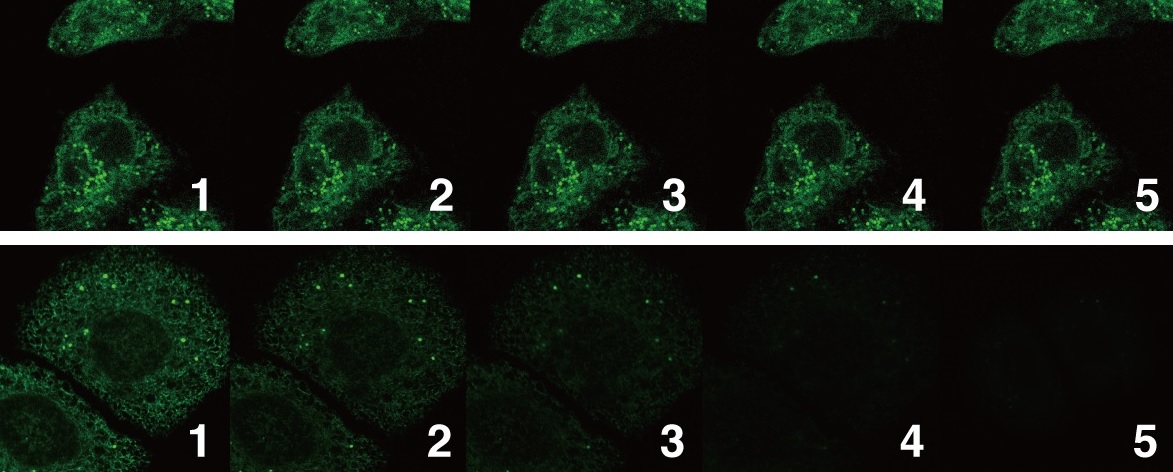
(Above) STED microscopy images of cells with C-Naphox remained stable. (Below) STED microscopy images with a commercially available compound. (Credit: Institute of Transformative Bio-Molecules (ITbM))

Professor Shigehiro Yamaguchi and Professor Tetsuya Higashiyama from the Institute of Transformative Bio-Molecules at Nagoya University in Japan have developed a dye, called C-Naphox, that, thanks to a carbon-bonded structure, is very stable and does not dim even under the harsh conditions of STED microscopy. It is also non-toxic, so it can be used in live cells.

The researchers found that the dye remained stable after two hours of irradiation. When taking multiple images in succession—a key part of super-resolution microscopy as it allows researchers to follow live cells undergoing their natural processes over time—the team found that C-Naphox remained stable after five images. Even after taking 50 images, more than 80 percent of the C-Naphox signal remained. In comparison, one of the best options available commercially, a compound called Alexa 488, dimmed almost to invisibility after taking only five images. Once widely available, C-Naphox should enable prolonged recording of live cells using STED microscopy; a previously unattainable feat.
Related Articles Read More >

The most innovative medical devices of 2026
An illustration showing Corcym's Memo 4D Curve's laser-cut nitinol core.
Laser-cut nitinol and a layered design let these cardiac implants flex
Reconstructed 3D fluorescence image of the stained biohybrid mesh-tissue integration. The red, green, and blue colors correspond to the mesh, F-actin, and nuclei, respectively.
Researchers mesh electronics with human cells to develop living battery
A photo of the Paradromics Connexus brain-computer interface on a fingertip.
How Paradromics designed its Connexus brain-computer interface system
“mdo
EXPAND YOUR KNOWLEDGE AND STAY CONNECTED
Get the latest medical device business news, application and technology trends.

DeviceTalks Weekly

See More >

MDO Digital Edition

Digital Edition

Subscribe to Medical Design & Outsourcing. Bookmark, share and interact with the leading medical design engineering magazine today.

MEDTECH 100 INDEX

Medtech 100 logo
Market Summary > Current Price
The MedTech 100 is a financial index calculated using the BIG100 companies covered in Medical Design and Outsourcing.

New MedTech Resource

Medical Tubing

MassDevice

Mass Device

The Medical Device Business Journal. MassDevice is the leading medical device news business journal telling the stories of the devices that save lives.

Visit Website
MDO ad
Medical Design and Outsourcing
  • MassDevice
  • DeviceTalks
  • MedTech100 Index
  • Medical Tubing + Extrusion
  • Medical Design Sourcing
  • Drug Delivery Business News
  • Drug Discovery & Development
  • Pharmaceutical Processing World
  • R&D World
  • About Us/Contact
  • Advertise With Us
  • Subscribe to Print Magazine
  • Subscribe to our E-Newsletter
  • Listen to our Weekly Podcasts
  • Join our DeviceTalks Tuesdays Discussion

Copyright © 2026 Arrowfly, LLC. All Rights Reserved. The material on this site may not be reproduced, distributed, transmitted, cached or otherwise used, except with the prior written permission of Arrowfly LLC. Site Map | Privacy Policy | RSS

Search Medical Design & Outsourcing

  • Home
  • Medical Device Business
    • Mergers & Acquisitions
    • Financial
    • Regulatory
  • Applications
    • Cardiovascular
    • Devices
    • Imaging
    • Implantables
    • Medical Equipment
    • Orthopedic
    • Surgical
  • Technologies
    • Supplies and Components Index
    • Contract Manufacturing
    • Components
    • Electronics
    • Extrusions
    • Materials
    • Motion Control
    • Prototyping
    • Pumps
    • Tubing
  • MedTech Resources
    • Medtech Events in 2026
    • The 2026 Medtech Big 100
    • Medical Device Handbook
    • MedTech 100 Index
    • Subscribe to Print Magazine
    • DeviceTalks
    • Digital Editions
    • eBooks
    • Educational Assets
    • Manufacturer Search
    • Podcasts
    • Webinars / Digital Events
    • Whitepapers
    • Voices
    • Views
    • Video
  • 2026 Leadership
    • 2025 Winners
    • 2024 Winners
    • 2023 Winners
    • 2022 Winners
    • 2021 Winners
  • Women in Medtech
  • Advertise
  • Subscribe