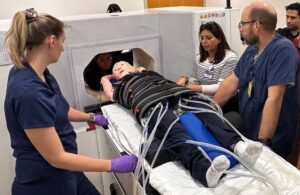
The New Phase electromagnetic induction system (EIS) magnetically heats Sarah Nanoparticle (SaNP) injected inside a patient to kill cancer cells. [Photo courtesy of Mayo Clinic]
Mayo Clinic installed New Phase’s electromagnetic induction system (EIS) in November 2025 and treated the first U.S. patient in December as a partner in the company’s clinical trial. It’s the first magnetic nanoparticle-mediated hyperthermia machine for cancer research in the U.S., said Mayo Clinic, which disclosed a financial interest in the technology.
“We planned to develop a technology that would be able to change cancer from a fatal disease into a chronic ailment or a manageable illness,” New Phase co-founder and CEO Ofer Shalev said in a Medical Design & Outsourcing interview.
New Phase’s Sarah Nanotechnology system uses nanoparticles and the EIS machine to deliver noninvasive, targeted treatments that damage and kill cancerous tumor cells with controlled magnetic hyperthermia while preserving healthy cells.
The technology is designed to treat multiple tumors simultaneously, including deep-seated tumors that are difficult to address with conventional treatments and existing hyperthermia options.
While the treatment kills cancer cells, it doesn’t completely destroy the entire solid tumor. Shalev likens New Phase’s technology to HIV/AIDS treatment.
HIV/AIDS “used to be very, very aggressive and fatal,” he said. “But now technology has found a way to manage the disease. The patient gets treatment from time to time and they survive. This was the idea for our technology.”
Six patients in the United States have already received the novel treatment with the device after the FDA granted it an Investigational Device Exemption (IDE) in 2024. In December 2025, New Phase partnered with Mayo Clinic to open an early feasibility clinical trial for patients with stage 4 metastatic solid tumors that don’t respond to conventional treatments.
“We have known for more than a century that temperature is the Achilles’ heel of cancer, but conventional hyperthermia has limitations and is not widely available,” said radiation oncologist Dr. Scott Lester at Mayo Clinic Comprehensive Cancer Center.
The investigational New Phase treatment “works like an induction cooktop,” he said, and “may enable us to harness heat in a novel way for advanced cancers.”
To treat a patient, New Phase’s Sarah Nanoparticles (SaNP) are intravenously administered and circulate through the patient’s bloodstream. The iron oxide core nanoparticles leak from the capillaries that surround tumors and attach to the malignant tissue.
About four hours after the SaNP injection, the patient is placed in the New Phase EIS, where the machine exposes them to low-frequency alternating magnetic field (AMF) radiation, the type of non-ionizing radiation that also comes from microwaves and cell phones.
AMF radiation heats the iron oxide core of the nanoparticles to precisely 50° C (122° F), inducing cancer cell death without affecting the surrounding healthy tissue.
Advice and technical tips for medical device startups: The 2026 MDO Medtech Startups Special Report
The Sarah Nanoparticle
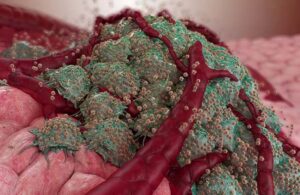
This illustration depicts New Phase Sarah Nanoparticles (SaNPs) attaching to a tumor. [Illustration courtesy of New Phase]
“Although the cancer is aggressive, there are many weak points in the disease,” Shalev said. “One of the major weaknesses is its inability to tolerate temperatures above 41° C to 45° C. Our idea was that if we’re able to control the temperature of the nanoparticles in the body to 50° C, then that temperature will destroy the cancer tissue and not cause any damage to normal cells.”
New Phase initially tried a gold nanoparticle heated with radiation at megahertz frequencies, which yielded great results in early rodent testing but failed to deliver in later tests more comparable to human anatomy, Shalev said.
“We didn’t plan to [use] the technology on mice, but on humans,” Shalev said. “So the outcome was moving from megahertz to kilohertz, which can penetrate our body mass and we had to change the … core of our nanoparticle from gold to iron.”
When New Phase tested its iron oxide nanoparticle, it reached an ablative temperature of 80° C (178° F), Shalev said. The new nanoparticle could heat, but New Phase needed to engineer a way to control the temperature, so they coated the iron oxide nanoparticles in a phase change material (PCM) to absorb extra thermal energy emitted by the core and maintain a constant temperature of 50° C.
“Our nanoparticle is built from several layers of coating,” Shalev said. “The core is made of iron oxide, which is coated with PCM to absorb excess heat and maintain a temperature of 50° C. The outer coating/surface is polyethylene glycol (PEG) 20,000, which is the main attribute that helps hide the nanoparticles from the macrophage system and allows longer circulation in the bloodstream.”
The Sarah Nanoparticle’s current diameter is 135 nanometers (about the size of a virus), and engineered with multicore superparamagnetic iron oxide nanoparticles embedded in layers of coating.
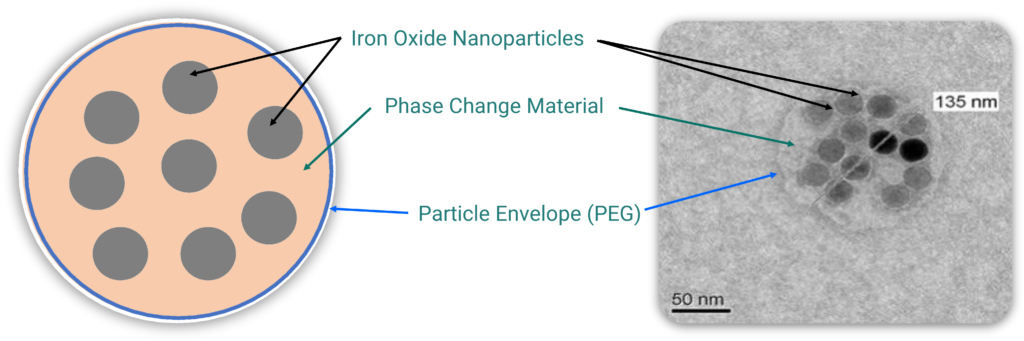
New Phase’s nanoparticle is engineered with multicore superparamagnetic iron oxide nanoparticles embedded in layers of coating. [Illustration courtesy of New Phase]
“At a certain time, the cancer starts to mutate and the drugs that work good at the beginning will not work anymore,” Shalev said. “But there are no cancer cells that have resistance above 45° C. We are treating patients in [whom] there is unmet need, because the patients in our study have exhausted other treatments.”
The Electromagnetic Induction System
New Phase’s ability to develop its nanoparticles and scale them for use in human patients was its first big advance, Shalev said. Next, it needed to engineer a system to deliver the radiation needed to heat those particles while keeping patients safe.
“Unfortunately, there was not much literature about it,” Shalev said. “So we had to develop, we had to be innovative.”
The New Phase EIS generates a controlled alternating magnetic field that activates the nanoparticles and converts the electromagnetic energy into heat.
The EIS looks like a small MRI machine. The patient lies down inside the machine with their upper body and lower extremities outside of the radiation area. Since the system delivers non-ionizing radiation, it doesn’t require a special radiation shielding room and could be installed anywhere, Shalev said. The company contracted New York-based UltraFlex Power Technologies to manufacture its electromagnetic induction systems.
Patients undergo 30 to 35 minutes of radiation in five-minute intervals with five-minute breaks, Shalev said. Since AMF exposure could induce eddy currents on the skin’s surface and raise body temperature, patients are covered with a cooling blanket system to regulate body temperature throughout treatment.
Early results and future plans
Before receiving IDE status in the U.S., New Phase tested the technology to treat nine different types of cancers. The startup also conducted a phase 1 clinical trial at Rabin Medical Center in Israel with 28 patients enrolled to test its technology’s safety, Shalev said. While data from this trial isn’t publicly available yet, he shared preliminary data with MDO.
The early feasibility study yielded “great outcomes,” Shalev said, with no serious adverse events or toxicity in the patients who received treatment with New Phase’s technology.

New Phase co-founder and CEO Ofer Shalev [Photo courtesy of New Phase]
New Phase’s ongoing U.S. feasibility study focuses on the technology’s safety and dosage for stage 4 metastatic solid tumors, but excludes tumors in the brain.
“In the future, we’ll be able to [treat] the third- or even early-fourth-stage patients that have exhausted other treatments,” he said.
While Shalev expects New Phase’s technology to become commercially available within the next two or three years, he said about three medical centers will adopt the technology and treat patients next year. In the meantime, New Phase remains focused on its clinical trial at Mayo Clinic in preparation for an FDA Premarket Approval (PMA) application submission.
“But even today, U.S. patients start to get a benefit from this technology,” Shalev said.