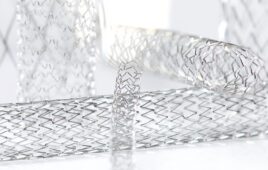
Structural heart robotics startup Capstan Medical designed its mitral valve implant with a self-expanding nitinol frame. [Photo courtesy of Capstan Medical]
I and the other editors of Medical Design & Outsourcing, MassDevice and DeviceTalks recently wrapped up 2024 with a DeviceTalks Weekly conversation about medtech’s biggest stories of 2024. My personal pick was nitinol, and while I’ll recap my points below, I’d encourage readers to listen to the whole episode at the end of this post.
Free webinar: Nitinol knowledge with former Edwards Lifesciences Engineering SVP Ming Wu
Big leaps for nitinol-enabled medical devices
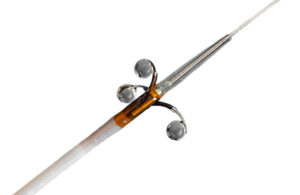
The Ablative Solutions Peregrine infusion catheter is designed to deliver alcohol through three nitinol microneedles (shown here with a drop of alcohol on each). [Photo courtesy of Ablative Solutions]
Nitinol in medtech: Flow Medical’s next-generation thrombolysis catheter for pulmonary embolism
For example, by December 2024, Medtronic’s nitinol-enabled Symplicity Spyral renal denervation (RDN) system had been treating hypertension patients for a year after its FDA approval in November 2023, while another device startup was developing an RDN system that uses nitinol in a different way.
Related: What Medtronic learned on its long road to RDN approval

The nitinol Synchron Stentrode BCI implant senses motor signals from inside the brain’s superior sagittal sinus. [Illustration courtesy of Synchron]
And in April 2024, the FDA approved Abbott’s TriClip system, which uses nitinol for transcatheter edge-to-edge repair (TEER) of tricuspid valves in the heart. Meanwhile, structural heart startup Capstan Medical reported progress on its system for robot-assisted heart valve replacements in 2024.
Pulse field ablation was nitinol’s big success story of 2024
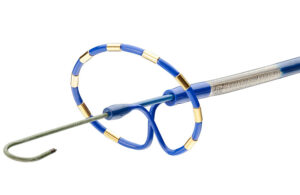
The Medtronic PulseSelect pulsed field ablation (PFA) system has a nitinol superstructure that allows it to compress down inside a catheter for delivery before expanding inside a patient. [Image courtesy of Medtronic]
Nitinol’s essential for PFA catheters, which go into the heart and expand into a predetermined shape (we featured several PFA catheter designs on the cover of our September 2024 magazine), then generate an energy field to open holes in heart muscle cells. That’s called electroporation, and it kills those myocytes to prevent AFib. At the same time, these energy fields do not affect nerve cells, so PFA minimizes the risk of harm to patients during and after these catheter ablations.
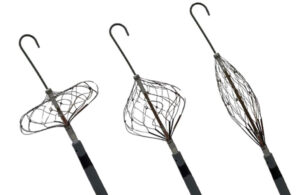
Medtronic’s Affera Sphere-360 pulsed field ablation catheter is adjustable, allowing the nitinol electrode to take different shapes inside a patient. [Illustration courtesy of Medtronic]
Nitinol was behind some of the biggest medtech deals of 2024

The V-Wave Ventura interatrial shunt (featuring a nitinol frame) is shown here anchoring inside a patient’s heart before the guidewire is retracted. [Image courtesy of V-Wave]
We covered nitinol technology at V-Wave after J&J announced its $1.7 billion acquisition of the cardiac implant developer.
Another nitinol-related deal was Boston Scientific’s $1.18 billion purchase of Silk Road Medical, which develops tech for transcarotid artery revascularization (TCAR), a minimally invasive procedure to prevent strokes in carotid artery disease patients,
And Edwards Lifesciences — which uses nitinol for its structural heart systems — in 2024 acquired heart failure implant developer Endotronix and announced a deal to purchase JenaValve Technologies. Endotronix and JenaValve both use nitinol for their devices. That pending JenaValve purchase could be the first big deal of 2025 if it closes soon.
Nitinol supply chain deals
Big nitinol news from late 2023 primed the year that followed, when Resonetics got into the nitinol melting business with its $900 million acquisition of Memry and Smart Materials in October 2023. In January 2024, Confluent Medical Technologies announced a partnership with ATI to expand its nitinol melting infrastructure.
In the months that followed, Johnson Matthey sold its Medical Device Components (MDC) business for $700 million to private equity firm Montagu, creating a newly independent nitinol device CDMO. Later in the year, MDC announced a purchase of its own with the acquisition of nitinol-based medical components maker Lighteum.
In the final months of 2024, MDO spoke with three of the world’s top medical nitinol melters to help device developers and manufacturers better understand the supply chain and trends in nitinol prices and lead times:
- Nitinol prices climb for medical devices after melting deals, says Confluent Chief Commercial Officer Doug Hutchison
- Resonetics VP Eric Veit on medical nitinol lead times, prices and ‘major changes’ in the works
- Fort Wayne Metals expands capacity as device demand surges
Medical Design & Outsourcing’s top stories of 2024: Medtronic moves, surgical robots, sterilization and more
Hear what my fellow editors had to say as they looked back at 2024 in the DeviceTalks Weekly episode below.