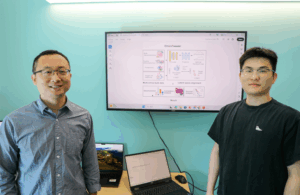
Zheng Xia (left) created the OmicsTweezer machine-learning tool; postdoc Xinxing Yang (right) is the study’s lead author. [Image courtesy of OHSU]
Mapping cell composition helps scientists understand how tumors interact with surrounding cells and respond to therapy. Single-cell sequencing can do this at high resolution but is too costly for large patient populations. Bulk data are plentiful, but technical differences between bulk and single-cell assays often distort results.
“The tumor microenvironment, made up of diverse cell types that shape tumor development and patient outcomes, has been a longstanding research priority at the Knight Cancer Institute,” said senior author Zheng Xia. “Our goal is to infer cell type composition using bulk data from large clinical sample sizes.”
OmicsTweezer tackles the mismatch by first placing bulk and single-cell datasets in a shared digital space. It relies on a deep-learning model to capture non-linear gene-expression patterns and uses optimal transport mathematics to align the two data distributions.
“We use optimal transport to align two different distributions — single-cell and bulk data — in the same space,” Xia said. “In this way, we can reduce the batch effect, which has long been a challenge when working with data from different sources.”
In simulated datasets and in prostate and colon cancer samples, the software detected subtle cell subtypes and measured shifts in cell populations between patient groups. Those insights could help researchers spot therapeutic targets and monitor disease progression.
Xia said integrating large bulk datasets with sparse single-cell data “builds a much clearer picture” of tumor biology and could guide treatment decisions as the tool is applied to larger clinical studies.
“With this tool, we can now estimate the fractions of those populations defined by single-cell data in bulk data from patient groups,” Xia said. “That could help us understand which cell populations are changing during disease progression and guide treatment decisions.”
The study was published in Cell Genomics.