Custom textiles can provide complex geometries, porosity, tensile strength and other critical characteristics for next-gen heart valve systems.
Michelle Lishner, Cortland Biomedical

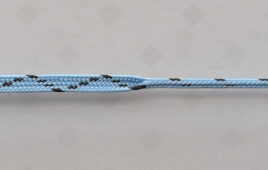
Hollow tubular polyester (PET) braid [Image courtesy of Cortland Biomedical]
Implantable textiles have become more innovative, including complex and fully customizable geometries that support and promote healing and regeneration of damaged cardiovascular tissue. In heart valves, biomedical textiles may be used as components for skirts, ring covers, or even cables for delivery systems.
The evolution of biomedical textile manufacturing for heart valve fabrics
Historically, textile machines were rudimentary, using oil and chain-links. Their geared configuration significantly limited pattern and design capabilities.
Today’s textile machines can be fully electronic, which is much cleaner and allows for more predictable output of consistent and repeatable patterning for highly customizable characteristics.
Modern equipment, coupled with engineering expertise, can blend different raw materials together for further customization. Laser cutting offers precise dimensions and unique shapes, important for fitting the fabric over frames with complex geometries.
Knitted heart valve fabric structures are formed by interlocking loops of yarn in a weft or warp pattern to form flat, broad, or tubular structures with open pores to promote native tissue growth as needed. Warp knitting is particularly ideal for creating textile products for vascular applications like mitral heart valve replacement because it can produce low profile, dense textile structures that prevent blood leakage around the valve.
Porosity can be tailored to recruit the desired cell by size, creating specialized regions of tissue regeneration. Densities can be changed quickly so you can transition from dense to porous within a single fabric. For heart valve fabrics, this means blood leakage can be prevented inside the valve, while native tissue ingrowth is encouraged outside. Applications of knitted heart valve fabrics include vascular prosthesis, hemostasis, cardiac support devices, and valve sewing cuffs.
Woven fabric configurations include tubular, flat, tapered, fabrics that are beneficial due to their low porosity, dimensional stability and high-tensile strength.
Material selection for heart valve components

Polyester (PET) warp knit with laser cut edge [Image courtesy of Cortland Biomedical]
Polyester (PET) has been used in heart valves since the first surgically implanted valve was developed in the 1960s. PET is still commonly used because the polymer is well researched, biocompatible, and results in a positive tissue response.
However, ultra-high molecular weight polyethylene (UHMWPE) may be a better option for applications that require high strength for a cardiovascular device designed for deployment and retrieval.
Polyester and polyethylene can both be braided, woven, or knitted. For heart valves, wovens are ideal for providing structure, while knits are well-suited for encouraging tissue growth. Components that incorporate both knitted and woven textiles mated together can be used on the same heart valve to achieve the desired result.
It is important that blood be able to flow through a valve, but surgeons generally want a seal around the edges of the valve to prevent paravalvular leakage. PET is known to have predictable coagulation cascade and can be placed around the circumference of the valve.
When a valve is inserted in the body, it is usually compressed and requires a force to allow it to spring open in situ. Shape memory materials such as nitinol are increasingly used for heart valves to maintain their shape and structure after catheter delivery and implantation in the body.
Engineering textiles for heart valves
When a heart valve manufacturer is working with a textile partner, it is important to define the mechanical specifications early in the process to prioritize performance. Due to many modern heart valves being delivered via catheter, dimensions are critical for the design process.
Understanding the purpose of the finished product — such as providing structure, promoting tissue ingrowth, or preventing leakage — helps inform critical design decisions.
For example, if the overall goal of a device is to prevent paravalvular leakage, a knit with a high surface area would be desirable. Braids, on the other hand, provide versatility, but it is important to understand the end use and application, such as whether the braid is going to be sewn on the heart valve or used as a deployment mechanism in the catheter.
Porosity and tensile strength are also vital to performance. Porosity is an important consideration for textiles that support tissue ingrowth. Textiles can be tailored to range in porosity from watertight to open to promote cell ingrowth. Tensile strength is another critical design requirement for valves. Valves experience immense pressure as the heart pumps, so it is essential to engineer them to prevent bursting or deformation under force.
Conclusion
Customizable textiles enable thinner, lower profile and better performing devices, allowing surgeons to transition many open-heart surgeries to procedures where a device can be delivered via catheter instead.

Michelle Lishner is a a new product design engineer at Cortland Biomedical. [Photo courtesy of Cortland Biomedical]
Michelle Lishner is a new product design engineer at Cortland Biomedical. Lishner has experience in industry and academia in tissue engineering and polymer-based medical devices with awards in leadership, project management, innovation, and product design.
Read more MDO Contributions and learn how to submit your own
The opinions expressed in this blog post are the author’s only and do not necessarily reflect those of Medical Design & Outsourcing or its employees.