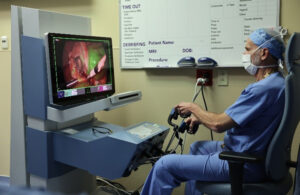
Dr. Steve Rothenberg at the controls of the Asensus Surgical Senhance system [Photo courtesy of HCA Healthcare’s HealthONE]
Rothenberg said his facility was the first dedicated pediatric hospital in the nation to use the Senhance surgical robotics system. The 16-year-old patient went home a few hours after the procedure and was dancing at his high school homecoming a couple days later.
DeviceTalks Minnesota: Learn more from Asensus Surgical at our Minneapolis show on June 11, 2025
The surgeon spoke with at The Robot Report (one of Medical Design & Outsourcing’s affiliate publications) about his impressions of the Sehance system.
He’s worked with surgical robotics for more than two decades and specializes in minimally invasive surgery in small children as young as infants. He’s spent most of his career trying to develop instrumentation for them.
“I was intrigued by the fact that [Senhance] could use smaller instrumentation,” Rothenberg told Wessling. “I liked that it was an open platform, meaning that not only can the surgeon sit and look at the console that he’s operating, but he can also see the patient.”
Related: What is minimally invasive medtech? It depends on who you ask.
Rothenberg said Senhance is easier to maneuver around if something doesn’t go according to plan during surgery.
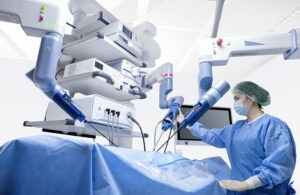
The Asensus Senhance surgical robotics system [Image courtesy of Asensus Surgical]
The Senhance system can also track where the surgeon is looking and direct the camera to those areas.
“Normally when I do standard laparoscopic surgery, I have to have an assistant who runs the laparoscopic camera for me,” said Rothenberg. “Even in other robotic systems, where the camera is hooked up to a robotic arm, you need to clutch and unclutch to take over that camera and move it around. With this system, I’m actually able to do it with my eyes, so I can maintain my hands on my two instruments.”
“I look where I want the telescope to look, and it goes right there,” he added. “It’s quite an amazing thing. I can make fine adjustments while I’m operating.”
Rothenberg said he is starting with relatively simple procedures on larger children and teenagers, but plans to conduct more complex surgers on smaller patients as he gets more familiar with the system.
“The learning curve is learning how to position the robot, how to get the arms just right where it works for that procedure. Some things we change because of the different ways the robot looks at things,” Rothenberg said. “Sometimes we use angled scopes in the robot, but we’re tending to use more straight scopes.”
Wessling also spoke with Asensus President and CEO Anthony Fernando about the system. Read the full story at The Robot Report.