Petal Surgical co-founder and CEO Prash Chopra envisions acoustic liquefaction for incisionless surgery and much more.

Petal Surgical co-founder and CEO Prash Chopra [Photo courtesy of Petal Surgical]
A few months after the $2.25 billion private-equity-fueled buyout of HistoSonics, Petal Surgical emerged as a new player with marquee name investors — including Dr. Fred Moll, the father of surgical robotics — and a grand vision to completely upend the health care industry.
Petal Surgical hasn’t shared many details about its approach. But in a Medical Design & Outsourcing interview, Petal Surgical co-founder and CEO Prash Chopra explains how a painful loss drove him and other high-powered medtech veterans to develop a way to “take away cuts from surgery so the next father, the next loved one will avoid the bad things that happen during surgery.”
The company is working with the same class of ultrasound energy used by HistoSonics and others. Petal Surgical is employing the expertise and experience of co-founders to expand the technology’s reach beyond ablation into a new class of surgery.
Like Chopra, who previously worked at Intuitive and Verb Surgical, the leadership team includes pivotal figures in surgical robotics and spine surgery:
- Co-founder Dr. Bowen Jiang is a neurosurgeon specializing in minimally invasive, robotic-assisted spine surgery who leads the Providence St. Jude Neuroscience Institute and a robotic spine center in California.

Dr. Fred Moll co-founded Intuitive Surgical and Auris Health. [Photo courtesy of Johnson & Johnson MedTech]
- Co-founder Dr. Nicholas Theodore, a Johns Hopkins neurosurgeon and robotics pioneer, co-founded spine surgery company Excelsius Surgical.
- Moll, listed as a Petal Surgical investor, founded Intuitive and Auris Surgical and sits on the board of many surgical robotics companies.
- Co-founding advisor Rony Abovitz is a co-founder of Mako Surgical, which was purchased by Stryker for $1.65 billion in 2013.
The following has been lightly edited for clarity.
MDO: Can you tell us about Petal Surgical’s origins?
Chopra: “I was frustrated. Every company I worked at was not fundamentally trying to help people like my father, who passed away when he was only 52. Petal came together out of personal frustration. I reached out to the three co-founders. All three said, ‘Let’s take away cuts from surgery so the next father, the next loved one will avoid the bad things that happen during surgery.’“
How did your father pass away?
Chopra: “He passed away because of a surgical complication that turned into an infection. Within 72 hours his body went into sepsis.”
How does Petal approach this problem?
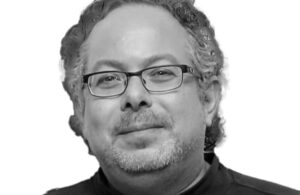
Mako Surgical co-founder Rony Abovitz is a co-founding advisor at Petal Surgical. [Photo courtesy of Petal Surgical]
How is Petal different from other ultrasound-based surgical systems in the market?
Chopra: “We use a refined form of histotripsy. We said we won’t be happy with just an ablative approach where we are helping a category of patients potentially for cancer treatments, palliative care. Instead, we’ve designed an end-to-end solution which starts with our form of histotripsy but then integrates everything we know, from robotics and AI to image guidance to the biology of disease states. We want to create an incisionless outpatient surgical experience that can scale, so we also avoided using active, big machine guidance like CT or MRIs.”
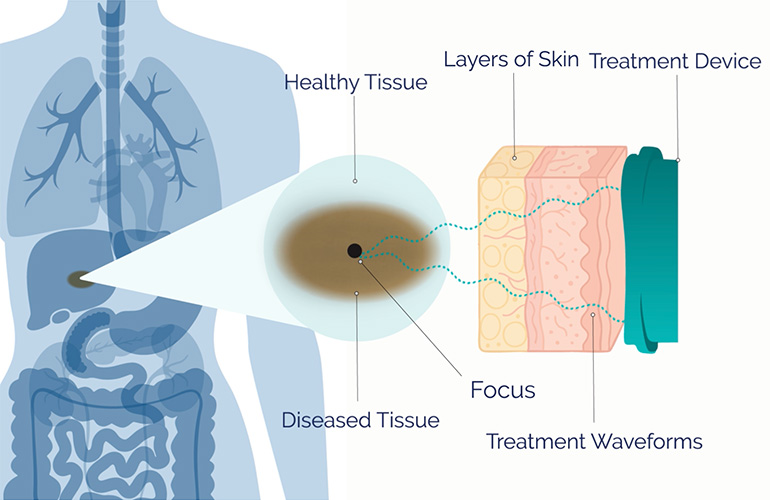
Petal Surgical says its acoustic liquefaction platform uses “focused acoustic energy to break down targeted tissue without incisions, heat, or trauma enabling the body to heal itself naturally.” [Illustration courtesy of Petal Surgical]
How are you impacting tissue?
Chopra: “Broadly speaking, histotripsy is about harnessing naturally present gas bubbles and popping them to destroy tissue. We’re thinking about the level of precision and control surgeons need from histotripsy, so our distinctive approach focuses on predictable shapes and sizes for each treatment. Instead of just relying on bubbles to mechanically destroy tissue, we’re adding more control. The mode of action enables us to create one vapor filled cavity at a time, the size of which is only limited by biology and physics. If you are a few centimeters beneath the skin surface of a patient, you’re talking rice grains or smaller. These vapor-filled cavities then become like micro universes for tiny hurricanes that we call jetting.”
What kind of imaging is used to guide the procedure?
Chopra: “We can use a multitude of imaging modalities, so it depends on the disease state and the organ system, but an example would be ultrasound. And then a couple other modalities mixed in as well, because we have to make sure what we are looking at is reliable with margins and predictable for surgeons to use.”

Petal Surgical explains acoustic liquefaction as “a new class of focused therapeutic ultrasound that delivers precise, controlled tissue manipulation without incisions, heat, or toxicity.” [Illustration courtesy of Petal Surgical]
What disease states have you identified as your first targets for treatment?
Chopra: “We’re starting with cancer first, but we’re designing our platform so we aren’t bound to ablative therapies alone. These are only a few examples, but other potential areas for Petal’s platform include softening plaque in the arteries in the heart, dissolving blood clots, and affecting bulging discs for low back pain treatment.”
Where can this go?
Chopra: “What I personally get very excited about is the potential of immunomodulatory properties, broadly speaking, from histotripsy. As an example, imagine a day where we are not just relieving a cancer patient’s pain and debilitating conditions by doing palliative care alone. Imagine us being able to tell a cancer patient we have treated a third of their tumor and because we didn’t burn the tissue, the rest has disappeared over a period of weeks to months, that it disappeared because the body’s immune system got the help it needs. We can think about not just destruction, but subcellular modulation of things we may not even be able to see today, protein level, or denaturing certain cells or tagging them. So if we open a whole new suite, not just for destruction of tissue, I can’t even imagine where the world will go with that.”
What specialists or surgeons do you envision using Petal’s system?

Petal Surgical co-founder Dr. Bowen Jiang [Photo courtesy of Providence]
Would this be used in larger clinical hospitals or ambulatory surgery centers?
Chopra: “This is a subjective vision statement. We’ll have to do our work to prove it, right? I believe in 15-20 years ambulatory surgical centers will become the primary setting for a technology like Petal, because the push is already there. We’re sitting at the juncture to make it happen.”
How are you going about building the company and raising capital?
Chopra: “We wanted to be very sure that the science we started to talk about is well understood by our team and repeatable in multiple clinical tissue targets. We want to have the big picture story settled and the strategic vision in place. We want to be able to talk about going from one to 100, not just zero to one. We are actively in talks with the next round to build Petal’s mission out in three steps. The first step is going to the first human trials to prove to ourselves, the societies and the market that we have a modality that works repeatedly. The second step will be commercialization of the platform with one example use case: Here’s what incisionless surgery means, here’s the value proposition and prove the fit. And the final one will be we start to think of Petal.Health, not just Petal Surgical.”
What does Petal.Health mean?
Chopra: “The last part means starting to harness the potential of acoustic liquefaction beyond just destroying tissue. So we could talk about completely noninvasive or incisionless diagnosis, biopsies and — this is where I get tingles down my spine — curative care. So it starts with cancer, but we believe the world is moving toward needing a high-tech yet cost-effective healthcare model at a fast rate. Starting in the U.S., what we have today is not sustainable. I have a 15-year-old daughter. I want to leave her a world where health insurance is less critical because it’s going to be less expensive for her to take care of acute illnesses. We’ll start with surgery and then cover the gamut: diagnosis, preventive care, all the way up to curative care. You’re relieved of cancer, you’re free of cancer, you’re free of heart disease, you’re free of stroke, it’s not going to show up again. But it’s a vision, so we’ll see how far we go.”
Do you see this moving more quickly than perhaps a traditional medical device startup would?
Chopra: “We are not worrying about how long it will take. What we are concerned about is getting started the right way. So hopefully the rest of the industry will take note because all stakeholders’ interests will be aligned with a company like Petal when we go out there. We are prepared for a long haul, and that’s okay because that’s how big transformations take place. That said, we’re also focused on right now so we can prove that our vision is viable.”