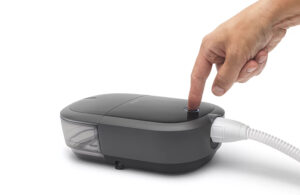
Philips is distributing DreamStation 2 continuous positive airway pressure (CPAP) devices as replacements for recalled DreamStation 1 machines. Philips has recalled more than 20 devices since 2021. [Photo courtesy of Philips]
That’s according to letters the Philips subsidiary sent to suppliers in June, saying contractor manufacturer Kimball Electronics will pick up the work at its Thailand facility over the next two years.
The Philips Respironics letters to suppliers were obtained by the Pittsburgh Post-Gazette, which reported that the move will eliminate hundreds of local jobs.
The two Pennsylvania manufacturing facilities are among the Philips Respironics operations subject to a consent decree with the FDA and U.S. Department of Justice concerning the company’s massive Class I recall of continuous positive airway pressure (CPAP) and bilevel positive airway pressure (BiPAP) machines.
“These changes will have no impact on Philips Respironics’ commitment to complying with the consent decree and will ensure it can provide patients with the highest quality products most efficiently and competitively,” Philips said in a statement to the Pittsburgh Post-Gazette.
Philips also said it would maintain a development hub for its breathing devices in the Pittsburgh region.
One Philips Respironics supplier, Tripak Industries, said it has more than $300,000 worth of packaging materials for which it can’t get paid. Philips told the newspaper that it did not approve orders for that much inventory and is “currently working to resolve this matter.”
Reached for comment by Medical Design & Outsourcing today, a Philips representative said he had no new information to share on the manufacturing move, referring instead to the company’s announcement in June that it would lay off 300 manufacturing employees and relocate another 500 workers to the Murrysville and New Kensington plants.
Amsterdam-based parent company Royal Philips is the world’s sixth-largest medical device manufacturer, according to our 2024 Medtech Big 100 ranking by revenue.
Kimball Electronics and Philips
Jasper, Indiana-based Kimball Electronics has its Thailand operations in the port city of Laem Chabang in Chonburi Province.
The company’s website says the 220,000-ft² facility does PCBA manufacturing, subassembly and system build, and complete medical system assembly. The company describes its Thailand facility as “FDA compliant,” but the location is not among the four Kimball Electronics site listed by the agency as FDA-registered.
Kimball Electronics reported net sales of $1.7 billion in its most recent year (ended June 30, 2024), down from $1.8 billion in 2023. Those two years were the company’s highest-ever for annual revenue, the company said in its annual report.
The medical industry accounted for 25% of net sales for Kimball Electronics in 2024. A “significant amount” of the company’s total sales in recent years came from Philips alone, the company said: 15% in 2022, 14% in 2023 and “less than 10%” in 2024.
Without mentioning Philips by name, Kimball Electronics said its total medical market sales decreased in 2024 due to decreased sales with “a large medical customer … who is remediating a recall.” Kimball said its lost $100 million worth of business due to the FDA recall.
“The cause of the recall is unrelated to the products we provided,” the company said.
In addition to sleep therapy and respiratory care devices, Kimball Electronics serves medical customers that develop image-guided therapies, in vitro diagnostics, drug delivery devices, automated external defibrillators (AEDs) and patient monitoring technology.
Automotive is the largest market for Kimball Electronics, followed by industrial and then medical. Kimball Electronics CEO Ric Phillips (no relation to Philips) said his company, like many other contract manufacturers, has “adjusted expectations for weak end-market demand.”
“In our verticals, the pullback has been more significant than we originally anticipated, setting up fiscal year 2025 for another year of ‘controlling what we can control,'” Phillips said in his annual letter to shareholders. “Near term, this translates into a continued focus on cost structure, margin levels, working capital management, and investments in capital expenditures. Over a longer period of time, however, ‘controlling what we can control’ is extending beyond these measures and focused on growing the top line.”
“The recent announcement by our largest medical customer — making Kimball the sole supplier on their respiratory care final assembly and high-level assembly business — is a great example where we see the growth potential,” Phillips later continued.