Medical Design and Outsourcing

  • Home
  • Medical Device Business
    • Mergers & Acquisitions
    • Financial
    • Regulatory
  • Applications
    • Cardiovascular
    • Devices
    • Imaging
    • Implantables
    • Medical Equipment
    • Orthopedic
    • Surgical
  • Technologies
    • Supplies and Components Index
    • Contract Manufacturing
    • Components
    • Electronics
    • Extrusions
    • Materials
    • Motion Control
    • Prototyping
    • Pumps
    • Tubing
  • MedTech Resources
    • Medtech Events in 2026
    • The 2026 Medtech Big 100
    • Medical Device Handbook
    • MedTech 100 Index
    • Subscribe to Print Magazine
    • DeviceTalks
    • Digital Editions
    • eBooks
    • Educational Assets
    • Manufacturer Search
    • Podcasts
    • Webinars / Digital Events
    • Whitepapers
    • Voices
    • Views
    • Video
  • 2026 Leadership
    • 2025 Winners
    • 2024 Winners
    • 2023 Winners
    • 2022 Winners
    • 2021 Winners
  • Women in Medtech
  • Advertise
  • Subscribe

Quantifying Radiation Damage in SAXS Experiments

December 16, 2016 By International Union of Crystallography

Biological small-angle X-ray scattering (SAXS) is an experimental technique that provides low-resolution structural information on macromolecules. The surge of popularity of the technique is a result of recent improvements in both software and hardware, allowing for high-throughput data collection and analysis, reflected in the increasing number of dedicated SAXS beamlines such as BM29 at the ESRF, P12 at EMBL Hamburg and B21 at Diamond Light Source.

However, as for most other macromolecular structural techniques, radiation damage is still a major factor hindering the success of experiments. The high solvent proportion of biological SAXS samples means that hydroxyl, hydroperoxyl radicals and hydrated electrons are produced in abundance by the radiolysis of water when it is irradiated with X-rays. These radicals can then interact with the protein molecules, ultimately leading to protein aggregation, fragmentation or unfolding. Furthermore, molecular repulsion due to protein charging can also decrease the scattering at low angles.
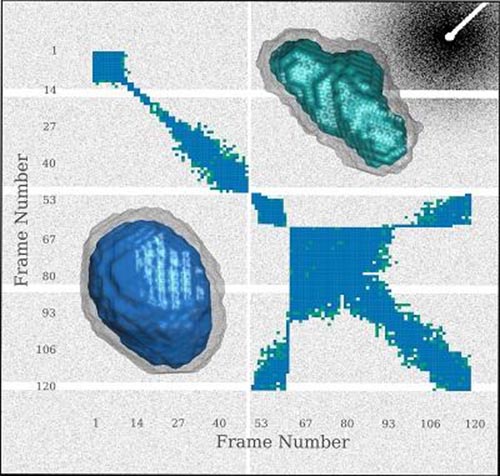
SAXS envelopes of Glucose Isomerase generated from frames collected early (bottom left) and late (top right) in the experiment. (Credit: Brooks-Bartlett et al)

Common methods used to reduce radiation damage to biological SAXS samples are generally concerned with limiting the X-ray exposure to any given volume of sample. In an analogous manner, cryo-cooling samples down to 100 K for SAXS (cryoSAXS) has been reported to increase the dose tolerance of SAXS samples by at least two orders of magnitude.

Applications of the above radiation damage mitigation approaches are unable to completely circumvent its detrimental effects, in particular the change of the scattering profile throughout the experiment. It is necessary to determine whether any two scattering profiles are similar so that noise can be reduced by averaging over similar curves.

For experiments by different researchers to be inter-comparable, the progression of radiation damage is most usefully tracked as a function of the dose absorbed by the sample. RADDOSE-3D is a free and open source software program used to calculate the time- and space-resolved three-dimensional distribution of the dose absorbed by a protein crystal in a macromolecular crystallography experiment; however, there is no equivalent software available for SAXS. Radiation damage studies in SAXS thus currently require the experimenters to correctly parameterize the experiment and manually calculate a single estimate of the dose within the sample.


Related Articles Read More >

The most innovative medical devices of 2026
An illustration showing Corcym's Memo 4D Curve's laser-cut nitinol core.
Laser-cut nitinol and a layered design let these cardiac implants flex
Reconstructed 3D fluorescence image of the stained biohybrid mesh-tissue integration. The red, green, and blue colors correspond to the mesh, F-actin, and nuclei, respectively.
Researchers mesh electronics with human cells to develop living battery
A photo of the Paradromics Connexus brain-computer interface on a fingertip.
How Paradromics designed its Connexus brain-computer interface system
“mdo
EXPAND YOUR KNOWLEDGE AND STAY CONNECTED
Get the latest medical device business news, application and technology trends.

DeviceTalks Weekly

See More >

MDO Digital Edition

Digital Edition

Subscribe to Medical Design & Outsourcing. Bookmark, share and interact with the leading medical design engineering magazine today.

MEDTECH 100 INDEX

Medtech 100 logo
Market Summary > Current Price
The MedTech 100 is a financial index calculated using the BIG100 companies covered in Medical Design and Outsourcing.

New MedTech Resource

Medical Tubing

MassDevice

Mass Device

The Medical Device Business Journal. MassDevice is the leading medical device news business journal telling the stories of the devices that save lives.

Visit Website
MDO ad
Medical Design and Outsourcing
  • MassDevice
  • DeviceTalks
  • MedTech100 Index
  • Medical Tubing + Extrusion
  • Medical Design Sourcing
  • Drug Delivery Business News
  • Drug Discovery & Development
  • Pharmaceutical Processing World
  • R&D World
  • About Us/Contact
  • Advertise With Us
  • Subscribe to Print Magazine
  • Subscribe to our E-Newsletter
  • Listen to our Weekly Podcasts
  • Join our DeviceTalks Tuesdays Discussion

Copyright © 2026 Arrowfly, LLC. All Rights Reserved. The material on this site may not be reproduced, distributed, transmitted, cached or otherwise used, except with the prior written permission of Arrowfly LLC. Site Map | Privacy Policy | RSS

Search Medical Design & Outsourcing

  • Home
  • Medical Device Business
    • Mergers & Acquisitions
    • Financial
    • Regulatory
  • Applications
    • Cardiovascular
    • Devices
    • Imaging
    • Implantables
    • Medical Equipment
    • Orthopedic
    • Surgical
  • Technologies
    • Supplies and Components Index
    • Contract Manufacturing
    • Components
    • Electronics
    • Extrusions
    • Materials
    • Motion Control
    • Prototyping
    • Pumps
    • Tubing
  • MedTech Resources
    • Medtech Events in 2026
    • The 2026 Medtech Big 100
    • Medical Device Handbook
    • MedTech 100 Index
    • Subscribe to Print Magazine
    • DeviceTalks
    • Digital Editions
    • eBooks
    • Educational Assets
    • Manufacturer Search
    • Podcasts
    • Webinars / Digital Events
    • Whitepapers
    • Voices
    • Views
    • Video
  • 2026 Leadership
    • 2025 Winners
    • 2024 Winners
    • 2023 Winners
    • 2022 Winners
    • 2021 Winners
  • Women in Medtech
  • Advertise
  • Subscribe

