Resonant Link Board Chair Ray Cohen [Photo courtesy of Andera Partners]
Cohen co-founded neurostimulation implant developer Axonics and served as its CEO until selling it to Boston Scientific for $3.7 billion in 2024, and was board chair of renal denervation developer SoniVie, which Boston Scientific acquired in May 2025.
DeviceTalks West: Cohen is scheduled to speak at our show in Santa Clara, California on Oct. 15. Register now! Here’s a 25% off discount code: MDO25OFF
“Ray’s deep experience building and guiding category-defining medical technology companies makes him an invaluable addition to our board,” Resonant Link Medical CEO Omari Bouknight said in a statement shared with Medical Design & Outsourcing ahead of the official announcement. “His track record of scaling innovative companies will help us accelerate Resonant Link Medical’s mission to power life-changing therapies along with our medical device partners.”
April 2025: Resonant Link Medical hires medtech vet Omari Bouknight as CEO
“These guys have come up with a really elegant way in which to recharge devices that are implanted in the body,” Cohen said in an exclusive interview. “There’s a lot of applications for devices that require transcutaneous charging, and it’s a trend that’s going to continue. Wearables are here to stay. If you’re going to do something that is implanted, it’s either going to have a battery life of X years or it’s going to be rechargeable.”
Cohen is currently board chair at Nalu Medical (which has developed a minimally invasive implant for chronic neuropathic pain), hypertension implant developer Archimedes Vascular, and cuffless blood pressure monitor developer BioBeat Technologies.
Min-Vasive Medtech: Watch on-demand interviews and audience Q&As with minimally invasive engineers from Edwards Lifesciences, Jupiter Endo and Compremium
He’s also vice chair of peripheral nerve surgery biomaterial developer Tulavi Therapeutics, a board director for stroke-preventing stent developer InspireMD and ophthalmic device developer RxSight, and a venture partner at Andera Partners.
“I’ve had personal experience at Axionics and other situations where the ability to efficiently and effectively charge a device is really important,” Cohen said. “The rub is that all of these devices, for the most part, are encased in titanium, and the problem with titanium is it attenuates the signal, so you’re only getting a portion of that energy. [If] you have something that is very efficient and can charge quickly without creating heat buildup … that’s a winner, and the advantage that a company would have working with Resonant Link is they don’t have to go through the process of development.”
“These guys are expert at this one thing,” he later continued, “and the business model is really good as well, because we’re not going to charge you some big NRE … we’re going to basically make whatever modifications you need, and you produce it [so] there’s no markup on the bill of materials. The company simply takes one point of revenue.”
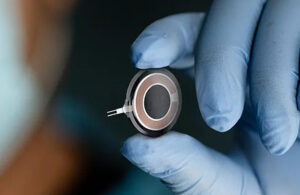
Resonant Link Medical says its Aurion WPT platform “combines core innovations in coils, power electronics, magnetics, and data transfer to make implantables smaller, smarter, longer-lasting, and easy to use.” [Photo courtesy of Resonant Link Medical]
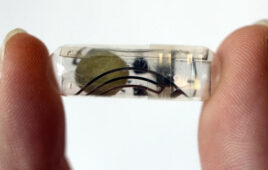
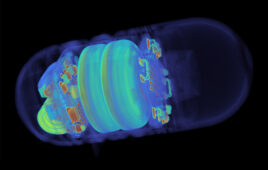
That technology platform — which Resonant Link says can deliver uninterrupted wireless power up to 10 times faster than conventional wireless over double the range — is finding applications in ventricular assist devices, neurostimulators, brain-computer interfaces, and other implants, the company said.
Look for more from our interview with Cohen at Medical Design & Outsourcing in the weeks ahead, starting with this post.