WashU researchers and Prognosia co-founders Graham Colditz (left) and Shu “Joy” Jiang [Photo courtesy of Washington University School of Medicine in St. Louis]
The technology received a Breakthrough Device designation from the FDA, potentially speeding its path to the market. The software, called Prognosia Breast, has been licensed to Prognosia Inc., a WashU startup.
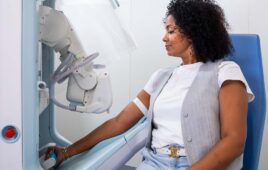
The system, compatible with full-field digital mammography and digital breast tomosynthesis mammograms, analyzes mammograms to produce a risk score representing the probability of a woman developing breast cancer in the next five years.
Early detection of breast cancer increases survival rate
The system was trained on tens of thousands of mammograms from the Siteman Cancer Center, which has five locations in Missouri and one in Illinois. By comparing the mammograms of women who developed breast cancer to those who didn’t, the researchers trained Prognosia Breast to detect early signs of the disease that human doctors can’t see.
Early detection is essential for successful breast cancer treatment. The five-year survival rate for breast cancer caught in the earliest stages is 99%, according to the American Cancer Society, but only 32% for breast cancer detected in the distant stage.
“Despite the sophistication of today’s breast imaging and its broad use for identifying existing tumors, today’s risk prediction for breast cancer is still questionnaire-based and not very good at estimating future risk,” said Shu “Joy” Jiang, one of the researchers who co-founded Prognosia. “Our work has focused on filling that need for better methods. Moving to image-based risk prediction — which our studies have shown is much more accurate — has the potential to be revolutionary for patient care.”
According to the developers, with the woman’s age and mammogram, Prognosia Breast estimates a patient’s five-year risk score 2.2 times more accurately than the standard method, which involves analyzing additional factors such as age, race and family history.
With Prognosia Breast, doctors could compare their patients’ five-year risk score to national breast cancer incidence rates to determine if their patient has an elevated risk.
“We’re excited about the potential of this technology to improve risk prediction and prevention of breast cancer broadly, no matter where a woman is getting screened,” said Graham Colditz, another Prognosia co-founder and WashU researcher. “The long-term goal is to make this technology available to any woman having a screening mammogram anywhere in the world.”
The developers are planning a clinical trial at the Siteman Cancer Center, combining the risk score from Prognosia Breast with standard screening protocols. They also plan to improve Prognosia Breast by making it able to analyze several years of a single patient’s mammograms, which might improve the risk score accuracy.