Medical Design and Outsourcing

  • Home
  • Medical Device Business
    • Mergers & Acquisitions
    • Financial
    • Regulatory
  • Applications
    • Cardiovascular
    • Devices
    • Imaging
    • Implantables
    • Medical Equipment
    • Orthopedic
    • Surgical
  • Technologies
    • Supplies and Components Index
    • Contract Manufacturing
    • Components
    • Electronics
    • Extrusions
    • Materials
    • Motion Control
    • Prototyping
    • Pumps
    • Tubing
  • MedTech Resources
    • Medtech Events in 2026
    • The 2025 Medtech Big 100
    • Medical Device Handbook
    • MedTech 100 Index
    • Subscribe to Print Magazine
    • DeviceTalks
    • Digital Editions
    • eBooks
    • Educational Assets
    • Manufacturer Search
    • Podcasts
    • Webinars / Digital Events
    • Whitepapers
    • Voices
    • Views
    • Video
  • 2026 Leadership
    • 2025 Winners
    • 2024 Winners
    • 2023 Winners
    • 2022 Winners
    • 2021 Winners
  • Women in Medtech
  • Advertise
  • Subscribe

Researchers Developing ‘GPS’ for Rectal Cancer Surgery

May 25, 2016 By Case Western Reserve University

Researchers estimate that up to 10,000 rectal cancer patients undergo unnecessary surgery, and more than 25,000 suffer from pelvic sepsis, wound infection and permanent impairments from aggressive surgery in the United States annually.

That’s because it’s difficult to reliably tell which patients treated with chemotherapy and radiation still need surgery. Another challenge is surgeons lack strong guidance on just how much tissue beyond the cancerous tumor they should remove.

A researcher at Case Western Reserve University aims to provide answers to both uncertainties by analyzing features found in magnetic resonance images regularly taken before surgery and pathological specimens removed during surgery.
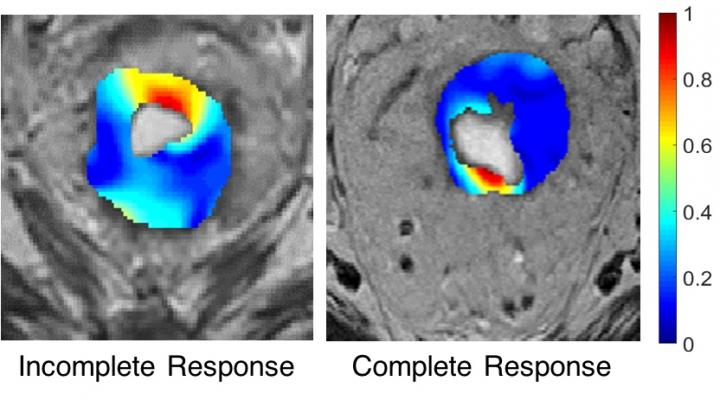
The post-chemoradiation image of rectal cancer on the left shows residual cancer that requires surgery. The image on the right shows no signs of residual cancer. (Credit: Case Western Reserve University)

The features are too small to be seen by the human eye, but can be measured with computers. When associated with the known outcomes of past patients, the features may be used to make risk assessments and surgical maps for new patients.

“Because we have access to the images and the pathology, we can create accurate maps of residual disease,” said Satish Viswanath, research assistant professor in biomedical engineering and member of the Center for Computational Imaging and Personalized Diagnostics (CCIPD) at Case Western Reserve. “These analytics can be used as a guide for the surgical margins–a GPS for surgeons.”

Viswanath has received a $569,000, three-year grant from the Department of Defense to fund the project.

While obviously not limited to those who serve in the military, colorectal cancer is the third most common cancer among veterans and active duty military personnel.

Although studies show less invasive laparoscopic surgery yields more benefit, more than 90 percent undergo radical surgery due largely to the lack of reliable guidance. Still, 5 percent to 10 percent suffer local recurrence, a significant cause of death among older veterans.

By mining the images and data, Viswanath and co-investigators aim to learn which features, such as textures associated with lesions or fibrosis, are associated with residual disease.

The researchers will co-register, or align and fuse, the post-chemoradiation MR images with post-surgery pathology images. They will then try to determine which features on MRI are associated with patients’ outcomes–whether the cancer returned, they suffered incontinence or other impairments, or they beat the disease with little collateral damage with or without surgery.

Researchers will develop a risk-assessment scoring system based on those associations. The score will help doctors determine which patients need surgery after chemotherapy and radiation treatments and which don’t.

For those who need surgery, the associations will be used to define the boundaries. The goal is to remove enough tissue to prevent recurrence of cancer, but no more. Researchers believe that will reduce metastasis and also the number of impairments caused by overly aggressive surgery.

Co-investigators on this project include: Joseph Willis, professor of pathology; Raj Paspulati, associate professor of radiology; Conor Delaney, professor of surgery (Cleveland Clinic); Pingfu Fu, associate professor of epidemiology and biostatistics; and Sanford Markowitz, professor of hematology and oncology and colon cancer researcher, from the Case Western Reserve School of Medicine; Anant Madabhushi, professor of biomedical engineering at Case School of Engineering and Director of the CCIPD; and Eric Marderstein, surgeon, Louis Stokes Cleveland Veterans Affairs Medical Center. Pablo Ros, chairman of radiology at the Case Western Reserve School of Medicine, will serve as a consultant.

The researchers will use post-chemoradiation images and pathology specimens from University Hospitals Case Medical Center to develop the surgical GPS and risk scores. They will validate the tools using images and pathology outcomes and assessments from the Stokes Cleveland VA.

Related Articles Read More >

An image of the September 2026 Medical Design & Outsourcing magazine featuring the Medtech Big 100 ranking of the world's largest medical device companies.
September 2026 issue: The MDO Medtech Big 100 breaks $500 billion
A photo of Petal Surgical co-founder and CEO Prash Chopra.
Petal Surgical CEO Prash Chopra offers advice for device developers
An image of Claria's system for minimally invasive hysterectomies.
This de novo minimally invasive system was designed for safer hysterectomies
A photo of Capstan Medical CEO Maggie Nixon posing with the structural heart startup's robotic catheter delivery system.
Capstan Medical CEO Maggie Nixon’s career advice, travel tips and how she starts her day
“mdo
EXPAND YOUR KNOWLEDGE AND STAY CONNECTED
Get the latest medical device business news, application and technology trends.

DeviceTalks Weekly

See More >

MDO Digital Edition

Digital Edition

Subscribe to Medical Design & Outsourcing. Bookmark, share and interact with the leading medical design engineering magazine today.

MEDTECH 100 INDEX

Medtech 100 logo
Market Summary > Current Price
The MedTech 100 is a financial index calculated using the BIG100 companies covered in Medical Design and Outsourcing.

New MedTech Resource

Medical Tubing

MassDevice

Mass Device

The Medical Device Business Journal. MassDevice is the leading medical device news business journal telling the stories of the devices that save lives.

Visit Website
MDO ad
Medical Design and Outsourcing
  • MassDevice
  • DeviceTalks
  • MedTech100 Index
  • Medical Tubing + Extrusion
  • Medical Design Sourcing
  • Drug Delivery Business News
  • Drug Discovery & Development
  • Pharmaceutical Processing World
  • R&D World
  • About Us/Contact
  • Advertise With Us
  • Subscribe to Print Magazine
  • Subscribe to our E-Newsletter
  • Listen to our Weekly Podcasts
  • Join our DeviceTalks Tuesdays Discussion

Copyright © 2026 Arrowfly, LLC. All Rights Reserved. The material on this site may not be reproduced, distributed, transmitted, cached or otherwise used, except with the prior written permission of Arrowfly LLC. Site Map | Privacy Policy | RSS

Search Medical Design & Outsourcing

  • Home
  • Medical Device Business
    • Mergers & Acquisitions
    • Financial
    • Regulatory
  • Applications
    • Cardiovascular
    • Devices
    • Imaging
    • Implantables
    • Medical Equipment
    • Orthopedic
    • Surgical
  • Technologies
    • Supplies and Components Index
    • Contract Manufacturing
    • Components
    • Electronics
    • Extrusions
    • Materials
    • Motion Control
    • Prototyping
    • Pumps
    • Tubing
  • MedTech Resources
    • Medtech Events in 2026
    • The 2025 Medtech Big 100
    • Medical Device Handbook
    • MedTech 100 Index
    • Subscribe to Print Magazine
    • DeviceTalks
    • Digital Editions
    • eBooks
    • Educational Assets
    • Manufacturer Search
    • Podcasts
    • Webinars / Digital Events
    • Whitepapers
    • Voices
    • Views
    • Video
  • 2026 Leadership
    • 2025 Winners
    • 2024 Winners
    • 2023 Winners
    • 2022 Winners
    • 2021 Winners
  • Women in Medtech
  • Advertise
  • Subscribe