Medical Design and Outsourcing

  • Home
  • Medical Device Business
    • Mergers & Acquisitions
    • Financial
    • Regulatory
  • Applications
    • Cardiovascular
    • Devices
    • Imaging
    • Implantables
    • Medical Equipment
    • Orthopedic
    • Surgical
  • Technologies
    • Supplies and Components Index
    • Contract Manufacturing
    • Components
    • Electronics
    • Extrusions
    • Materials
    • Motion Control
    • Prototyping
    • Pumps
    • Tubing
  • MedTech Resources
    • Medtech Events in 2026
    • The 2026 Medtech Big 100
    • Medical Device Handbook
    • MedTech 100 Index
    • Subscribe to Print Magazine
    • DeviceTalks
    • Digital Editions
    • eBooks
    • Educational Assets
    • Manufacturer Search
    • Podcasts
    • Webinars / Digital Events
    • Whitepapers
    • Voices
    • Views
    • Video
  • 2026 Leadership
    • 2025 Winners
    • 2024 Winners
    • 2023 Winners
    • 2022 Winners
    • 2021 Winners
  • Women in Medtech
  • Advertise
  • Subscribe

Researchers test microrobots for treating spinal cord injuries

June 3, 2026 By Sean Whooley

The microbotic technology for delivering stem cell therapies could also have applications in cardiology, oncology and wound healing.
ETH Zurich Microrobots for stem cell delivery to treat spinal cord injuries EN Pic

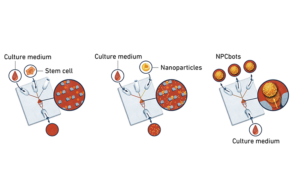
Illustration of how microrobots are fabricated on a lab-on-a-chip (LoC). (Image courtesy of ETH Zurich)

Researchers in Zurich say they have developed a method to use microrobots delivering stem cell therapies to treat spinal cord injuries.

According to ETH Zurich and the University of Zurich (UZH), modern therapies for spinal cord injuries attempt to influence implanted stem cells using electrical stimulation, promoting the growth of new nerve cells. However, researchers say the approach requires implanted electrodes, while transplanted cells may not always survive or integrate properly into existing tissue.

To address this, the research team say they found a novel approach to treating spinal cord injuries (SCIs). They use controllable microrobots to deliver stem cells directly to the site of an injury. There, they promote nerve cell regeneration. The researchers say that animal experiments showed that the approach significantly improved mobility.

Combining therapeutic stem cells with magnetoelectric nanoparticles, the researchers can guide cells magnetically to the precise site of an injury to stimulate the stem cells and accelerate repair. They created a biohybrid microrobot to achieve this, combining living neural progenitor cells (NPCs) with a technical component in the form of specially engineered nanoparticles. The researchers derived the NPCs from induced pluripotent stem (iPS) cells, which are regular body cells reprogrammed in the laboratory to regain stem cell properties. Nanoparticles feature an inner layer that responds to magnetic fields and an outer layer that converts the response into electrical signals.
ETH Zurich microrobot stem cell delivery in animals EN Pic

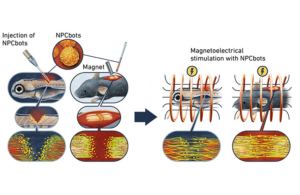
Schematic illustration of nerve cell recovery in zebrafish and mice. (Image courtesy of ETH Zurich)

Altogether, the researchers say they fabricate what they label “NPCbots.” They create the NPCbots in specialized labs on a surface totaling just one square centimeter. Each measuring about six micrometers in size, the NPCbots are ready to use after just 30 minutes.

“We place a reservoir in the centre where we trap the cells. Then we inject the nanoparticles and wait for the two components to bind,” said Professor Salvador Pané i Vidal of the Multi-Scale Robotics Lab at ETH Zurich.

Testing the microrobot technology in animals and beyond

The researchers tested the microrobots on zebrafish larvae with SCI. They injected them precisely into the injury site and generated the electromagnetic fields. In just three days, the zebrafish exhibited nearly normal swimming and exploratory behavior.

Following this test, the researchers used the microrobots in mice with completely severed spinal cords. After 28 days, the animals’ nerve cells had reconnected at the injury site. During this period, the researchers say the treated mice demonstrated increasingly normal movement patterns. Gait, stride length, coordination and exploratory behavior all improved significantly, they noted. The significance with the outcomes in mice, the researchers say, is that their spinal cords don’t normally regenerate, unlike zebrafish. All animals also tolerated the treatment well, with no evidence of adverse effects or immune reactions.

The researchers say the electrical stimulation of stem cells made the successes in these studies possible. They only needed to apply external magnetic fields around the injury site when using the microrobots. This eliminated the need for implanted electrodes or cables. Meanwhile, magnetic fields can penetrate tissue easily, while their frequency and field strength can be flexibly adjusted.

Once the progenitor cells have been stimulated and differentiated into nerve cells, the microrobots essentially dissolve within the tissue. The researchers expect the nanoparticles to remain stable and minimally reactive due to their barium titanate coating. Future studies are set to evaluate how the particles degrade or are excreted over the long term.

The researchers say that, despite promising results, they require further research before testing the NPCbots in humans. Potential applications could include biomedical areas, such as cardiology, oncology and wound healing.


About The Author

Avatar photo
Sean Whooley

Sean Whooley is an associate editor who mainly produces work for MassDevice, Medical Design & Outsourcing and Drug Delivery Business News. He received a bachelor's degree in multiplatform journalism from the University of Maryland, College Park. You can connect with him on LinkedIn or email him at [email protected].

Related Articles Read More >

The most innovative medical devices of 2026
An illustration showing Corcym's Memo 4D Curve's laser-cut nitinol core.
Laser-cut nitinol and a layered design let these cardiac implants flex
Reconstructed 3D fluorescence image of the stained biohybrid mesh-tissue integration. The red, green, and blue colors correspond to the mesh, F-actin, and nuclei, respectively.
Researchers mesh electronics with human cells to develop living battery
A photo of J&J MedTech SVP and Global Head of Digital Shan Jegatheeswaran.
Where Johnson & Johnson sees opportunity in surgical intelligence
“mdo
EXPAND YOUR KNOWLEDGE AND STAY CONNECTED
Get the latest medical device business news, application and technology trends.

DeviceTalks Weekly

See More >

MDO Digital Edition

Digital Edition

Subscribe to Medical Design & Outsourcing. Bookmark, share and interact with the leading medical design engineering magazine today.

MEDTECH 100 INDEX

Medtech 100 logo
Market Summary > Current Price
The MedTech 100 is a financial index calculated using the BIG100 companies covered in Medical Design and Outsourcing.

New MedTech Resource

Medical Tubing

MassDevice

Mass Device

The Medical Device Business Journal. MassDevice is the leading medical device news business journal telling the stories of the devices that save lives.

Visit Website
MDO ad
Medical Design and Outsourcing
  • MassDevice
  • DeviceTalks
  • MedTech100 Index
  • Medical Tubing + Extrusion
  • Medical Design Sourcing
  • Drug Delivery Business News
  • Drug Discovery & Development
  • Pharmaceutical Processing World
  • R&D World
  • About Us/Contact
  • Advertise With Us
  • Subscribe to Print Magazine
  • Subscribe to our E-Newsletter
  • Listen to our Weekly Podcasts
  • Join our DeviceTalks Tuesdays Discussion

Copyright © 2026 Arrowfly, LLC. All Rights Reserved. The material on this site may not be reproduced, distributed, transmitted, cached or otherwise used, except with the prior written permission of Arrowfly LLC. Site Map | Privacy Policy | RSS

Search Medical Design & Outsourcing

  • Home
  • Medical Device Business
    • Mergers & Acquisitions
    • Financial
    • Regulatory
  • Applications
    • Cardiovascular
    • Devices
    • Imaging
    • Implantables
    • Medical Equipment
    • Orthopedic
    • Surgical
  • Technologies
    • Supplies and Components Index
    • Contract Manufacturing
    • Components
    • Electronics
    • Extrusions
    • Materials
    • Motion Control
    • Prototyping
    • Pumps
    • Tubing
  • MedTech Resources
    • Medtech Events in 2026
    • The 2026 Medtech Big 100
    • Medical Device Handbook
    • MedTech 100 Index
    • Subscribe to Print Magazine
    • DeviceTalks
    • Digital Editions
    • eBooks
    • Educational Assets
    • Manufacturer Search
    • Podcasts
    • Webinars / Digital Events
    • Whitepapers
    • Voices
    • Views
    • Video
  • 2026 Leadership
    • 2025 Winners
    • 2024 Winners
    • 2023 Winners
    • 2022 Winners
    • 2021 Winners
  • Women in Medtech
  • Advertise
  • Subscribe


