Medical Design and Outsourcing

  • Home
  • Medical Device Business
    • Mergers & Acquisitions
    • Financial
    • Regulatory
  • Applications
    • Cardiovascular
    • Devices
    • Imaging
    • Implantables
    • Medical Equipment
    • Orthopedic
    • Surgical
  • Technologies
    • Supplies and Components Index
    • Contract Manufacturing
    • Components
    • Electronics
    • Extrusions
    • Materials
    • Motion Control
    • Prototyping
    • Pumps
    • Tubing
  • MedTech Resources
    • Medtech Events in 2026
    • The 2026 Medtech Big 100
    • Medical Device Handbook
    • MedTech 100 Index
    • Subscribe to Print Magazine
    • DeviceTalks
    • Digital Editions
    • eBooks
    • Educational Assets
    • Manufacturer Search
    • Podcasts
    • Webinars / Digital Events
    • Whitepapers
    • Voices
    • Views
    • Video
  • 2026 Leadership
    • 2025 Winners
    • 2024 Winners
    • 2023 Winners
    • 2022 Winners
    • 2021 Winners
  • Women in Medtech
  • Advertise
  • Subscribe

Small, inexpensive wearable sensors could improve Parkinson’s treatment

May 24, 2024 By Sean Whooley

University of Illinois small wearable sensors

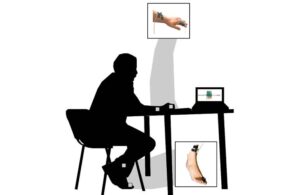
Subjects completed tasks normally done during in-person clinical assessment with sensors on their arms, hands and feet to gather data. [Image courtesy of Manuel Enrique Hernandez]

Researchers at the University of Illinois say low-cost, wearable sensors could increase access to care for Parkinson’s disease patients.

The team, along with clinical collaborators at Johns Hopkins, say new machine learning approaches and baseline data from healthy older adults improve the accuracy of the results from these sensors.

“This study demonstrates that the expansion of datasets with healthy older adult motion data and integration with deep learning approaches can help improve the accuracy of detecting differences in motor impairment in persons with Parkinson’s disease for use in future telemedicine sessions,” said study leader Manuel Enrique Hernandez, a professor of biomedical and translational sciences within the Carle Illinois College of Medicine at the University of Illinois.

Patients with Parkinson’s have to periodically undergo assessments to have their symptoms monitored. This time-consuming, in-person specialist visit often comes with limited availability, Hernandez said. Telemedicine evaluations could improve care but is hampered by a lack of quantifiable measurements.

The Illinois team set out to take on these issues by improving assessments with low-cost wearable sensors. They published results in the journal Sensors.

“Ideally, we’d have something that’s completely passive, gathering data as a person goes through their everyday environment and using that information to provide guidance on their overall motor function and progression of neurological symptoms,” Hernandez said. “But then you face the big challenge of how to parse all that information and make it useful to a clinician. That’s what led to our strategy of improving the machine learning, honing in on activities useful for assessment and looking at healthy individuals as a baseline.”

The researchers adapted the Movement Disorders Society-sponsored revision of the Unified Parkinson’s Disease Rating Scale, a clinical assessment method. MDS-UPDRS outlines tasks that a patient would perform and qualitative observations a physician would make during an exam. It then organizes them into categories for scoring.

For the study, the investigators had patients perform tasks and muscle movements while wearing sensors to provide data for the categories scored by MDS-UPDRS. They used data from both patients with Parkinson’s disease and from healthy older adults to train the machine learning model. Hernandez said this helped build a comparative model to identify marked change in terms of motor function or motor impairment.

The researchers used a method of deep learning called pretraining to enhance the model. This helps to better identify important data points and filter out irrelevant ones. According to the team, pretraining improved the accuracy of identifying motor impairments in hand movement tasks by more than 12% over the current standard model. Additionally, data from healthy older adults improved the accuracy of assessing every task for the upper and lower body, excluding toe tapping.

Looking forward, the team seeks to collaborate with neurologists and clinicians to expand their model. They hope to find additional tasks that could quantitatively measure more information about the symptoms of Parkinson’s, like tremor.

“There’s a very large need for us to better understand and better quantify changes that are ongoing with Parkinson’s disease,” Hernandez said. “The ability to use wearable sensors while performing activities that are part of the course of clinical evaluations in a telehealth setting might open up the doors for more objective, more quantifiable information that can help direct treatment for individuals with Parkinson’s disease and hopefully improve quality of life moving forward.”


About The Author

Avatar photo
Sean Whooley

Sean Whooley is an associate editor who mainly produces work for MassDevice, Medical Design & Outsourcing and Drug Delivery Business News. He received a bachelor's degree in multiplatform journalism from the University of Maryland, College Park. You can connect with him on LinkedIn or email him at [email protected].

Related Articles Read More >

Reconstructed 3D fluorescence image of the stained biohybrid mesh-tissue integration. The red, green, and blue colors correspond to the mesh, F-actin, and nuclei, respectively.
Researchers mesh electronics with human cells to develop living battery
The 1.84 volt paper battery (brown circle structure) was tested in pigs with a bioabsorbable radio-frequency identification (RFID) device.
MIT researchers develop bioresorbable batteries for ingestible medical devices
A clinician guides a needle and wire into the side of a patient's neck during a central venous catheter insertion.
New campaign targets fibrin sheath CVC complication
An illustration of HITMAN operating in glioblastoma cells.
MIT researchers develop injectable nanodevices that remotely kill brain tumor cells
“mdo
EXPAND YOUR KNOWLEDGE AND STAY CONNECTED
Get the latest medical device business news, application and technology trends.

DeviceTalks Weekly

See More >

MDO Digital Edition

Digital Edition

Subscribe to Medical Design & Outsourcing. Bookmark, share and interact with the leading medical design engineering magazine today.

MEDTECH 100 INDEX

Medtech 100 logo
Market Summary > Current Price
The MedTech 100 is a financial index calculated using the BIG100 companies covered in Medical Design and Outsourcing.

New MedTech Resource

Medical Tubing

MassDevice

Mass Device

The Medical Device Business Journal. MassDevice is the leading medical device news business journal telling the stories of the devices that save lives.

Visit Website
MDO ad
Medical Design and Outsourcing
  • MassDevice
  • DeviceTalks
  • MedTech100 Index
  • Medical Tubing + Extrusion
  • Medical Design Sourcing
  • Drug Delivery Business News
  • Drug Discovery & Development
  • Pharmaceutical Processing World
  • R&D World
  • About Us/Contact
  • Advertise With Us
  • Subscribe to Print Magazine
  • Subscribe to our E-Newsletter
  • Listen to our Weekly Podcasts
  • Join our DeviceTalks Tuesdays Discussion

Copyright © 2026 Arrowfly, LLC. All Rights Reserved. The material on this site may not be reproduced, distributed, transmitted, cached or otherwise used, except with the prior written permission of Arrowfly LLC. Site Map | Privacy Policy | RSS

Search Medical Design & Outsourcing

  • Home
  • Medical Device Business
    • Mergers & Acquisitions
    • Financial
    • Regulatory
  • Applications
    • Cardiovascular
    • Devices
    • Imaging
    • Implantables
    • Medical Equipment
    • Orthopedic
    • Surgical
  • Technologies
    • Supplies and Components Index
    • Contract Manufacturing
    • Components
    • Electronics
    • Extrusions
    • Materials
    • Motion Control
    • Prototyping
    • Pumps
    • Tubing
  • MedTech Resources
    • Medtech Events in 2026
    • The 2026 Medtech Big 100
    • Medical Device Handbook
    • MedTech 100 Index
    • Subscribe to Print Magazine
    • DeviceTalks
    • Digital Editions
    • eBooks
    • Educational Assets
    • Manufacturer Search
    • Podcasts
    • Webinars / Digital Events
    • Whitepapers
    • Voices
    • Views
    • Video
  • 2026 Leadership
    • 2025 Winners
    • 2024 Winners
    • 2023 Winners
    • 2022 Winners
    • 2021 Winners
  • Women in Medtech
  • Advertise
  • Subscribe