Medical Design and Outsourcing

  • Home
  • Medical Device Business
    • Mergers & Acquisitions
    • Financial
    • Regulatory
  • Applications
    • Cardiovascular
    • Devices
    • Imaging
    • Implantables
    • Medical Equipment
    • Orthopedic
    • Surgical
  • Technologies
    • Supplies and Components Index
    • Contract Manufacturing
    • Components
    • Electronics
    • Extrusions
    • Materials
    • Motion Control
    • Prototyping
    • Pumps
    • Tubing
  • MedTech Resources
    • Medtech Events in 2026
    • The 2026 Medtech Big 100
    • Medical Device Handbook
    • MedTech 100 Index
    • Subscribe to Print Magazine
    • DeviceTalks
    • Digital Editions
    • eBooks
    • Educational Assets
    • Manufacturer Search
    • Podcasts
    • Webinars / Digital Events
    • Whitepapers
    • Voices
    • Views
    • Video
  • 2026 Leadership
    • 2025 Winners
    • 2024 Winners
    • 2023 Winners
    • 2022 Winners
    • 2021 Winners
  • Women in Medtech
  • Advertise
  • Subscribe

Soft Robotic Glove Rehabilitates Post-stroke Hand

August 10, 2015 By University of Texas at Arlington

Muthu Wijesundara, left, and Mahdi Haghshenas-Jaryani, both from UTARI, work on the robotic glove that would help rehabilitate post-stroke patients. The research is being done in collaboration with the UNT Health Science Center. (Credit: UT Arlington)Initial rehabilitation therapy for many stroke victims may focus on regaining the ability to walk. But when hands also are affected, therapy focused only on the legs can leave hand muscles contracted, a condition that can be difficult to overcome.

A new, soft robotic glove that can open and close a patient’s hand may bring stroke victims relief in a lightweight device that is less expensive and more pliant than current exoskeleton technology. The glove is being developed through the Texas Medical Research Collaborative at the UT Arlington Research Institute in Fort Worth.

A team led by Muthu Wijesundara, UTARI principal research scientist, and University of North Texas Health Science Center researchers Drs. Rita Patterson, Nicoleta Bugnariu and Timothy Niacaris won a $99,000 grant to move their current prototype into a clinical setting. Development of this device will be conducted at UTARI, while UNTHSC collaborators will evaluate the system’s safety and usability.

“Part of the focus in this development is to create a portable and independent system, capable of applying therapy without the constant supervision of a therapist,” Wijesundara said.

About 800,000 people in the United States have a stroke each year, and up to two-thirds of patients experience impaired hand function, the team wrote in its proposal.

Neurological impairment or severe injury can cause dysfunction in hand motion. Current commercial rehabilitation and assistive devices are based on conventional, rigid robotics, which often incorporate exoskeleton structures. Such devices, however, can be mechanically complex, costly, large and heavy.

By comparison, the soft robotic approach typically utilizes inflatable structures that are less complex, relatively inexpensive and considered a safer option. Yet there are currently no commercial options for soft robotics on the rehabilitation market, researchers said.

“If continuous passive motion devices can be used to apply hand opening and closing motions starting early in the rehabilitation process, it would immensely benefit the standard care of stroke patients and improve their long-term functional abilities and quality of life,” said Bugnariu, a UNTHSC associate professor of physical therapy.

UTARI’s soft robotic glove incorporates a hybrid soft-and-rigid pneumatic actuator, a design that offers a low operating pressure, easy fabrication, a lightweight structure and individual control of joints. The flexible nature of this glove allows it to be adapted to various medical conditions and anatomical features.

The system’s technology is based on another UT Arlington invention, the Bubble Actuator, an adaptive interface that fits between a prosthetic device and a patient’s limb to improve fit and comfort.

Mickey McCabe, UTARI executive director, said the project is a wonderful example of UTARI’s drive to develop technologies that can be commercialized in order to improve quality of life.

“In this case, we’re helping patients regain use of their hands and fingers,” said. “This grant from TxMRC brings us one step closer to developing a device that will ultimately improve health and the human condition for the benefit of society.”


Related Articles Read More >

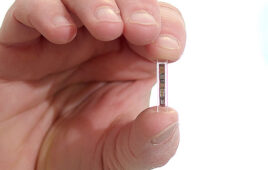
A photo of the Paradromics Connexus brain-computer interface on a fingertip.
How Paradromics designed its Connexus brain-computer interface system
An illustration of HITMAN operating in glioblastoma cells.
MIT researchers develop injectable nanodevices that remotely kill brain tumor cells
An illustration of CSF flow through the brain.
MIT researchers find pink noise can encourage CSF flow during sleep
A photo of Kitea Health's Kitea Sensor with fingers for scale.
Intracranial sensor maker says automated testing slashed firmware development time
“mdo
EXPAND YOUR KNOWLEDGE AND STAY CONNECTED
Get the latest medical device business news, application and technology trends.

DeviceTalks Weekly

See More >

MDO Digital Edition

Digital Edition

Subscribe to Medical Design & Outsourcing. Bookmark, share and interact with the leading medical design engineering magazine today.

MEDTECH 100 INDEX

Medtech 100 logo
Market Summary > Current Price
The MedTech 100 is a financial index calculated using the BIG100 companies covered in Medical Design and Outsourcing.

New MedTech Resource

Medical Tubing

MassDevice

Mass Device

The Medical Device Business Journal. MassDevice is the leading medical device news business journal telling the stories of the devices that save lives.

Visit Website
MDO ad
Medical Design and Outsourcing
  • MassDevice
  • DeviceTalks
  • MedTech100 Index
  • Medical Tubing + Extrusion
  • Medical Design Sourcing
  • Drug Delivery Business News
  • Drug Discovery & Development
  • Pharmaceutical Processing World
  • R&D World
  • About Us/Contact
  • Advertise With Us
  • Subscribe to Print Magazine
  • Subscribe to our E-Newsletter
  • Listen to our Weekly Podcasts
  • Join our DeviceTalks Tuesdays Discussion

Copyright © 2026 Arrowfly, LLC. All Rights Reserved. The material on this site may not be reproduced, distributed, transmitted, cached or otherwise used, except with the prior written permission of Arrowfly LLC. Site Map | Privacy Policy | RSS

Search Medical Design & Outsourcing

  • Home
  • Medical Device Business
    • Mergers & Acquisitions
    • Financial
    • Regulatory
  • Applications
    • Cardiovascular
    • Devices
    • Imaging
    • Implantables
    • Medical Equipment
    • Orthopedic
    • Surgical
  • Technologies
    • Supplies and Components Index
    • Contract Manufacturing
    • Components
    • Electronics
    • Extrusions
    • Materials
    • Motion Control
    • Prototyping
    • Pumps
    • Tubing
  • MedTech Resources
    • Medtech Events in 2026
    • The 2026 Medtech Big 100
    • Medical Device Handbook
    • MedTech 100 Index
    • Subscribe to Print Magazine
    • DeviceTalks
    • Digital Editions
    • eBooks
    • Educational Assets
    • Manufacturer Search
    • Podcasts
    • Webinars / Digital Events
    • Whitepapers
    • Voices
    • Views
    • Video
  • 2026 Leadership
    • 2025 Winners
    • 2024 Winners
    • 2023 Winners
    • 2022 Winners
    • 2021 Winners
  • Women in Medtech
  • Advertise
  • Subscribe