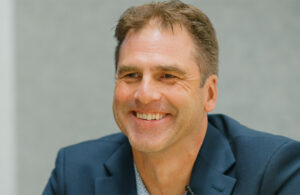
Sovato CEO Brian Miller [Photo by Cole Kistler for Medical Design & Outsourcing]
In a Medical Design & Outsourcing interview ahead of the announcement that he’s joined Sovato, Miller — who joined Sovato co-founder Yulun Wang’s Computer Motion as a software engineer in 2000, before it was acquired by Intuitive — identified the areas where he sees the most potential for remote medtech and his company’s plan to scale their platform and take telesurgery worldwide.
The following has been lightly edited for length and clarity.
MDO: Why do you believe now is the time for telesurgery?
Miller: “You need a strong problem to solve, you need technology that is ready, and need a market that can adopt it. … The problem to solve is there. You’ve got high variability in surgery. It is shocking when I’ve traveled around the globe to see the different results patients get depending on time of day, where they live, things like that. And then you’ve got a shortage of healthcare professionals that’s only going to get worse. So when you look at remote interventions and remote telesurgery, it is one of the strong answers for being able to overcome those barriers. You eliminate the barrier of having to be in the same location. You can take expertise that you may not have in a rural area, and you can get it on demand and immediately. The problem’s there to solve, the technology clearly works — it’s been demonstrated — and I think the market’s ready.”
Where do you see the biggest opportunities for telesurgery?
Miller: “There is a strong value in some of the diagnostic elements that are starting to emerge like ultrasound, some of the things where it may not be highly complex, but getting patients access to that care is a challenge. We’re looking at use cases and applications there that would be valuable. There is a strong telehealth and telepresence use case that is pervasive in the market right now, and while it doesn’t have as stringent requirements of a network like remote telesurgery does, the reliability and security to put the healthcare system in a position to be able to rely on it will be important as well.
“I think we’ll see a range of new applications enabled by robotic systems, where that enables some of the remote interaction and intervention, but I also see some of the existing applications folding onto the Sovato platform so it can be done in a way where they can do intelligent workforce planning and run their hospital because they can count on all of those remote capabilities being up at a very high availability. That’s how we see it evolving.
“Then at a point we will get into telesurgery. I’m a big believer that it’s going to add significant value, the ability for either two surgeons to collaborate during a procedure or maybe there’s a sub specialist who’s only at the flagship hospital in the city and when they need it out in a rural area, that individual can connect in and do a part of the procedure. Those use cases are pretty strong, and as med device companies go through the regulatory approval process, our goal is to have the Sovato platform ready and out there so these devices can plug in and immediately start working.”
When we most recently interviewed Sovato co-founder Cynthia Perazzo, she said your startup was working with device developers on regulatory submissions. Any update on timing you can offer?
Miller: “Timing is hard to tell. The conversations are going well. … The SRS telesurgery guideline meeting in February was a nice combination of med device, clinicians, regulators, legislators. At that meeting, it was really clear people were understanding the value of it, but also understanding the pathway, understanding the risk models and things that you had to deal with. I’m highly encouraged that people are viewing it in a way where there is a viable path forward. And I know several medtech companies are already on the pathway to get there.”
MassDevice: Learn more about the surgical robotics market with our free special report
How are you going to scale this telesurgery opportunity?

Sovato’s telesurgery platform is device-agnostic. [Photo courtesy of Sovato]
“When you start to look at scale, I never want to say anything’s easy, but Sovato’s platform has been built to be able to scale quickly. Starting off in an IDN (integrated delivery network) where they can really start to interface between their different locations, they’ll start to drive down the variability in surgery, leverage their expertise, all those other things. Then you start going between healthcare systems. Those things will be very easy for the Sovato platform to enable once you’ve got all the connectivity at the different IDNs. The cool part is as we see use cases that add value — we’ve got a strong set of them right now, and we’re going to work through those — other ones will emerge. If I’ve learned anything in my 26 years, it’s that you come out with a set of use cases and value that you believe is there, some of it’s right, some of it’s wrong, but then customers will tell you things you didn’t even think of. I imagine we’ll start to see those.
“We’re anticipating how to create this global telesurgery network where we can start to connect people in a range of ways, very secure and very reliable. At that point in time, the use case scale and the utilization will scale as well. So that’s how we’re going to proceed through it and strategies will harden as we get there.”
What are the big barriers to expanding access worldwide and how do you plan to overcome them?
Miller: “The technology is really not the challenge in this space. We’ve seen it, it works, you’ve got to do it right and you’ve got to be able to scale. But when you start to look at some of the other dynamics like credentialing, licensing, liability elements associated with surgery and reimbursement schemes — which is an important part of success — my background has shown those are very diverse, depending upon where you’re at and what you’re doing. Those are the things that are going to have to be navigated along with the regulatory pathway for the devices.
“Earlier this year I was in India, Japan, Taiwan and China, the EU, and this is one aspect when you start talking about remote interactions where we’ve got to think about this globally, because that’s part of the strong value proposition. It’s not you do it in the U.S., and then you transplant it to Europe, and then you transplant it to Asia. It’s a core part of the value. Those things are never easy, but I do see a willingness and a recognition to go in and talk about these things in a global sense. Sovato’s been spearheading a set of technical guidelines and clinical guidelines. The first pass at that was done, and then coming up this summer we’ll be heading to Hong Kong to make it much more international and bring other players in. Those kinds of efforts will start to bring things in alignment, but there will be specific things in each of the geographies that will have to be tackled to make it a success.”
Read more from our interview with Miller here: Robotics expert Brian Miller on product development, AI and what he learned at Intuitive



