Medical Design and Outsourcing

  • Home
  • Medical Device Business
    • Mergers & Acquisitions
    • Financial
    • Regulatory
  • Applications
    • Cardiovascular
    • Devices
    • Imaging
    • Implantables
    • Medical Equipment
    • Orthopedic
    • Surgical
  • Technologies
    • Supplies and Components Index
    • Contract Manufacturing
    • Components
    • Electronics
    • Extrusions
    • Materials
    • Motion Control
    • Prototyping
    • Pumps
    • Tubing
  • MedTech Resources
    • Medtech Events in 2026
    • The 2025 Medtech Big 100
    • Medical Device Handbook
    • MedTech 100 Index
    • Subscribe to Print Magazine
    • DeviceTalks
    • Digital Editions
    • eBooks
    • Educational Assets
    • Manufacturer Search
    • Podcasts
    • Webinars / Digital Events
    • Whitepapers
    • Voices
    • Views
    • Video
  • 2026 Leadership
    • 2025 Winners
    • 2024 Winners
    • 2023 Winners
    • 2022 Winners
    • 2021 Winners
  • Women in Medtech
  • Advertise
  • Subscribe

Imaging detects difference between depression and cognitive disorders

March 20, 2017 By Danielle Kirsh

Representative brain SPECT scans in a patient with Alzheimer’s dementia showing substantially reduced brain blood flow in the temporal and parietal lobes compared to a person with depression with mild decreased frontal lobe blood flow. [Image from Journal of Alzheimer’s Disease]

Researchers claim that single photon emission computed tomography (SPECT) imaging can accurately help differentiate between depression and cognitive disorders like dementia.

The study examined 4541 people in total — 847 with dementia, 3269 with depression and 425 with both. SPECT imaging measures the blood flow and activity in the brain and the researchers saw that people with cognitive disorders had reduced blood flow in the hippocampus, temporal and parietal lobes of the brain. With 86% accuracy, SPECT imaging could tell the difference from a cognitive disorder and depression. It can also distinguish depression or dementia in people with both conditions with 83% accuracy.

“This is a critical clinical question that has practical implications for patient management and treatment,” said Dr. Daniel G. Amen, lead researcher, psychiatrist, and director of the Amen Clinics, in a news release. “These disorders have very different prognoses and treatments and being able to improve diagnostic accuracy can improve outcomes for some patients.”

Amen has been a major proponent of SPECT over the years, though he has been criticized for being over-promotional.

Depression affects more than 300 million people worldwide, according to the World Health Organization. Other methods for diagnosing depression include a physical exam, blood tests or psychological evaluation, and a mental health professional may use information from the Diagnostic and Statistical Manual of Mental Disorders (DSM-5) to diagnose someone. Doctors also use the Beck’s Depression Inventory questionnaire that asks a patient to rate how they’re feeling on a scale of 0 to 3 on a variety of questions.

To diagnose a cognitive disorder, doctors look at the patient’s medical history, independent function and daily activities, consult a family member or friend, evaluate their mental status, perform a neurological exam, evaluate their mood and perform lab tests. The Alzheimer’s Association suggests that 15-20% of those who are 65 years or older may have some form of mild cognitive impairment.

The Beck’s Depression Inventory questionnaire makes it harder to tell the difference between someone with depression and someone with a cognitive disorder because the symptoms overlap, according to the study.

“One of the greatest new insights of the past decade is the linkage of depression to the psychology of late-life cognitive decline. Raji and coworkers extend the approach to the biological substrate by an elegant imaging approach. These studies further place brain aging on a firm biological basis,” said George Perry, PhD, editor-in-chief of the Journal of Alzheimer’s Disease and dean and professor of biology at the University of Texas at San Antonio.

The study was published online in the Journal of Alzheimer’s Disease.

[Want to stay more on top of MDO content? Subscribe to our weekly e-newsletter.]

About The Author

Danielle Kirsh

Danielle Kirsh is an award-winning journalist and senior editor for Medical Design & Outsourcing, MassDevice, and Medical Tubing + Extrusion, and the founder of Women in Medtech and lead editor for Big 100. She received her bachelor's degree in broadcast journalism and mass communication from Norfolk State University and is pursuing her master's in global strategic communications at the University of Florida. You can connect with her on Twitter and LinkedIn, or email her at [email protected].

Related Articles Read More >

A photo of J&J MedTech SVP and Global Head of Digital Shan Jegatheeswaran.
Where Johnson & Johnson sees opportunity in surgical intelligence
A close of of Medical 21's Maverics graft.
A surgeon’s prayer helped St. Jude Medical founder Manny Villafaña size his latest device
A photo of the Paradromics Connexus brain-computer interface on a fingertip.
How Paradromics designed its Connexus brain-computer interface system
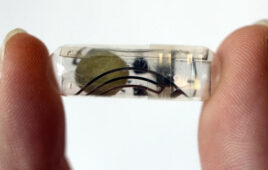
The 1.84 volt paper battery (brown circle structure) was tested in pigs with a bioabsorbable radio-frequency identification (RFID) device.
MIT researchers develop bioresorbable batteries for ingestible medical devices
“mdo
EXPAND YOUR KNOWLEDGE AND STAY CONNECTED
Get the latest medical device business news, application and technology trends.

DeviceTalks Weekly

See More >

MDO Digital Edition

Digital Edition

Subscribe to Medical Design & Outsourcing. Bookmark, share and interact with the leading medical design engineering magazine today.

MEDTECH 100 INDEX

Medtech 100 logo
Market Summary > Current Price
The MedTech 100 is a financial index calculated using the BIG100 companies covered in Medical Design and Outsourcing.

New MedTech Resource

Medical Tubing

MassDevice

Mass Device

The Medical Device Business Journal. MassDevice is the leading medical device news business journal telling the stories of the devices that save lives.

Visit Website
MDO ad
Medical Design and Outsourcing
  • MassDevice
  • DeviceTalks
  • MedTech100 Index
  • Medical Tubing + Extrusion
  • Medical Design Sourcing
  • Drug Delivery Business News
  • Drug Discovery & Development
  • Pharmaceutical Processing World
  • R&D World
  • About Us/Contact
  • Advertise With Us
  • Subscribe to Print Magazine
  • Subscribe to our E-Newsletter
  • Listen to our Weekly Podcasts
  • Join our DeviceTalks Tuesdays Discussion

Copyright © 2026 Arrowfly, LLC. All Rights Reserved. The material on this site may not be reproduced, distributed, transmitted, cached or otherwise used, except with the prior written permission of Arrowfly LLC. Site Map | Privacy Policy | RSS

Search Medical Design & Outsourcing

  • Home
  • Medical Device Business
    • Mergers & Acquisitions
    • Financial
    • Regulatory
  • Applications
    • Cardiovascular
    • Devices
    • Imaging
    • Implantables
    • Medical Equipment
    • Orthopedic
    • Surgical
  • Technologies
    • Supplies and Components Index
    • Contract Manufacturing
    • Components
    • Electronics
    • Extrusions
    • Materials
    • Motion Control
    • Prototyping
    • Pumps
    • Tubing
  • MedTech Resources
    • Medtech Events in 2026
    • The 2025 Medtech Big 100
    • Medical Device Handbook
    • MedTech 100 Index
    • Subscribe to Print Magazine
    • DeviceTalks
    • Digital Editions
    • eBooks
    • Educational Assets
    • Manufacturer Search
    • Podcasts
    • Webinars / Digital Events
    • Whitepapers
    • Voices
    • Views
    • Video
  • 2026 Leadership
    • 2025 Winners
    • 2024 Winners
    • 2023 Winners
    • 2022 Winners
    • 2021 Winners
  • Women in Medtech
  • Advertise
  • Subscribe