Medical Design and Outsourcing

  • Home
  • Medical Device Business
    • Mergers & Acquisitions
    • Financial
    • Regulatory
  • Applications
    • Cardiovascular
    • Devices
    • Imaging
    • Implantables
    • Medical Equipment
    • Orthopedic
    • Surgical
  • Technologies
    • Supplies and Components Index
    • Contract Manufacturing
    • Components
    • Electronics
    • Extrusions
    • Materials
    • Motion Control
    • Prototyping
    • Pumps
    • Tubing
  • MedTech Resources
    • Medtech Events in 2026
    • The 2025 Medtech Big 100
    • Medical Device Handbook
    • MedTech 100 Index
    • Subscribe to Print Magazine
    • DeviceTalks
    • Digital Editions
    • eBooks
    • Educational Assets
    • Manufacturer Search
    • Podcasts
    • Webinars / Digital Events
    • Whitepapers
    • Voices
    • Views
    • Video
  • 2026 Leadership
    • 2025 Winners
    • 2024 Winners
    • 2023 Winners
    • 2022 Winners
    • 2021 Winners
  • Women in Medtech
  • Advertise
  • Subscribe

Stem Cells Could Treat Sepsis-Damaged Muscles

December 15, 2015 By Institut Pasteur

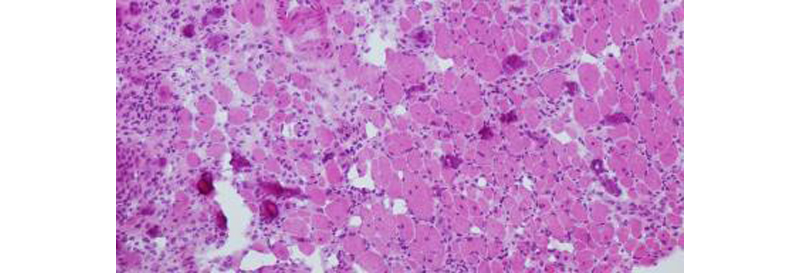
Muscle fibers are shown in pink. The lighter spaces between the fibers indicate defects in muscle regeneration. (Courtesy of Institut Pasteur)

Scientists from the Institut Pasteur, Paris Descartes University, Sainte-Anne Hospital and the CNRS have recently published a paper in Nature Communications in which they reveal mayor players in the severe muscle damage caused by sepsis, or septicemia, which explains why many patients suffer debilitating muscle impairment long-term after recovery. They propose a therapeutic approach based on mesenchymal stem cell transplantation, which has produced encouraging results and has proved successful in restoring muscle capacity in animals.

Sepsis is an inflammatory response by the entire body to severe infection. This disease, although poorly known by the general public, is actually quite common, affecting some 28 million people and claiming 8 million victims worldwide each year. In France, sepsis-related mortality stands at 27 percent, and for the more severe syndrome, septic shock, it can reach 50 percent. This rate is falling, however, as a result of progress in medicine, especially in intensive care – but surviving patients can suffer from severe impairment, particularly at neurological and muscular level, which can be highly debilitating and can prevent survivors from leading a normal active life in the long term. Estimations suggest that the number of cases of sepsis will double over the next fifty years, due in large part to population aging. Research into new therapeutic possibilities is therefore of major importance for public health.

To help shed further light on the significant loss of muscle capacity observed in patients, scientists from the Institut Pasteur’s Human Histopathology and Animal Models Unit, directed by Prof. Fabrice Chrétien , working together with the research group led by Miria Ricchetti in the Stem Cells and Development Unit (Institut Pasteur/CNRS), investigated the consequences of sepsis on muscle stem cells – known as satellite cells – which develop into muscles, particularly in the limbs. They observed a drastic fall in the mitochondrial mass of these stem cells in mice. Mitochondria are organelles which serve as the cell’s “powerhouse”: they produce the energy-rich ATP molecules which are required for all chemical reactions. The scientists demonstrated that following sepsis, the few remaining mitochondria provide satellite cells with just enough energy for their basic survival, but not enough for dividing and differentiating into muscle cells when required for muscle growth, repair and maintenance. This damage, which occurs at an early stage and has a long-term impact, prevents the organism from fully restoring muscle function, hence the persistent muscle impairment observed in patients.

This research led the scientists to explore the possibility of using mesenchymal stem cell transplantation as a potential avenue for therapy. Mesenchymal stem cells can be easily cultured in the laboratory and are known for their immunomodulatory properties, which makes them an excellent option for cell therapy transplants that aim to repair degenerative or traumatic lesions. Using a mouse model, Fabrice Chrétien and his team demonstrated that an intramuscular mesenchymal stem cell transplant carried out after septic shock resulted in a drop in the level of overall inflammation and related symptoms: fever, atony (loss of muscle tone), circulation of cytokines, inflammatory molecules, etc. A histological analysis performed after the transplant showed that the mesenchymal stem cells provided support for the damaged satellite cells without actually replacing them. The mesenchymal stem cells were then eliminated by the organism, with the transplant having successfully repaired the mitochondrial dysfunction and fully restored the metabolic and division capability of the satellite cells.

After these encouraging results, the scientists hope to be able to continue their investigation in humans. The first stage of their research, which should confirm whether the same tissue damage is observed in human patients, is due to begin shortly.
Related Articles Read More >

An image of the September 2026 Medical Design & Outsourcing magazine featuring the Medtech Big 100 ranking of the world's largest medical device companies.
September 2026 issue: The MDO Medtech Big 100 breaks $500 billion
A photo of Petal Surgical co-founder and CEO Prash Chopra.
Petal Surgical CEO Prash Chopra offers advice for device developers
An image of Claria's system for minimally invasive hysterectomies.
This de novo minimally invasive system was designed for safer hysterectomies
A photo of Capstan Medical CEO Maggie Nixon posing with the structural heart startup's robotic catheter delivery system.
Capstan Medical CEO Maggie Nixon’s career advice, travel tips and how she starts her day
“mdo
EXPAND YOUR KNOWLEDGE AND STAY CONNECTED
Get the latest medical device business news, application and technology trends.

DeviceTalks Weekly

See More >

MDO Digital Edition

Digital Edition

Subscribe to Medical Design & Outsourcing. Bookmark, share and interact with the leading medical design engineering magazine today.

MEDTECH 100 INDEX

Medtech 100 logo
Market Summary > Current Price
The MedTech 100 is a financial index calculated using the BIG100 companies covered in Medical Design and Outsourcing.

New MedTech Resource

Medical Tubing

MassDevice

Mass Device

The Medical Device Business Journal. MassDevice is the leading medical device news business journal telling the stories of the devices that save lives.

Visit Website
MDO ad
Medical Design and Outsourcing
  • MassDevice
  • DeviceTalks
  • MedTech100 Index
  • Medical Tubing + Extrusion
  • Medical Design Sourcing
  • Drug Delivery Business News
  • Drug Discovery & Development
  • Pharmaceutical Processing World
  • R&D World
  • About Us/Contact
  • Advertise With Us
  • Subscribe to Print Magazine
  • Subscribe to our E-Newsletter
  • Listen to our Weekly Podcasts
  • Join our DeviceTalks Tuesdays Discussion

Copyright © 2026 Arrowfly, LLC. All Rights Reserved. The material on this site may not be reproduced, distributed, transmitted, cached or otherwise used, except with the prior written permission of Arrowfly LLC. Site Map | Privacy Policy | RSS

Search Medical Design & Outsourcing

  • Home
  • Medical Device Business
    • Mergers & Acquisitions
    • Financial
    • Regulatory
  • Applications
    • Cardiovascular
    • Devices
    • Imaging
    • Implantables
    • Medical Equipment
    • Orthopedic
    • Surgical
  • Technologies
    • Supplies and Components Index
    • Contract Manufacturing
    • Components
    • Electronics
    • Extrusions
    • Materials
    • Motion Control
    • Prototyping
    • Pumps
    • Tubing
  • MedTech Resources
    • Medtech Events in 2026
    • The 2025 Medtech Big 100
    • Medical Device Handbook
    • MedTech 100 Index
    • Subscribe to Print Magazine
    • DeviceTalks
    • Digital Editions
    • eBooks
    • Educational Assets
    • Manufacturer Search
    • Podcasts
    • Webinars / Digital Events
    • Whitepapers
    • Voices
    • Views
    • Video
  • 2026 Leadership
    • 2025 Winners
    • 2024 Winners
    • 2023 Winners
    • 2022 Winners
    • 2021 Winners
  • Women in Medtech
  • Advertise
  • Subscribe