Medical Design and Outsourcing

  • Home
  • Medical Device Business
    • Mergers & Acquisitions
    • Financial
    • Regulatory
  • Applications
    • Cardiovascular
    • Devices
    • Imaging
    • Implantables
    • Medical Equipment
    • Orthopedic
    • Surgical
  • Technologies
    • Supplies and Components Index
    • Contract Manufacturing
    • Components
    • Electronics
    • Extrusions
    • Materials
    • Motion Control
    • Prototyping
    • Pumps
    • Tubing
  • MedTech Resources
    • Medtech Events in 2026
    • The 2026 Medtech Big 100
    • Medical Device Handbook
    • MedTech 100 Index
    • Subscribe to Print Magazine
    • DeviceTalks
    • Digital Editions
    • eBooks
    • Educational Assets
    • Manufacturer Search
    • Podcasts
    • Webinars / Digital Events
    • Whitepapers
    • Voices
    • Views
    • Video
  • 2026 Leadership
    • 2025 Winners
    • 2024 Winners
    • 2023 Winners
    • 2022 Winners
    • 2021 Winners
  • Women in Medtech
  • Advertise
  • Subscribe

Here’s what Steute Meditech learned from 20 years of making wireless footswitches

December 19, 2018 By Chris Newmarker

Steute Meditech pioneered the wireless footswitch in 1998. Here are some lessons learned along the way.

Maurizio Lauria, Steute Meditech 
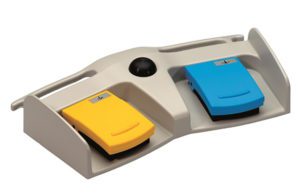
Steute Meditech footswitches

[Image courtesy of Steute Meditech]

Historically, medical device manufacturers who needed a foot control as a human interface used a cabled unit that plugged into the system console of the device. Until the late 1990s, a cabled unit was the only available option.

Although these cabled solutions proved acceptable, many OEMs recognized that the cable presented some limitations. For example, the cable made it difficult to store and/or clean the foot switch. It was also typically the single most frequent point of failure, and it posed a tripping hazard, especially in busy operating rooms.

These issues, combined with field experience and the proliferation of wireless equipment, led many medical device OEMs to wonder whether it was possible to eliminate the cable. Wireless operation became the most frequently requested feature on a Steute foot switch.

Even with all the initial interest, few of our OEM customers wanted to be the first to offer a wireless foot switch, due to concerns about the unknown including worldwide acceptability, the robustness of the wireless signal and interference with other wireless signals commonly found within an OR environment (i.e. WLAN, wireless computer accessories, etc.).

In 1998, Steute used its first wireless foot switch to control a medical imaging device. This switch used an infrared interface, the only suitable option at that time. Just two years later, Steute created a radio-frequency-based wireless foot switch to control an MRI system. Among the first lessons we learned was understanding the risk classification of the medical application and how to select a suitable wireless protocol to meet it and the functional system requirements. We also had to keep in mind the acceptable wireless protocol used in a specific geographic area.

Since these early days of wireless foot switches, Steute has evaluated several technologies, including ENOCEAN, DECT, WLAN, ZIGBEE and Bluetooth. They all had pros and cons; ultimately, Steute decided to create its own wireless protocol specifically for medical device applications. This proprietary protocol, called SW2.4(LE), is based on spread spectrum technology. By creating our own protocol, we were able to customize the software to carry enough data packets, and customize the best broadcasting algorithm to improve coexistence characteristics. It allowed us the freedom to meet the customer’s functional requirements.

Battery management was also a careful consideration. Various medical applications require different battery capacities. Some applications require a simple “on/off” function. The pedal is pressed or released, sending an “on” or “off” data packet signal. In this case, a simple primary battery may suffice. Other applications, such as for ophthalmology, require a battery that can power an electronic breaking system. These magnet-based breaks, which are often actuated, consume substantial battery power. In this case, a rechargeable Li-ion battery is better suited.

Other battery management considerations include the use of a sleep mode, which completely cuts off the foot switch communication to preserve battery life. Once the user presses the pedal or any other type of actuator, the foot switch “wakes up” and sends the command signal within 50-70 ms. This rapid response time is seamless to the user.

Lastly, one of the most important lessons we learned over the years was the need to work as partners with our customers, rather than having a typical supplier-customer relationship. It’s not realistic to build a one-size-fits-all wireless foot switch, because every medical device manufacturer has different interface requirements and receiver mounting locations.

For example, one medical OEM may require serial communication from the receiver to the medical device; another may request relay outputs. Some may wish to install the foot switch receiver inside the host medical device, while some may request an externally-mounted solution. It was important for Steute to learn about the medical application and how the system was being used in order to design and offer a safe and robust system that could easily interface with the host medical device.

In addition, Steute needed to offer supporting documentation to its customer base to allow them to comply with the numerous medical regulations. These included test certificates, test reports, component testing, etc. Working in a partnership was the only way to ensure a smooth development cycle and make life easier for the medical device manufacturer.

Maurizio Lauria has more than 18 years of application engineering and product management experience with Schmersal and Steute Meditech. He holds a B.E. in electrical engineering and B.S. in applied mathematics from Stony Brook University and an MBA from Marist College.


About The Author

Avatar photo
Chris Newmarker

Chris Newmarker is the executive editor of WTWH Media life science's news websites and publications including MassDevice, Medical Design & Outsourcing and more. A professional journalist of 18 years, he is a veteran of UBM (now Informa) and The Associated Press whose career has taken him from Ohio to Virginia, New Jersey and, most recently, Minnesota. He’s covered a wide variety of subjects, but his focus over the past decade has been business and technology. He holds bachelor’s degrees in journalism and political science from Ohio State University. Connect with him on LinkedIn or email at [email protected].

Related Articles Read More >

PE firm Vance Street merges medtech suppliers MRPC, PDC and Injectech
This is an Aerotech marketing image of tube laser processing.
How Aerotech’s new cylinder-lasering machine speeds medical device production
A photo of Multilumen medical tubing
An engineer’s perspective on medical tubing design
An X-ray CT scan of a Dexcom G7 continuous glucose monitor
Device scan: Look inside a Dexcom G7 CGM with an industrial X-ray CT scanner
“mdo
EXPAND YOUR KNOWLEDGE AND STAY CONNECTED
Get the latest medical device business news, application and technology trends.

DeviceTalks Weekly

See More >

MDO Digital Edition

Digital Edition

Subscribe to Medical Design & Outsourcing. Bookmark, share and interact with the leading medical design engineering magazine today.

MEDTECH 100 INDEX

Medtech 100 logo
Market Summary > Current Price
The MedTech 100 is a financial index calculated using the BIG100 companies covered in Medical Design and Outsourcing.

New MedTech Resource

Medical Tubing

MassDevice

Mass Device

The Medical Device Business Journal. MassDevice is the leading medical device news business journal telling the stories of the devices that save lives.

Visit Website
MDO ad
Medical Design and Outsourcing
  • MassDevice
  • DeviceTalks
  • MedTech100 Index
  • Medical Tubing + Extrusion
  • Medical Design Sourcing
  • Drug Delivery Business News
  • Drug Discovery & Development
  • Pharmaceutical Processing World
  • R&D World
  • About Us/Contact
  • Advertise With Us
  • Subscribe to Print Magazine
  • Subscribe to our E-Newsletter
  • Listen to our Weekly Podcasts
  • Join our DeviceTalks Tuesdays Discussion

Copyright © 2026 Arrowfly, LLC. All Rights Reserved. The material on this site may not be reproduced, distributed, transmitted, cached or otherwise used, except with the prior written permission of Arrowfly LLC. Site Map | Privacy Policy | RSS

Search Medical Design & Outsourcing

  • Home
  • Medical Device Business
    • Mergers & Acquisitions
    • Financial
    • Regulatory
  • Applications
    • Cardiovascular
    • Devices
    • Imaging
    • Implantables
    • Medical Equipment
    • Orthopedic
    • Surgical
  • Technologies
    • Supplies and Components Index
    • Contract Manufacturing
    • Components
    • Electronics
    • Extrusions
    • Materials
    • Motion Control
    • Prototyping
    • Pumps
    • Tubing
  • MedTech Resources
    • Medtech Events in 2026
    • The 2026 Medtech Big 100
    • Medical Device Handbook
    • MedTech 100 Index
    • Subscribe to Print Magazine
    • DeviceTalks
    • Digital Editions
    • eBooks
    • Educational Assets
    • Manufacturer Search
    • Podcasts
    • Webinars / Digital Events
    • Whitepapers
    • Voices
    • Views
    • Video
  • 2026 Leadership
    • 2025 Winners
    • 2024 Winners
    • 2023 Winners
    • 2022 Winners
    • 2021 Winners
  • Women in Medtech
  • Advertise
  • Subscribe