Medical Design and Outsourcing

  • Home
  • Medical Device Business
    • Mergers & Acquisitions
    • Financial
    • Regulatory
  • Applications
    • Cardiovascular
    • Devices
    • Imaging
    • Implantables
    • Medical Equipment
    • Orthopedic
    • Surgical
  • Technologies
    • Supplies and Components Index
    • Contract Manufacturing
    • Components
    • Electronics
    • Extrusions
    • Materials
    • Motion Control
    • Prototyping
    • Pumps
    • Tubing
  • MedTech Resources
    • Medtech Events in 2026
    • The 2026 Medtech Big 100
    • Medical Device Handbook
    • MedTech 100 Index
    • Subscribe to Print Magazine
    • DeviceTalks
    • Digital Editions
    • eBooks
    • Educational Assets
    • Manufacturer Search
    • Podcasts
    • Webinars / Digital Events
    • Whitepapers
    • Voices
    • Views
    • Video
  • 2026 Leadership
    • 2025 Winners
    • 2024 Winners
    • 2023 Winners
    • 2022 Winners
    • 2021 Winners
  • Women in Medtech
  • Advertise
  • Subscribe

Stick-On Patch Collects, Analyzes and Wirelessly Transmits a Variety of Health Metrics

August 14, 2017 By Phys.org

A research team led by Professor Kyung-In Jang of Robotics Engineering collects, analyzes and diagnoses bio-signals wirelessly transmitted to mobile application from the soft electronic skin. (Credit: DGIST)

A new, electronic skin microsystem tracks heart rate, respiration, muscle movement and other health data, and wirelessly transmits it to a smartphone. The electronic skin offers several improvements over existing trackers, including greater flexibility, smaller size, and the ability to stick the self-adhesive patch—which is a very soft silicone about four centimeters (1.5 inches) in diameter—just about anywhere on the body.

The microsystem was developed by an international team led by Kyung-In Jang, a professor of robotics engineering at South Korea’s Daegu Gyeongbuk Institute of Science and Technology, and John A. Rogers, the director of Northwestern University’s Center for Bio-Integrated Electronics. The team described the new device in the journal Nature Communications.

The electronic skin contains about 50 components connected by a network of 250 tiny wire coils embedded in protective silicone. The soft material enables it to conform to body, unlike other hard monitors. It wirelessly transmits data on movement and respiration, as well as electrical activity in the heart, muscles, eyes and brain to a smartphone application.

Unlike flat sensors, the tiny wires coils in this device are three-dimensional, which maximizes flexibility. The coils can stretch and contract like a spring without breaking. The coils and sensor components are also configured in an unusual spider web pattern that ensures “uniform and extreme levels of stretchability and bendability in any direction.” It also enables tighter packing of components, minimizing size. The researchers liken the design to a winding, curling vine, connecting sensors, circuits and radios like individual leaves on the vine.

Optical image of the 3-dimensional network of helical coils as electrical interconnects for soft electronics. (Credit: DGIST)

The key to creating this novel microsystem is stretching the elastic silicone base while the tiny wire arcs, made of gold, chromium and phosphate, are laid flat onto it. The arcs are firmly connected to the base only at one end of each arc. When the base is allowed to contract, the arcs pop up, forming three-dimensional coils.

The entire system is powered wirelessly rather than being charged by a battery. The researchers also considered key electrical and mechanical issues to optimize the system’s physical layout, such as sensor placement or wire length, to minimize signal interference and noise.

The electronic skin could be used in a variety of applications, including continuous health monitoring and disease treatment. Professor Jang states “Combining big data and artificial intelligence technologies, the wireless biosensors can be developed into an entire medical system which allows portable access to collection, storage, and analysis of health signals and information.” He added “We will continue further studies to develop electronic skins which can support interactive telemedicine and treatment systems for patients in blind areas for medical services such as rural houses in mountain village.” The microsystem could also be used in other areas of emerging interest, such as soft robotics or autonomous navigation, which the team is now investigating.

Assembly of 3D helical coils (right) geometrically imitating a structure of plant’s vine (left). (Credit: DGIST)


Related Articles Read More >

The most innovative medical devices of 2026
Reconstructed 3D fluorescence image of the stained biohybrid mesh-tissue integration. The red, green, and blue colors correspond to the mesh, F-actin, and nuclei, respectively.
Researchers mesh electronics with human cells to develop living battery
A photo of the Paradromics Connexus brain-computer interface on a fingertip.
How Paradromics designed its Connexus brain-computer interface system
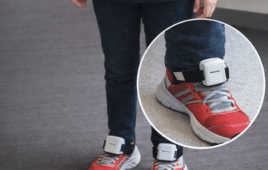
A photo of the wearable gait sensors used in the study.
Yale-led study finds wearable sensors match motion capture for gait tracking in knee osteoarthritis
“mdo
EXPAND YOUR KNOWLEDGE AND STAY CONNECTED
Get the latest medical device business news, application and technology trends.

DeviceTalks Weekly

See More >

MDO Digital Edition

Digital Edition

Subscribe to Medical Design & Outsourcing. Bookmark, share and interact with the leading medical design engineering magazine today.

MEDTECH 100 INDEX

Medtech 100 logo
Market Summary > Current Price
The MedTech 100 is a financial index calculated using the BIG100 companies covered in Medical Design and Outsourcing.

New MedTech Resource

Medical Tubing

MassDevice

Mass Device

The Medical Device Business Journal. MassDevice is the leading medical device news business journal telling the stories of the devices that save lives.

Visit Website
MDO ad
Medical Design and Outsourcing
  • MassDevice
  • DeviceTalks
  • MedTech100 Index
  • Medical Tubing + Extrusion
  • Medical Design Sourcing
  • Drug Delivery Business News
  • Drug Discovery & Development
  • Pharmaceutical Processing World
  • R&D World
  • About Us/Contact
  • Advertise With Us
  • Subscribe to Print Magazine
  • Subscribe to our E-Newsletter
  • Listen to our Weekly Podcasts
  • Join our DeviceTalks Tuesdays Discussion

Copyright © 2026 Arrowfly, LLC. All Rights Reserved. The material on this site may not be reproduced, distributed, transmitted, cached or otherwise used, except with the prior written permission of Arrowfly LLC. Site Map | Privacy Policy | RSS

Search Medical Design & Outsourcing

  • Home
  • Medical Device Business
    • Mergers & Acquisitions
    • Financial
    • Regulatory
  • Applications
    • Cardiovascular
    • Devices
    • Imaging
    • Implantables
    • Medical Equipment
    • Orthopedic
    • Surgical
  • Technologies
    • Supplies and Components Index
    • Contract Manufacturing
    • Components
    • Electronics
    • Extrusions
    • Materials
    • Motion Control
    • Prototyping
    • Pumps
    • Tubing
  • MedTech Resources
    • Medtech Events in 2026
    • The 2026 Medtech Big 100
    • Medical Device Handbook
    • MedTech 100 Index
    • Subscribe to Print Magazine
    • DeviceTalks
    • Digital Editions
    • eBooks
    • Educational Assets
    • Manufacturer Search
    • Podcasts
    • Webinars / Digital Events
    • Whitepapers
    • Voices
    • Views
    • Video
  • 2026 Leadership
    • 2025 Winners
    • 2024 Winners
    • 2023 Winners
    • 2022 Winners
    • 2021 Winners
  • Women in Medtech
  • Advertise
  • Subscribe