Medical Design and Outsourcing

  • Home
  • Medical Device Business
    • Mergers & Acquisitions
    • Financial
    • Regulatory
  • Applications
    • Cardiovascular
    • Devices
    • Imaging
    • Implantables
    • Medical Equipment
    • Orthopedic
    • Surgical
  • Technologies
    • Supplies and Components Index
    • Contract Manufacturing
    • Components
    • Electronics
    • Extrusions
    • Materials
    • Motion Control
    • Prototyping
    • Pumps
    • Tubing
  • MedTech Resources
    • Medtech Events in 2026
    • The 2026 Medtech Big 100
    • Medical Device Handbook
    • MedTech 100 Index
    • Subscribe to Print Magazine
    • DeviceTalks
    • Digital Editions
    • eBooks
    • Educational Assets
    • Manufacturer Search
    • Podcasts
    • Webinars / Digital Events
    • Whitepapers
    • Voices
    • Views
    • Video
  • 2026 Leadership
    • 2025 Winners
    • 2024 Winners
    • 2023 Winners
    • 2022 Winners
    • 2021 Winners
  • Women in Medtech
  • Advertise
  • Subscribe

Stimulating Brain Cells Stops Binge Drinking

January 6, 2014 By Ellen Goldbaum, University at Buffalo

Results suggest it may be possible to use gene therapy in the brain to treat substance abuse, neurological diseases and mental illnesses

Researchers at the University at Buffalo have found a way to change alcohol drinking behavior in rodents, using the emerging technique of optogenetics, which uses light to stimulate neurons.

Their work could lead to powerful new ways to treat alcoholism, other addictions, and neurological and mental illnesses; it also helps explain the underlying neurochemical basis of drug addiction.

The findings, published in November in Frontiers in Neuroscience, are the first to demonstrate a causal relationship between the release of dopamine in the brain and drinking behaviors of animals. Research like this, which makes it possible to map the neuronal circuits responsible for specific behaviors, is a major focus of President Obama’s Brain Research for Advancing Innovative Neurotechnologies initiative, known as BRAIN.

In the experiments, rats were trained to drink alcohol in a way that mimics human binge-drinking behavior.

First author Caroline E. Bass, PhD, assistant professor of pharmacology and toxicology in the UB School of Medicine and Biomedical Sciences explains:  “By stimulating certain dopamine neurons in a precise pattern, resulting in low but prolonged levels of dopamine release, we could prevent the rats from binging. The rats just flat out stopped drinking,” she says.

Bass’s co-authors are at Wake Forest University, where she worked previously.

Interestingly, the rodents continued to avoid alcohol even after the stimulation of neurons ended, she adds.

“For decades, we have observed that particular brain regions light up or become more active in an alcoholic when he or she drinks or looks at pictures of people drinking, for example, but we didn’t know if those changes in brain activity actually governed the alcoholic’s behavior,” says Bass.

The researchers activated the dopamine neurons through a type of deep brain stimulation, but unlike techniques now used to treat certain neurological disorders, such as severe tremors in Parkinson’s disease patients, this new technique, called optogenetics, uses light instead of electricity to stimulate neurons.

“Electrical stimulation doesn’t discriminate,” Bass explains. “It hits all the neurons, but the brain has many different kinds of neurons, with different neurotransmitters and different functions. Optogenetics allows you to stimulate only one type of neuron at a time.”

Bass specializes in using viral vectors to study the brain in substance abuse. In this study, she used a virus to introduce a gene encoding a light-responsive protein into the animals’ brains. That protein then activated a specific subpopulation of dopamine neurons in the brain’s reward system.

“I created a virus that will make this protein only in dopaminergic neurons,” Bass says.

The neuronal pathways affected in this research are involved in many neurological disorders, she says. For that reason, the results have application not only in understanding and treating alcohol-drinking behaviors in humans, but also in many devastating mental illnesses and neurological diseases that have a dopamine component.

Bass notes that this ability to target genes to dopamine neurons could potentially lead to the use of gene therapy in the brain to mitigate many of these disorders.

“We can target dopamine neurons in a part of the brain called the nigrostriatal pathway, which is what degenerates in Parkinson’s disease,” she says. “If we could infuse a viral vector into that part of the brain, we could target potentially therapeutic genes to the dopamine neurons involved in Parkinson’s. And by infusing the virus into other areas of the brain, we could potentially deliver therapeutic genes to treat other neurological diseases and mental illnesses, including schizophrenia and depression.”

Bass’s co-authors are Evgeny Budygin, Valentina P. Grinevich, Dominic Gioia, Jonathan D. Day-Brown, Keith D. Bonin and Jeff Weiner, all of Wake Forest Baptist Medical Center, and Garret D. Stuber of the University of North Carolina Neuroscience Center.

The research was funded by the National Institutes of Health.

Related Articles Read More >

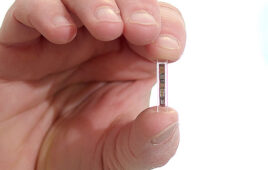
A photo of the Paradromics Connexus brain-computer interface on a fingertip.
How Paradromics designed its Connexus brain-computer interface system
An illustration of HITMAN operating in glioblastoma cells.
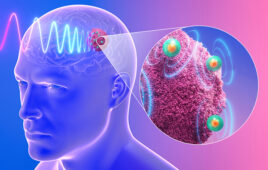
MIT researchers develop injectable nanodevices that remotely kill brain tumor cells
An illustration of CSF flow through the brain.
MIT researchers find pink noise can encourage CSF flow during sleep
A photo of Kitea Health's Kitea Sensor with fingers for scale.
Intracranial sensor maker says automated testing slashed firmware development time
“mdo
EXPAND YOUR KNOWLEDGE AND STAY CONNECTED
Get the latest medical device business news, application and technology trends.

DeviceTalks Weekly

See More >

MDO Digital Edition

Digital Edition

Subscribe to Medical Design & Outsourcing. Bookmark, share and interact with the leading medical design engineering magazine today.

MEDTECH 100 INDEX

Medtech 100 logo
Market Summary > Current Price
The MedTech 100 is a financial index calculated using the BIG100 companies covered in Medical Design and Outsourcing.

New MedTech Resource

Medical Tubing

MassDevice

Mass Device

The Medical Device Business Journal. MassDevice is the leading medical device news business journal telling the stories of the devices that save lives.

Visit Website
MDO ad
Medical Design and Outsourcing
  • MassDevice
  • DeviceTalks
  • MedTech100 Index
  • Medical Tubing + Extrusion
  • Medical Design Sourcing
  • Drug Delivery Business News
  • Drug Discovery & Development
  • Pharmaceutical Processing World
  • R&D World
  • About Us/Contact
  • Advertise With Us
  • Subscribe to Print Magazine
  • Subscribe to our E-Newsletter
  • Listen to our Weekly Podcasts
  • Join our DeviceTalks Tuesdays Discussion

Copyright © 2026 Arrowfly, LLC. All Rights Reserved. The material on this site may not be reproduced, distributed, transmitted, cached or otherwise used, except with the prior written permission of Arrowfly LLC. Site Map | Privacy Policy | RSS

Search Medical Design & Outsourcing

  • Home
  • Medical Device Business
    • Mergers & Acquisitions
    • Financial
    • Regulatory
  • Applications
    • Cardiovascular
    • Devices
    • Imaging
    • Implantables
    • Medical Equipment
    • Orthopedic
    • Surgical
  • Technologies
    • Supplies and Components Index
    • Contract Manufacturing
    • Components
    • Electronics
    • Extrusions
    • Materials
    • Motion Control
    • Prototyping
    • Pumps
    • Tubing
  • MedTech Resources
    • Medtech Events in 2026
    • The 2026 Medtech Big 100
    • Medical Device Handbook
    • MedTech 100 Index
    • Subscribe to Print Magazine
    • DeviceTalks
    • Digital Editions
    • eBooks
    • Educational Assets
    • Manufacturer Search
    • Podcasts
    • Webinars / Digital Events
    • Whitepapers
    • Voices
    • Views
    • Video
  • 2026 Leadership
    • 2025 Winners
    • 2024 Winners
    • 2023 Winners
    • 2022 Winners
    • 2021 Winners
  • Women in Medtech
  • Advertise
  • Subscribe