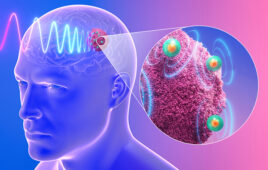
One of the treatments for managing Parkinson’s Disease is to use deep electrical brain stimulation to relieve debilitating symptoms like muscle stiffness and tremors.
But it’s a daunting procedure. Surgeons must cut into the skull to expose the brain and stimulate it directly. Unsurprisingly, this kind of open brain surgery carries with it a long list of risks, including brain trauma.
What if the brain could be stimulated without having to drill a hole in patients’ skulls?
A team of Melbourne based researchers have been working on a replacement for open brain surgery since 2012, inventing a stimulation device that can be implanted in blood vessels next to the brain’s motor cortex, in a minimally invasive procedure involving a small ‘keyhole’ incision in the neck.
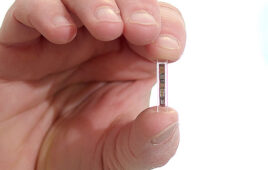
The device, called a Stentrode™, measures just 4mm in diameter and is made from a strong but very flexible alloy called nitinol.
In 2016 the team, which includes researchers from the University of Melbourne, Florey Institute of Neuroscience and Mental Health, The Royal Melbourne Hospital and Synchron Australia, demonstrated that the Stentrode™ can record neural signals in the brain.
Now, they have shown the same device can not only ‘listen’ to brain signals, but also ‘talk back’ – delivering currents directly to targeted areas of the brain, known as ‘focal brain stimulation’. The results are published in Nature Biomedical Engineering.
“We were able to not just passively record, but also deliver currents through the device to cause muscle movement,” says lead researcher Dr Nick Opie from the University of Melbourne’s Vascular Bionics Laboratory.
The proof-of-concept discovery is the first time this kind of brain stimulation has been achieved using a device permanently implanted inside a blood vessel, instead of through invasive direct brain stimulation.
Dr Opie believes the range of potential applications is huge.
“There are probably ways the technology could be used that we haven’t even thought of, yet, so we’re really keen to hear from clinicians on their ideas,” he says.
“Some of the obvious applications include offering an alternative to the deep brain stimulation that is currently used to treat Parkinson’s symptoms, and also as a replacement for some drugs in treating certain kinds of epilepsy.”
Deep brain stimulation is also used in some instances to treat serious mental illnesses like major depression, and the team are optimistic that Stentrode™ could offer these patients a less invasive alternative too.
Because it has now been shown to manage two-way communication, essentially acting as a feedback loop within the brain, the device also has potential applications for helping people with spinal cord injuries control prosthetic limbs with their brain.
“We can now target both the motor cortex (responsible for planning, control and execution of movements) and the sensory cortex (which receives feedback about actions) with one device,” says Dr Opie.
“This means we could, for example, help spinal cord patients use a prosthetic arm by commanding it to grab an item, and then providing feedback on that action so they don’t grab it too hard or too soft.”
The Stentrode™ is positioned using a minimally-invasive surgical technique. Surgeons use a microwire and a microcatheter to deploy it at the desired location, guided by ‘contrast angiography’ – a special x-ray technique that allows doctors to see inside blood vessels.
Once in place, it is operated wirelessly.
“We implanted the device over the motor cortex on the top of the brain, in a small vessel just under the skull,” says Dr Opie.
“The electrodes were positioned along the Stentrode, adjacent to different regions of the brain. By delivering current through these electrodes, we were able to stimulate different brain regions and observe different responses.”
The team observed focused muscle movements in response to the device being stimulated, like twitches in the neck, lip and eyes.
Their next step is to investigate the parameters for stimulation, to discover the lowest possible current the device requires and make it as safe as possible, before progressing to human trials.
“We have a lot of work to do in fine-tuning the parameters,” says Dr Opie. “And these will vary depending on how the device is being used.”
While the researchers are planning on conducting a clinical trial early next year to help paralysed people regain movement by enabling them to operate a wheelchair or even an exoskeleton with a Stentrode™ designed to record brain activity, the ultimate goal is to combine this with the ability to stimulate the brain.
“I am excited to see our technology enhance the quality of someone’s life” says Dr Opie.