Medical Design and Outsourcing

  • Home
  • Medical Device Business
    • Mergers & Acquisitions
    • Financial
    • Regulatory
  • Applications
    • Cardiovascular
    • Devices
    • Imaging
    • Implantables
    • Medical Equipment
    • Orthopedic
    • Surgical
  • Technologies
    • Supplies and Components Index
    • Contract Manufacturing
    • Components
    • Electronics
    • Extrusions
    • Materials
    • Motion Control
    • Prototyping
    • Pumps
    • Tubing
  • MedTech Resources
    • Medtech Events in 2026
    • The 2026 Medtech Big 100
    • Medical Device Handbook
    • MedTech 100 Index
    • Subscribe to Print Magazine
    • DeviceTalks
    • Digital Editions
    • eBooks
    • Educational Assets
    • Manufacturer Search
    • Podcasts
    • Webinars / Digital Events
    • Whitepapers
    • Voices
    • Views
    • Video
  • 2026 Leadership
    • 2025 Winners
    • 2024 Winners
    • 2023 Winners
    • 2022 Winners
    • 2021 Winners
  • Women in Medtech
  • Advertise
  • Subscribe

Subsense is developing inhalable BCI nanoparticles for brain signal sensing and neurostimulation

September 4, 2025 By Jim Hammerand

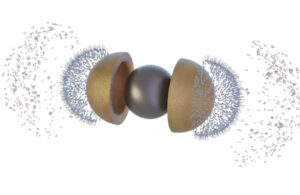
An illustration of nanoparticles under development by BCI developer Subsense.

Subsense is developing inhalable plasmonic nanoparticles for brain signal sensing and magnetoelectric nanoparticles for neurostimulation. [Illustration courtesy of Subsense]

Neurotech developer Subsense is developing technology that might become the first nonsurgical, nanoparticle-based bidirectional brain-computer interface (BCI).

It would be a big leap forward for the BCI space, where device developers like Synchron and Neuralink are testing their implants in paralyzed patients. But those systems are implanted on the brain surgically. Neuralink requires a craniotomy, while Synchron takes a minimally-invasive vascular approach.

Subsense CEO Tetiana Aleksandrova co-founded the company with Golden Falcon Capital Founder And General Partner Artem Sokolov, emerging from stealth mode in February and collaborating with researchers at UC Santa Cruz and ETH Zurich.

They hope to one day help patients with Parkinson’s, Alzheimer’s, epilepsy, depression, strokes, chronic pain and more before expanding the technology to healthy patients who might, for example, want to connect their minds directly to artificial intelligence.

“We see our company as a platform, as a solution that will allow other companies and entrepreneurs — future entrepreneurs — to build their application based on these nanoparticles,” Aleksandrova told DeviceTalks Editorial Director Tom Salemi in a DeviceTalks interview.

DeviceTalks West: Aleksandrova is set to speak on a neurotech panel featuring synchron and Cognito Therapeutics  in Santa Clara, California Oct. 15-16. Registration is now open here. Here’s a 25% off discount code: MDO25OFF

Subsense says those applications could include “sensorimotor recovery of vision, hearing and movement; inner speech decoding and thought translation; integration with AI by merging brain and artificial neural networks; external memory as an instant backup and extended capacity; mental health regulation – happiness monitoring and control; [and] appetite control – identification and managing of regulatory mechanisms.”

Related: BCI basics with Synchron co-founder and CEO Dr. Tom Oxley

How Subsense’s technology is designed to work

Subsense is developing nanoparticles that would be inhaled via the nasal cavity and delivered to the brain’s olfactory bulb, then steered magnetically to their specific targets within the brain, depending on the application.

“It’s important to understand that it’s two types of nanoparticles — completely different — and they’re not interfering with each other at all,” Aleksandrova said. “The first type of nanoparticles is plasmonic nanoparticles. We use these nanoparticles for neural reading. … It’s gold nanoparticles covered with electrochromic polymer.”
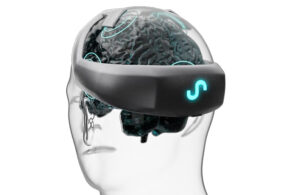
An illustration of Subsense's wearable headset for brain signal sensing and neurostimulation.

Subsense patients would wear a headset that emits near-infrared light to sense brain signals and magnetic fields to deliver neurostimulation. [Illustration courtesy of Subsense]

A user would wear a small, portable headset that emits near infrared light and reads light reflected back at a certain frequency associated with neuron activity.

“The frequency is changing on this nanoparticle, so that’s how we know in a certain area there is the activation in the brain,” she said.

The second type of nanoparticles are magnetoelectric for neurostimulation. The wearable headset would also generate magnetic fields to generate piezoelectricity in those nanoparticles.

“When we affect nanoparticles with magnetic fields, the nanoparticles are deforming,” she said. “And when they are deforming, they produce electricity and affect the neurons around them. … That’s how we can both read and stimulate the neurons in the brain.”

These nanoparticles are temporary and can be tuned to last for days or weeks, with Subsense focusing on a range of 20 to 60 days. The company’s biocompatibility studies are “all good” so far, Aleksandrova said.

But there are limitations that mean this technology will likely complement other BCIs rather than compete against them. One example is Subsense’s neuro reading depth, she said, which so far can’t go deeper than 4 cm.

“Some medical applications will be executed much better with the traditional approach than with ours,” she said. “… Maybe it’s bold to say, but 80%, maybe 70% of something that already is executing, we can cover it better … because of the nonsurgical approach.”

What’s next for Subsense

A photo of Subsense co-founder and CEO Tetiana Aleksandrova.

Subsense co-founder and CEO Tetiana Aleksandrova [Photo courtesy of Subsense]

The company anticipates research and nanoparticle development to continue through 2026, with biocompatibility and safety assessment completed by 2028. A regulatory submission would soon follow, with regulatory approval sometime by 2031.

Within 18 months, Aleksandrova hopes her team can demonstrate the technology can be used to read brain signals in mice, stimulate their brains and treat a symptom of either Parkinson’s or epilepsy before moving on to other neurodegenerative diseases.

“It’s a moonshot,” Aleksandrova said. “That word, moonshot, you can hear it in our company almost every day. … Our North Star is to create a safe, efficient brain computer interface for healthy individuals to merge technology and the brain.”


About The Author

Jim Hammerand

Jim Hammerand is the managing editor of Arrowfly's Medical Design & Outsourcing, where he leads coverage of medtech innovation, design, engineering and manufacturing. He also reports breaking news at Arrowfly's MassDevice and contributes to our DeviceTalks podcasts and live events. Hammerand has more than two decades of journalism experience spanning newspapers, magazines, websites, live events, radio and TV news. For nearly a decade, Hammerand reported and edited business news for American City Business Journals as a reporter and digital editor at the Minneapolis/St. Paul Business Journal and then as managing editor of the Puget Sound Business Journal in Seattle. He holds degrees in journalism and management from the University of Minnesota and has won journalism awards from the Society of Professional Journalists, American Society of Business Publication Editors, and Trade, Association, Business Publications International. Connect with him on LinkedIn or by email at [email protected].

Related Articles Read More >

The most innovative medical devices of 2026
A photo of PTFE coating delamination.
Passing the tape test doesn’t mean your coating is reliable
An illustration showing Corcym's Memo 4D Curve's laser-cut nitinol core.
Laser-cut nitinol and a layered design let these cardiac implants flex
A photo of J&J MedTech SVP and Global Head of Digital Shan Jegatheeswaran.
Where Johnson & Johnson sees opportunity in surgical intelligence
“mdo
EXPAND YOUR KNOWLEDGE AND STAY CONNECTED
Get the latest medical device business news, application and technology trends.

DeviceTalks Weekly

See More >

MDO Digital Edition

Digital Edition

Subscribe to Medical Design & Outsourcing. Bookmark, share and interact with the leading medical design engineering magazine today.

MEDTECH 100 INDEX

Medtech 100 logo
Market Summary > Current Price
The MedTech 100 is a financial index calculated using the BIG100 companies covered in Medical Design and Outsourcing.

New MedTech Resource

Medical Tubing

MassDevice

Mass Device

The Medical Device Business Journal. MassDevice is the leading medical device news business journal telling the stories of the devices that save lives.

Visit Website
MDO ad
Medical Design and Outsourcing
  • MassDevice
  • DeviceTalks
  • MedTech100 Index
  • Medical Tubing + Extrusion
  • Medical Design Sourcing
  • Drug Delivery Business News
  • Drug Discovery & Development
  • Pharmaceutical Processing World
  • R&D World
  • About Us/Contact
  • Advertise With Us
  • Subscribe to Print Magazine
  • Subscribe to our E-Newsletter
  • Listen to our Weekly Podcasts
  • Join our DeviceTalks Tuesdays Discussion

Copyright © 2026 Arrowfly, LLC. All Rights Reserved. The material on this site may not be reproduced, distributed, transmitted, cached or otherwise used, except with the prior written permission of Arrowfly LLC. Site Map | Privacy Policy | RSS

Search Medical Design & Outsourcing

  • Home
  • Medical Device Business
    • Mergers & Acquisitions
    • Financial
    • Regulatory
  • Applications
    • Cardiovascular
    • Devices
    • Imaging
    • Implantables
    • Medical Equipment
    • Orthopedic
    • Surgical
  • Technologies
    • Supplies and Components Index
    • Contract Manufacturing
    • Components
    • Electronics
    • Extrusions
    • Materials
    • Motion Control
    • Prototyping
    • Pumps
    • Tubing
  • MedTech Resources
    • Medtech Events in 2026
    • The 2026 Medtech Big 100
    • Medical Device Handbook
    • MedTech 100 Index
    • Subscribe to Print Magazine
    • DeviceTalks
    • Digital Editions
    • eBooks
    • Educational Assets
    • Manufacturer Search
    • Podcasts
    • Webinars / Digital Events
    • Whitepapers
    • Voices
    • Views
    • Video
  • 2026 Leadership
    • 2025 Winners
    • 2024 Winners
    • 2023 Winners
    • 2022 Winners
    • 2021 Winners
  • Women in Medtech
  • Advertise
  • Subscribe