By Aaron Zimmerman, Trelleborg Medical Solutions
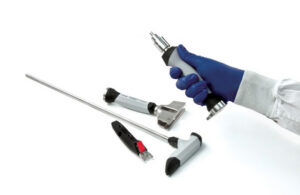
Surgical instrument overmolding requires technical knowledge, material expertise and precision, but also intangible know-how and the finesse of a craftsperson.
[Image courtesy of Trelleborg Medical Solutions]
The tolerances are tight, the quality standards are uncompromising, and the consequences of failure are serious. However, the real expertise is in the judgment calls, hands-on adjustments and experience that tells you something isn’t right before a measurement confirms it.
The bond is everything
The most critical challenge in overmolding surgical instruments is bond integrity. If the bond between the polymer handle and the metal substrate fails, you get microscopic gaps that harbor bacteria even after sterilization. In a reusable instrument that goes through multiple autoclave cycles, a compromised bond is a patient safety risk.
A multi-stage surface preparation sequence is the best option for success: media blasting to mechanically roughen the substrate, plasma etching to activate the surface at a molecular level, and chemical primers targeted to the specific material combination being bonded.
Without these steps, silicone will not adhere to stainless steel. Getting this right requires masking precision. You’re protecting the areas of the instrument you don’t want primed while ensuring full coverage on the bonding surfaces. This requires part-specific fixturing that can adapt to insert variation.
Material choices that match the application
Most of our instruments use medical-grade silicone. It withstands repeated autoclave sterilization, offers excellent grip characteristics and remains stable across a wide temperature range. But the material selection isn’t always that simple.
Silicone comes in varieties: peroxide-cured, platinum-cured, self-bonding and standard non-self-bonding grades. Each behaves differently in the mold and interacts differently with different substrates. We work with all of them, which means our operators need to understand the material science behind what they’re processing.
We also work with thermoplastic elastomers and thermoplastic polyurethane for certain applications, and we bond onto substrates including stainless steel, titanium and aluminum. The substrate material affects how we approach surface preparation, how aggressive the blasting needs to be and which primer chemistry will provide the correct bond strength. These decisions come from years of development work and refined process controls.
The case for vertical transfer molding
Many people in this industry default to injection molding because it’s precise, fast and scales well for high volumes. But vertical transfer molding is best for surgical instrument overmolding because manufacturers like us run a high-mix, low-volume operation.
Some parts run at 50 units a year, some at a few thousand. Our highest-volume part runs around 6,000 annually. With that kind of variability, changeovers happen constantly. Injection molding in that environment would mean extensive downtime, complex purging between materials and significant risk of cross-contamination between color runs or material types.
Transfer molding gives us the control and flexibility we need. We’ve engineered molds so the grip geometry stays constant while the working-end can be modified. A customer can add new instruments to an existing tool with a relatively minor changeover time without needing to invest in entirely new tooling.
Where craftsmanship meets process discipline
One of the things that defines a superior product outcome is the combination of rigorous process documentation and hands-on operator expertise.
Operators should work from detailed instructions that specify time, temperature and pressure parameters. Those documents capture accumulated knowledge and get updated when a process improvement is made or when a customer specification changes.
But documentation can’t fully capture an operator’s instinct to spot a part that is off before it reaches final inspection, their judgment to sense when a mold needs attention, and experience to adapt when a batch of material behaves differently than the last.
We do 100% inspection on overmolded parts. We’ve built a rework loop into the process so that if a part fails inspection, it goes back through rather than going to scrap. The result is near-100 percent utilization of customer-supplied inserts.
The standard that drives everything

Trelleborg Medical Solutions Engineering Manager Aaron Zimmerman. [Photo courtesy of Trelleborg Medical Solutions]
The steps taken to ensure these instruments perform correctly require technical knowledge, material expertise and precision, but also intangible know-how and the finesse of a craftsperson.
Aaron Zimmerman is an engineering manager at Trelleborg Medical Solutions.
Read more MDO Contributions and learn how to submit your own.
The opinions expressed in this blog post are the author’s only and do not necessarily reflect those of Medical Design & Outsourcing or its employees.