Medical Design and Outsourcing

  • Home
  • Medical Device Business
    • Mergers & Acquisitions
    • Financial
    • Regulatory
  • Applications
    • Cardiovascular
    • Devices
    • Imaging
    • Implantables
    • Medical Equipment
    • Orthopedic
    • Surgical
  • Technologies
    • Supplies and Components Index
    • Contract Manufacturing
    • Components
    • Electronics
    • Extrusions
    • Materials
    • Motion Control
    • Prototyping
    • Pumps
    • Tubing
  • MedTech Resources
    • Medtech Events in 2026
    • The 2025 Medtech Big 100
    • Medical Device Handbook
    • MedTech 100 Index
    • Subscribe to Print Magazine
    • DeviceTalks
    • Digital Editions
    • eBooks
    • Educational Assets
    • Manufacturer Search
    • Podcasts
    • Webinars / Digital Events
    • Whitepapers
    • Voices
    • Views
    • Video
  • 2026 Leadership
    • 2025 Winners
    • 2024 Winners
    • 2023 Winners
    • 2022 Winners
    • 2021 Winners
  • Women in Medtech
  • Advertise
  • Subscribe

This sweat-powered biofuel cell could create better wearable devices

September 21, 2017 By Danielle Kirsh

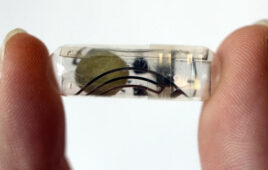
sweat-powered biofuel cell University of California San Diego

[Image from UC San Diego]

Engineers at the University of California at San Diego have created a stretchable sweat-powered biofuel cell, and it could enable better wearables.

The biofuel cells use energy from sweat to generate 10 times more power per surface area than other biofuel cells that are used in wearables. The researchers claim it could be used to power a variety of wearable devices.

Using lithography and screen printing, engineers created a stretchable electronic foundation that was a 3D carbon nanotube-based cathode and anode arrays.

The epidermal biofuel cells have an enzyme that can oxidize the lactic acid in sweat and use that to generate electricity. The researchers were able to test the fuel cell and power an LED light while a person wore it during exercise.

To make the biofuel cells compatible with wearable devices, the team of engineers, led by the director of the Center for Wearable Sensors at UC San Diego Joseph Wang, used a bridge and island structure to make the biofuel cells flexible and stretchable. The structure consists of rows of dots that are connected by spring-shaped structures. Half of the dots are anode, and the other half are cathode. The spring-like structures between the dots are able to stretch and bend without breaking or deforming the anode and cathode.

The islands and bridges were made using lithography and are made of gold. The researchers then used screen printing to put layers of biofuel materials on top of anode and cathode dots.

The engineers on the project were then challenged with determining how much energy the biofuel cell could create per surface area. The more energy generated, the more powerful they cells can be.

“We needed to figure out the best combination of materials to use and in what ratio to use them,” Amy Bandodkar, the paper’s first author, said in a press release.

Engineers screen printed a 3D carbon nanostructure on top of the anodes and cathodes to increase power density. Each anodic dot could then be loaded with more of the enzyme and silver oxide at the cathode dots. The tubes could also transfer electrons easier to improve biofuel cell performance.

When the biofuel cell was created, the researchers connected it to a custom-made circuit board that was a DC/DC converter and could even out the power created by the fuel cells. The power generated tends to fluctuate when powered by sweat because the amount of sweat a user produces can vary. The evened out power was turned into constant power with a constant voltage.

Four people wore the biofuel cell-board combination and exercised on a stationary bike. Each of the participants were able to power a blue LED light for four minutes.

Now the researchers plan to find a more stable solution for silver oxide, which tends to degrade over time and is light sensitive. They also plan to find a way to store energy that is produced because sweat becomes diluted over time.

The research was published online in the journal Energy and Environmental Science.

(Learn from some of the medical device industry’s top executives and experts at DeviceTalks Boston on Oct. 2.)

About The Author

Danielle Kirsh

Danielle Kirsh is an award-winning journalist and senior editor for Medical Design & Outsourcing, MassDevice, and Medical Tubing + Extrusion, and the founder of Women in Medtech and lead editor for Big 100. She received her bachelor's degree in broadcast journalism and mass communication from Norfolk State University and is pursuing her master's in global strategic communications at the University of Florida. You can connect with her on Twitter and LinkedIn, or email her at [email protected].

Related Articles Read More >

A photo of the Paradromics Connexus brain-computer interface on a fingertip.
How Paradromics designed its Connexus brain-computer interface system
The 1.84 volt paper battery (brown circle structure) was tested in pigs with a bioabsorbable radio-frequency identification (RFID) device.
MIT researchers develop bioresorbable batteries for ingestible medical devices
An illustration of HITMAN operating in glioblastoma cells.
MIT researchers develop injectable nanodevices that remotely kill brain tumor cells
A photo of Becton, Dickinson and Co. Advanced Patient Monitoring Worldwide President Tim Patz.
A continuous monitoring medtech vet charts the course to a less-invasive future
“mdo
EXPAND YOUR KNOWLEDGE AND STAY CONNECTED
Get the latest medical device business news, application and technology trends.

DeviceTalks Weekly

See More >

MDO Digital Edition

Digital Edition

Subscribe to Medical Design & Outsourcing. Bookmark, share and interact with the leading medical design engineering magazine today.

MEDTECH 100 INDEX

Medtech 100 logo
Market Summary > Current Price
The MedTech 100 is a financial index calculated using the BIG100 companies covered in Medical Design and Outsourcing.

New MedTech Resource

Medical Tubing

MassDevice

Mass Device

The Medical Device Business Journal. MassDevice is the leading medical device news business journal telling the stories of the devices that save lives.

Visit Website
MDO ad
Medical Design and Outsourcing
  • MassDevice
  • DeviceTalks
  • MedTech100 Index
  • Medical Tubing + Extrusion
  • Medical Design Sourcing
  • Drug Delivery Business News
  • Drug Discovery & Development
  • Pharmaceutical Processing World
  • R&D World
  • About Us/Contact
  • Advertise With Us
  • Subscribe to Print Magazine
  • Subscribe to our E-Newsletter
  • Listen to our Weekly Podcasts
  • Join our DeviceTalks Tuesdays Discussion

Copyright © 2026 Arrowfly, LLC. All Rights Reserved. The material on this site may not be reproduced, distributed, transmitted, cached or otherwise used, except with the prior written permission of Arrowfly LLC. Site Map | Privacy Policy | RSS

Search Medical Design & Outsourcing

  • Home
  • Medical Device Business
    • Mergers & Acquisitions
    • Financial
    • Regulatory
  • Applications
    • Cardiovascular
    • Devices
    • Imaging
    • Implantables
    • Medical Equipment
    • Orthopedic
    • Surgical
  • Technologies
    • Supplies and Components Index
    • Contract Manufacturing
    • Components
    • Electronics
    • Extrusions
    • Materials
    • Motion Control
    • Prototyping
    • Pumps
    • Tubing
  • MedTech Resources
    • Medtech Events in 2026
    • The 2025 Medtech Big 100
    • Medical Device Handbook
    • MedTech 100 Index
    • Subscribe to Print Magazine
    • DeviceTalks
    • Digital Editions
    • eBooks
    • Educational Assets
    • Manufacturer Search
    • Podcasts
    • Webinars / Digital Events
    • Whitepapers
    • Voices
    • Views
    • Video
  • 2026 Leadership
    • 2025 Winners
    • 2024 Winners
    • 2023 Winners
    • 2022 Winners
    • 2021 Winners
  • Women in Medtech
  • Advertise
  • Subscribe