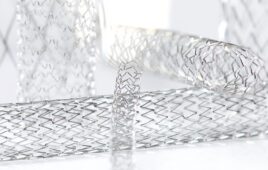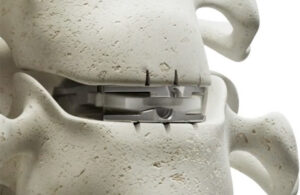
Synergy Disc includes a new patented geometry that incorporates alignment and full range of motion. [Illustration courtesy of Synergy Spine]
Synergy Spine engineers created Synergy Disc using a new patented geometry paired with time-tested materials.
“One of the secrets to great design is to just keep it simple, keep it highly manufacturable,” Synergy Spine CEO Josh Butters said in an interview with Medical Design & Outsourcing.
After earning FDA premarket approval in February, Butters spoke to MDO about the biggest challenge his team faced in Synergy Disc’s development, shared advice for device developers and offered his perspective on the future of cervical spine technology. (Read part one of our interview here.)
The following has been lightly edited for length and clarity.
MDO: What were the challenges that you faced in the cervical spine anatomy, and what did you learn that might help other device developers?

Synergy Spine says its disc is the first artificial cervical disc on the market that improves alignment while preserving range of motion. [Illustration courtesy of Synergy Spine]
“We’ve rolled out an initial quantity of 12 configurations that we felt balanced this very well and it worked for us for many years. We’re in the process now of expanding the different sizing options for Synergy Disc to apply to more patients and to be better suited for more patients.”
The 2026 MDO Medtech Startups Special Report: Advice and technical tips for medical device startups
Is the next generation already in the works?
Butters: “We have other developments going on in the background and in parallel. Things that can augment or improve the device, maybe expanded indications, are certainly going to be a natural extension of this technology. We have [Synergy Disc] in two trials, and now our approval in the cervical spine for one level.
“Another area for this technology that I think the device would do even better in is the lumbar spine. A lumbar total disc replacement has the same, if not greater, challenges as cervical disc replacements and so naturally we could extend that concept into the lumbar spine. It will require another design, other instrumentation and other trials, so we’re certainly taking that on very carefully. But there are a lot of future advancements to come.”
Where is your field of medtech headed next, and what technologies do you need to get there?
Butters: “There’s a lot of innovation around improving the overall workflows for these patients and for these surgeries, from navigation to robotics in the cervical spine, especially for anterior procedures.

Synergy Spine CEO Josh Butters [Photo courtesy of Synergy Spine]
“Even in the cervical spine where you’re doing an anterior procedure, it’s a very simple trajectory. Very simple. I could see other things that really help bring the outcomes from the best surgeon to the worst surgeon into a more predictable zone. That’s really been a philosophy around the Synergy Disc. We wanted to create a disc that was not just great in a top surgeon’s hands, but a disc that really worked for everybody and gave you predictable and reliable outcomes.”