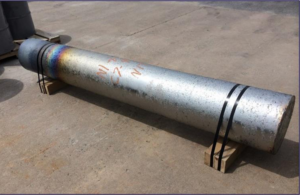
Starting out, there’s a need to produce high-quality ingots — such as the one in this image — through a clean and consistent melt, according to Resonetics. [Image courtesy of the company]
In medtech, developing advanced nitinol components requires a deep understanding of the material’s behavior from the moment it is melted to the time it becomes part of a life-changing medical device. Resonetics experts explain the different stages of nitinol’s journey.
Nitinol’s unique combination of shape memory and superelasticity makes it indispensable in modern medtech.
However, materials science, engineering, and manufacturing all need to work together to turn raw nickel and titanium into precision-engineered components. At Resonetics, the entire process happens in-house. Here’s how our experts have perfected each step.
Step 1: Melting and alloy development
Starting out, there’s a need to produce high-quality ingots through a clean and consistent melt.
“We carefully melt raw nickel and titanium on a large scale, using proven methods that produce high-quality nitinol ingots with superior consistency and cleanliness,” says Rich LaFond, VP of Operations at Resonetics.
Weimin Yin, Principal Metallurgist, adds, “My primary focus is enhancing process robustness and producing ultra-clean nitinol mill products that enable superior reliability and durability in medical devices.”
Purity and microstructure are essential to support long-term performance in critical medical applications.
Step 2: Tubing and material forming
After the alloy is melted and refined, it can be transformed into usable forms such as tube, wire, and sheet. Once again, a deep metallurgical understanding and precise control of process parameters are key.
“We focus on achieving exceptional dimensional control, surface finish, and concentricity to deliver consistent, high-performance tubing for advanced medical applications,” explains Igor Drugov, a Resonetics technical fellow.
Step 3: Characterization and testing
Characterization is where science meets validation. Engineers measure how nitinol behaves under stress, fatigue, and strain to ensure its safety and durability in medical devices.
“This information is both used to improve our material and inform customers. Fatigue testing is very important as nitinol is used abundantly in the cardiovascular space where long-term durability is critical,” explains Louis Malito, technical fellow. “
Testing data guides both process improvements and design choices.
Step 4: Nitinol component processing and prototyping
Advanced nitinol processing is central to cutting, shaping, and joining complex, high-precision nitinol components while maintaining the integrity of the material’s unique properties.
“In our LightSpeed Labs, we collaborate with customers daily from early design and quoting through prototyping, validation, and production ramp-up,” says Andie Pequegnat, Director of LightSpeed Lab. “The most exciting projects are those where we are involved from the beginning, taking a customer’s idea from a napkin sketch through clinical trials and into production.”
Early collaboration during this stage accelerates development and helps ensure that designs are both functional and manufacturable.
Step 5: Integration and market readiness
The final step connects every stage of the process. Integration ensures that material science, design intent, and manufacturing processes align to produce components that meet the highest performance and reliability standards.
“Nitinol is an incredibly complex and sensitive material,” says Scott Robertson, VP of Nitinol Technology. “We advance both raw material manufacturing and component processes to create scalable products, from rapid prototyping to full production.”
Eric Veit, VP of Business Development, described Resonetics as “the partner of choice for nitinol raw material and processing,” noting that “the benefits of this integrated supply chain stem from the company’s deep and varied expertise.”
Their combined insight ensures each project benefits from a complete view of nitinol’s behavior and potential, from early development through commercialization.
End-to-end nitinol expertise
From alloy development to final integration, creating advanced medtech nitinol components requires deep expertise every step of the way. Resonetics brings all of these capabilities together under one roof, ensuring coordination, quality control, and a streamlined path from concept to market.
 Igor Drugov is a technical fellow at Resonetics’ LightSpeed ADL. He brings nearly 20 years of nitinol expertise and leads the Premium Nitinol Tubing initiative to advance implant-grade precision, reliability, and collaborative innovation.
 Weimin Yin, Resonetics principal metallurgist, applies his nitinol expertise in alloy development, process refinement, and materials characterization to advance ultra-clean nitinol sheet and raw material production that strengthens reliability, durability, and manufacturing standards for medical devices.
 Louis Malito, a technical fellow in R&D at Resonetics, brings over a decade of nitinol characterization experience that includes grain structure, fatigue, and fracture analysis to advance understanding of nitinol’s mechanical and thermomechanical behavior.
 Andie Pequegnat, director of the LightSpeed Lab at Resonetics, brings 17 years of nitinol experience across wire and tube drawing, sheet rolling, component processing, and materials testing to drive comprehensive process expertise and material excellence.
 Scott Robertson, VP of nitinol technology at Resonetics, brings over 25 years of experience advancing nitinol from melt to market and leads long-term strategies for raw materials and component manufacturing while fostering clear, practical collaboration across teams.
 Rich LaFond, Resonetics VP of operations, brings over two decades of nitinol experience and leads the melting and mill production of high-quality ingots, bars, hollows, wires, and plates that form the foundation of the nitinol supply chain.
 Eric Veit, VP of business development at Resonetics, brings nearly two decades of experience across the nitinol world from melt to market and supports customers and internal teams while driving progress throughout the nitinol supply chain.
The opinions expressed in this blog post are the author’s only and do not necessarily reflect those of Medical Design & Outsourcing or its employees.