Medical Design and Outsourcing

  • Home
  • Medical Device Business
    • Mergers & Acquisitions
    • Financial
    • Regulatory
  • Applications
    • Cardiovascular
    • Devices
    • Imaging
    • Implantables
    • Medical Equipment
    • Orthopedic
    • Surgical
  • Technologies
    • Supplies and Components Index
    • Contract Manufacturing
    • Components
    • Electronics
    • Extrusions
    • Materials
    • Motion Control
    • Prototyping
    • Pumps
    • Tubing
  • MedTech Resources
    • Medtech Events in 2026
    • The 2026 Medtech Big 100
    • Medical Device Handbook
    • MedTech 100 Index
    • Subscribe to Print Magazine
    • DeviceTalks
    • Digital Editions
    • eBooks
    • Educational Assets
    • Manufacturer Search
    • Podcasts
    • Webinars / Digital Events
    • Whitepapers
    • Voices
    • Views
    • Video
  • 2026 Leadership
    • 2025 Winners
    • 2024 Winners
    • 2023 Winners
    • 2022 Winners
    • 2021 Winners
  • Women in Medtech
  • Advertisers
    • Advertise
    • PR Submissions
    • Eblast Submissions
  • Subscribe

This tiny sensor could non-invasively monitor brain aneurysm treatment

August 8, 2018 By Danielle Kirsh

brain-aneurysm-stent

With gloved fingers for scale, a proof-of-concept flow sensor is shown here on a stent backbone. [Image from Georgia Tech]

Researchers have developed a stretchable sensor that can be used with a flow diverter in brain aneurysm treatments to track hemodynamics in blood vessels without diagnostic procedures.

A collaborative team of researchers from Georgia Tech’s Institute for Electronics and Nanotechnology, the University of Pittsburgh and the Korea Institute of Materials Science have developed a sensor that uses capacitance changes to measure blood flow. The team showed that the sensor could accurately measure fluid flow in animal blood vessel in vitro. Now they are working toward wireless operation for in vivo testing.

“The nanostructure sensor system could provide advantages for patients, including a less invasive aneurysm treatment and an active monitoring capability,” Woon-Hong Yeo, a researchers on the project, said in a press release. “The integrated system could proved active monitoring of hemodynamics after surgery, allowing the doctor to follow up with quantitative measurement of how well the flow diverter is working in the treatment.”

The most common treatment for aneurysms is using platinum coils to fill the aneurysm sac. However, stent-like flow diverters offer a less invasive treatment for cerebral aneurysms. Flow diversion places a porous stent across the neck of an aneurysm to redirect flow from the sac to create local blood clots.

“We have developed a highly stretchable, hyper-elastic flow diverter using a highly-porous thin film nitinol,” Youngjae Chun, an associate professor in the Swanson School of Engineering at the University of Pittsburgh, said. “None of the existing flow diverters, however, provide quantitative, real-time monitoring of hemodynamics within the sac of cerebral aneurysm. Through the collaboration with Dr. Yeo’s group at Georgia Tech, we have developed a smart flow-diverter system that can actively monitor the flow alterations during and after surgery.”

A damaged artery can take months or years to repair, which means the flow diverter has to be monitoring using an MRI and angiogram. Both processes can be costly and require injection of a magnetic dye into the bloodstream.

The research team developed the sensor as a solution to monitoring treatment in a doctor’s office by using wireless inductive coils to send electromagnetic energy through the sensor. Blood flow changes in the sac can be measured in the system by how the energy’s resonant frequency changes as it passes through the sensor.

“We are trying to develop a batteryless, wireless device that is extremely stretchable and flexible that can be miniaturized enough to be routed through the tiny and complex blood vessels of the brain and then deployed without damage,” Yeo said. “It’s very challenging to insert such an electronic system into the brain’s narrow and contoured blood vessels.”

Using a micro-membrane of two metal layers around a dielectric material that wraps around the flow diverter, the sensor is a few hundred nanometers thick. It produces using nano fabrication and material transfer printing techniques, within a soft elastomeric material.

“The membrane is deflected by the flow through the diverter, and depending on the strength of the flow, the velocity difference, the amount of deflection changes,” Yeo said. “We measure the amount of deflection based on the capacitance change because the capacitance is inversely proportional to the distance between two metal layers.”

Since blood vessels in the brain are so small, flow diverters can only be five to 10 millimeters long and only a few millimeters thick, which means traditional sensors can’t be used because of their bulky electronic circuits.

“Putting functional materials and circuits into something that size is pretty much impossible right now,” Yeo said. “What we are doing is very challenging based on conventional materials and design strategies.”

The research team tested gold, magnesium and nitinol on the sensors and found that all of the materials could be safely used in the body, but magnesium can be dissolved into the bloodstream after it is no longer needed. Through in vitro testing, the team connected a proof-of-concept sensor to a guide wire, but now the they are working on a wireless sensor that can be used in animal models.

Currently, implantable sensors are being used clinically for monitoring abdominal blood vessels, but the small vessels of the brain has created challenges.

“The sensor has to be completely compressed for placement, so it must be capable of stretching 300 or 400%,” Yeo said. “The sensor structure has to be able to endure that kind of handling while being conformable and bending to fit inside the blood vessel.”

The research was published in the journal ACS Nano.

About The Author

Danielle Kirsh

Danielle Kirsh is an award-winning journalist and senior editor for Medical Design & Outsourcing, MassDevice, and Medical Tubing + Extrusion, and the founder of Women in Medtech and lead editor for Big 100. She received her bachelor's degree in broadcast journalism and mass communication from Norfolk State University and is pursuing her master's in global strategic communications at the University of Florida. You can connect with her on Twitter and LinkedIn, or email her at [email protected].

Related Articles Read More >

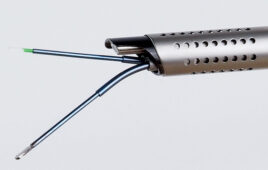
The Virtuoso System endoscope tip with manipulators,
Tiny, superelastic nitinol arms make this breakthrough surgical robot possible
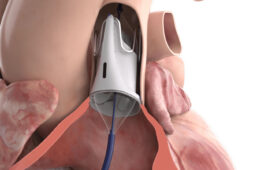
An illustration showing the Autus size-adjustable heart valve being expanded years after implantation with a minimally invasive balloon catheter.
The first-of-its-kind Autus pediatric heart valve is designed for expansion and durability
J&J EP leader Michael Bodner offers a PFA program update
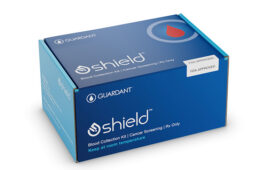
Guardant Health Shield
Guardant’s colorectal cancer blood test wins most innovative medtech of 2026
“mdo
EXPAND YOUR KNOWLEDGE AND STAY CONNECTED
Get the latest medical device business news, application and technology trends.

DeviceTalks Weekly

See More >

MDO Digital Edition

Digital Edition

Subscribe to Medical Design & Outsourcing. Bookmark, share and interact with the leading medical design engineering magazine today.

MEDTECH 100 INDEX

Medtech 100 logo
Market Summary > Current Price
The MedTech 100 is a financial index calculated using the BIG100 companies covered in Medical Design and Outsourcing.

New MedTech Resource

Medical Tubing

MassDevice

Mass Device

The Medical Device Business Journal. MassDevice is the leading medical device news business journal telling the stories of the devices that save lives.

Visit Website
MDO ad
Medical Design and Outsourcing
  • MassDevice
  • DeviceTalks
  • MedTech100 Index
  • Medical Tubing + Extrusion
  • Medical Design Sourcing
  • Drug Delivery Business News
  • Drug Discovery & Development
  • Pharmaceutical Processing World
  • R&D World
  • About Us/Contact
  • Advertise With Us
  • Subscribe to Print Magazine
  • Subscribe to our E-Newsletter
  • Listen to our Weekly Podcasts
  • Join our DeviceTalks Tuesdays Discussion

Copyright © 2026 Arrowfly, LLC. All Rights Reserved. The material on this site may not be reproduced, distributed, transmitted, cached or otherwise used, except with the prior written permission of Arrowfly LLC. Site Map | Privacy Policy | RSS

Search Medical Design & Outsourcing

  • Home
  • Medical Device Business
    • Mergers & Acquisitions
    • Financial
    • Regulatory
  • Applications
    • Cardiovascular
    • Devices
    • Imaging
    • Implantables
    • Medical Equipment
    • Orthopedic
    • Surgical
  • Technologies
    • Supplies and Components Index
    • Contract Manufacturing
    • Components
    • Electronics
    • Extrusions
    • Materials
    • Motion Control
    • Prototyping
    • Pumps
    • Tubing
  • MedTech Resources
    • Medtech Events in 2026
    • The 2026 Medtech Big 100
    • Medical Device Handbook
    • MedTech 100 Index
    • Subscribe to Print Magazine
    • DeviceTalks
    • Digital Editions
    • eBooks
    • Educational Assets
    • Manufacturer Search
    • Podcasts
    • Webinars / Digital Events
    • Whitepapers
    • Voices
    • Views
    • Video
  • 2026 Leadership
    • 2025 Winners
    • 2024 Winners
    • 2023 Winners
    • 2022 Winners
    • 2021 Winners
  • Women in Medtech
  • Advertisers
    • Advertise
    • PR Submissions
    • Eblast Submissions
  • Subscribe