We sat down with Schmid to discuss spinouts, robots, M&A strategy and how to grow the world’s second-largest device business faster.

Tim Schmid leads Johnson & Johnson MedTech, the world’s second-largest medical device business. [Photo courtesy of Johnson & Johnson]
Johnson & Johnson MedTech resisted that trend until October, when it announced plans to spin out one of its core businesses — DePuy Synthes — into what will be the world’s largest independent orthopedic device company.
The move surprised many, including me. I was scheduled to interview Tim Schmid, EVP and global medtech chairman, at DeviceTalks West the day after the announcement and planned to ask why J&J MedTech had not yet shed any businesses.
Instead, I asked Schmid why J&J MedTech is lopping $9 billion in annual revenue off its bottom line by spinning out DePuy Synthes. His answer: the pursuit of higher growth.
“We will move from a four-company focus to three. It’s all about cardiovascular, surgery and vision,” Schmid said. “So what you could expect … is a much greater focus on innovating in those three areas.”
Schmid took over the world’s second-largest medtech business (as ranked by revenue) in October 2023. He spent his career at J&J, including the last few years as leader of its Asia Pacific Group. That was the fastest-growing business at the company at the time, so he was seen as someone who could accelerate growth.
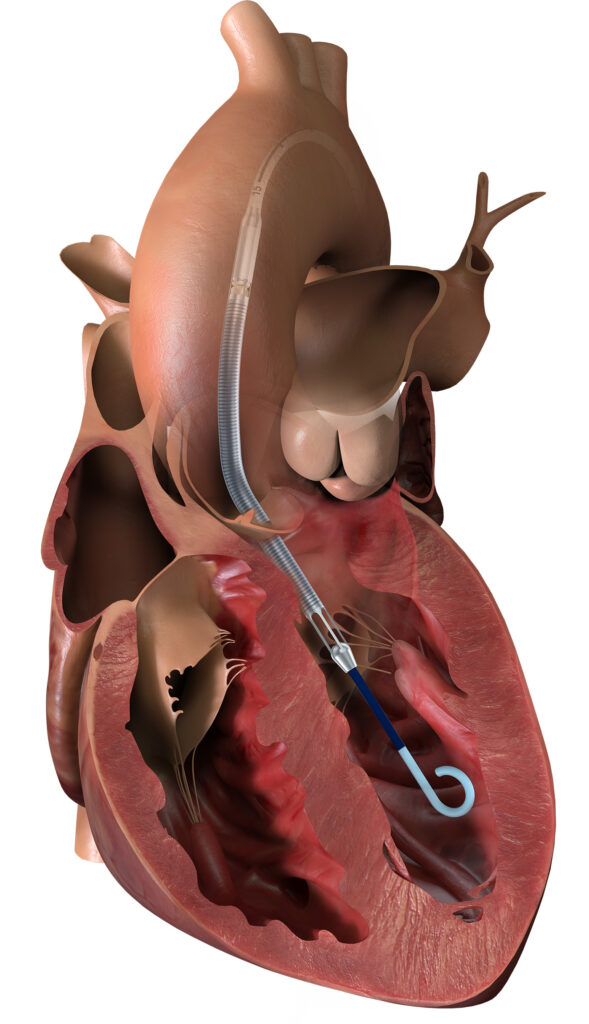
Abiomed’s Impella CP with SmartAssist Pump [Illustration courtesy of Johnson & Johnson MedTech]
In our talk at DeviceTalks West, Schmid said only 18% of the company’s portfolio sold into markets growing at greater than 5% in 2018. This produced anemic annual growth of 1.5%, he said.
Today, thanks to acquisitions like Abiomed and intravascular lithotripsy leader Shockwave Medical, roughly half of J&J MedTech products fall in those high-growth categories. In the third quarter of 2025, J&J MedTech reported quarterly revenue of $8.4 billion, a 5.6% year-over-year gain.
Those two major acquisitions and some smaller deals moved J&J’s cardiovascular business beyond electrophysiology into heart failure and peripheral vascular disease. Growth from these new products and EP delivered full-year revenue of $7.7 billion, a 21.4% increase in sales from 2023. (Compare that to 2020 sales, which were less than half that at $3.05 billion.)
“We made a distinctive decision to … play a bigger role in the cardiovascular space,” Schmid said. “It’s an area where we can make the biggest impact on patients and certainly the greatest opportunity for us to drive returns for our shareholders.”
Previously: How Shockwave Medical sealed the deal that could put Johnson & Johnson back on top
The robotics race
J&J’s Abiomed and Shockwave acquisitions were widely hailed. But growth from J&J’s legacy surgical business is harder to predict. J&J reported a 1.9% drop in annual revenue for its surgical unit, citing a drop in China-based business as well as competitive pressure for energy and endocutter devices.
The future growth of this business rests on one high-profile project: Ottava, J&J’s surgical robotics system. Promotional videos offer glimpses of a sleek design with robotic arms emerging from underneath the surgical bed. The design is important, of course, but the more critical element is giving J&J sales teams a way to fend off advances from longtime leader Intuitive and Medtronic, the surgical robotics newcomer that just secured FDA approval for its Hugo robotic-assisted surgery (RAS) system.
Some wonder if J&J missed the opening for its own system. Schmid says that’s not the case.
“While I haven’t been leading it before the last two years, I’ve certainly been part of the journey. And it is hard. Yeah, it is really, really hard,” Schmid said. “But I will tell you that today, J&J leads in open surgery, we lead in laparoscopic surgery, and our intent is absolutely to be a player in robotic surgery.
“And we’re not naive. We know there’s a very significant incumbent in that space,” he continued. “But I can’t speak to a surgeon or a C-suite customer who isn’t demanding competition because it makes everyone better. And given our leadership in those two categories I mentioned earlier, we have no doubt that there is a tremendous opportunity for us to participate.”
Schmid sees the unique design as the first reason for optimism. The second is J&J’s position in the surgical instrument business.
“While surgeons around the world are enjoying and appreciating the benefits that come with robotic surgery, what they miss is the best-in-class instruments that they get from J&J. … These are best-in-class endocutters, energy devices, and they’re not available on robots today.”
He also cited the release of J&J’s Polyphonic digital ecosystem for applications and other data-analyzing tools used in the operating room as another lure for customers.
J&J expects to complete Ottava’s pivotal clinical trials this year, enabling the company to submit it for FDA approval in 2026.
The vision for vision

Johnson & Johnson MedTech leader Tim Schmid (left) and DeviceTalks Editorial Director Tom Salemi at DeviceTalks West 2025. [Photo courtesy of DeviceTalks]
Over the past five years, the vision business has had the second-largest increase in sales at 31%, only trailing cardiovascular. But vision sales increased by just 1.5% from 2023 to $5.1 billion in 2024. Vision sales tend to be tied more closely to consumer preference than other medtech businesses.
Schmid said he sees an upside in the business, pointing to J&J’s Acuvue Oasys Max Multifocal for Astigmatism, the first and only daily disposable lens for both presbyopia and astigmatism.
“Most of these patients didn’t think that contact lenses were an option for them, and now they are,” he said.
Schmid also sees huge growth potential from intraocular lenses that can be implanted to permanently correct vision and treat conditions like cataracts, with Tecnis lens sales growing at almost 15%.
“We couldn’t be prouder of the impact we’re making in that particular area,” he said.
Going forward
Schmid’s old territory — Asia — was once a steady source of growth. But even growing markets are looking to contain healthcare costs.
“China is a bit of a headwind for us,” Schmid said. “That used to be a business that drove a significant portion of our growth. We’ve now been able to move resources to the United States and other markets to make sure we can offset that.”
J&J spent $3.7 billion on R&D in 2024 (up 19% from the year prior) and maintains a busy investment program through the Johnson & Johnson Development Corp. venture arm that invests within the parent company’s core businesses. For example, JJDC participated in a $67 million Series D round in Ronovo Surgical, a Shanghai-based surgical robotics company.
“We believe that the investment we’ve made in Ronovo gives us an opportunity to learn and also bring to market a technology that is desirable” in a highly competitive market, Schmid said. “This is our pathway to get there faster and to participate in one of the most exciting spaces within medtech in China.”
Schmid also said J&J will remain an active buyer after spending $30 billion on Abiomed and Shockwave. Acquired companies can benefit from J&J’s size and scale in markets as well as back-office functions like human resources and finance. But Johnson & Johnson is choosing to let these small companies be themselves.
“We’ve learned that anything to do with driving innovation in [individual] businesses has got to be kept in the businesses,” he said. “When we acquired Abiomed and Shockwave, we just let them run.”
Starting in January 2026, J&J MedTech is restructuring into “a more decentralized” business-unit-led operating model to “cut down on bureaucracy, increase accountability and ownership, and help us move faster,” the company told employees in a memo.
Next is letting go of DePuy Synthes, which operates in a sector with modest growth expectations. When it’s sold to either private equity or public investors, DePuy Synthes will become the world’s 14th-largest medical device company,
The separation made sense for all involved, Schmid said.
“Once the transaction is done, we immediately will have accretive top line growth and better margins,” he said. “Just as importantly, with such a broad portfolio, we have had to deprioritize our ortho business given its lower growth and margin profile.
“As a separate company, it will compete head-to-head with dedicated orthopedic competitors,” he continued. “It was a difficult choice for all stakeholders, but one that we fundamentally believe will set up J&J as well as DePuy Synthes for greater success.”