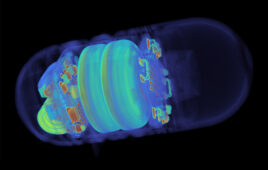
The incorporation of dopants into the calcium sites of hydroxyapatite introduces atomic defects that endow it with unique luminescent properties for bioimaging applications. [Image courtesy of UC San Diego]
By adding europium, which emits light, the researchers could see the material during bioimaging. This could allow scientists to track implants or bone-regeneration scaffolds inside the body without surgery. The work was published in the Journal of Solid State Chemistry.
The researchers modeled computationally how europium, a rare-earth element that behaves like calcium, fits into hydroxyapatite’s structure. That analysis ran on Expanse, the supercomputer housed at UC San Diego’s Halıcıoğlu School of Data Science and Computing, using time allocated through the National Science Foundation’s ACCESS program.
“Density functional theory calculations play a crucial role in understanding the impact of elemental substitution on materials, while allowing for precise control over substitution sites and concentrations,” said Olivia Graeve, who directs UC San Diego’s Program in Materials Science and Engineering and led the research, in a news release.

UC San Diego professor Olivia Graeve [Photo courtesy of UCSD]
Graeve sees the results as a step toward more reliable design of bone-like imaging materials down the line. Lab experiments backed up the simulation results, giving the researchers confidence the model isn’t just theoretical.
Editor’s note: This article was updated with additional information and attribution after initial publication.