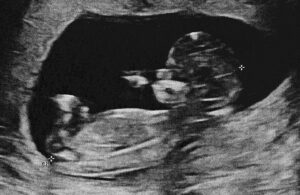
An accurate predicted delivery date helps guide clinical decision making and helps reduce the occurrence of premature or postmature babies. [Image via Stock.Adobe.com by Tampatra]
Ultrasound AI founder and President Robert Bunn called it “a major milestone in our mission to reduce the burden of preterm birth by supporting earlier, more informed clinical decision-making.”
Delivery Date AI is designed as a tool to aid clinical decision making in pregnancies where traditional methods to predict a delivery date are unreliable.
The startup said its technology was trained on millions of de-identified ultrasound images across diverse pregnancies and clinical settings. Delivery Date AI’s technology predicts delivery dates using a variety of deep-learning neural networks to analyze entire ultrasound images, including fetal and maternal characteristics correlated with delivery timing.
Traditionally, predicted delivery dates are forecasted using the patients last menstrual period and/or an ultrasound gestational-age assessment which measures the crown-rump length and has an accuracy of plus or minus 5 to 7 days, accuracy of ultrasound gestational dating decreases after the first trimester.
In a peer-reviewed study, conducted by Ultrasound AI in collaboration with the University of Kentucky, Delivery Date AI’s technology predicted delivery timing in more than 5,700 patients. The technology yielded 92% accuracy in predicting days to delivery using only standard ultrasound images. Researchers also concluded that the technology can predict preterm delivery with limited sensitivity.
Delivery Date AI is compatible with most existing ultrasound machines, allowing for no workflow disruption and minimal onboarding time, according to Ultrasound AI.
Ultrasound AI said its image-first technology supports equitable care across diverse patient populations and clinical settings. The technology is scalable across high-volume health systems, resource-constrained clinics and obstetric deserts and offers the potential to reduce downstream costs associated with preterm birth, Ultrasound AI says.
“Fetal development and delivery timing impact nearly every decision in obstetrics,” Dr. Nathan Fox, board-certified OBGYN and partner physician with Ultrasound AI, said in a news release. “Delivery Date AI gives clinicians unprecedented insight into a pregnancy’s progression, allowing us to make more informed decisions for how and when we intervene. This technology has transformative implications for maternal and fetal healthcare.”
Delivery Date AI is now available to U.S. healthcare providers who use ultrasound equipment.