
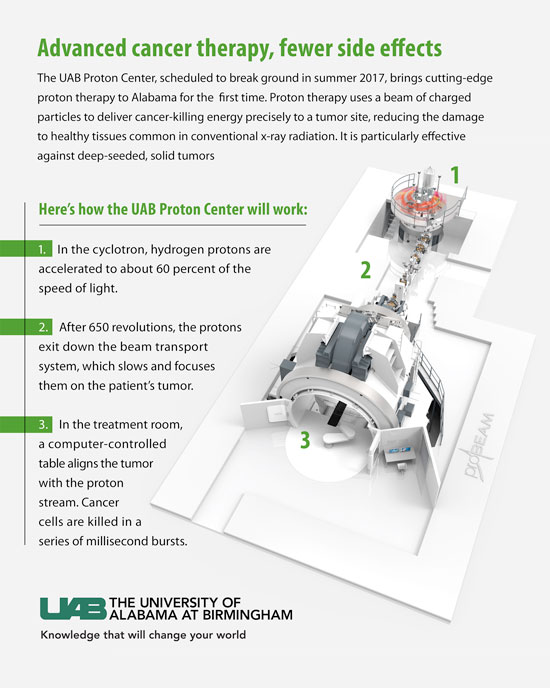
The ability to make protons a cancer-fighting tool starts with speed.
The protons must first accelerate to about 60 percent of the speed of light, or around 114,000 miles per second. Only then can the stream of protons be tuned and focused on its target — a human tumor.
The science behind this proton therapy has two elements. What happens when bursts of those high-speed protons enter the body of a patient? And how can you make them go so fast?
(Credit: UAB)
Cell death
Protons are tiny, subatomic particles found in the nucleus of every atom. They have a positive charge, which is key to both their impact in a patient and how they can be accelerated.
Inside cells of the body, the proton wants to strip electrons — the negatively charged subatomic particles — from molecules. When this happens, particularly to DNA in a tumor cell, it damages the genetic material enough to cause cell death. Kill enough cells in a tumor, and the tumor is destroyed.
The moving protons have an odd characteristic with regard to this damage — they do most of their electron stripping just before they stop. Thus, as protons speed through healthy tissue toward a tumor, they cause less damage in that healthy tissue than cancer radiotherapy using traditional X-rays.
By varying the speed of the protons, radiation oncologists can vary how deeply the protons will travel into the body before they stop. Through fine control of speed and aiming, they can target bursts of proton ionizing energy to every point inside the volume of a tumor. As the protons reach the depth of the tumor and begin to stop, they cause the most damage. Unlike X-rays, there is no damage to healthy tissue beyond the tumor.
90-ton machine
The machine that will accelerate protons for the The University of Alabama at Birmingham (UAB) Proton Center is called a cyclotron. The planned cyclotron will weigh 90 tons, with a superconducting magnet cooled by liquid helium to a temperature of about minus 452 degrees Fahrenheit.
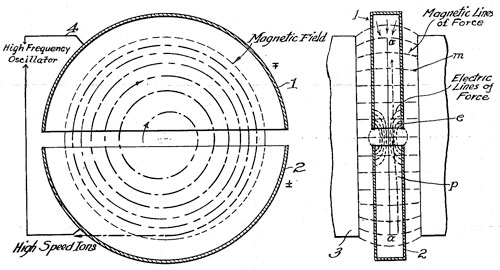
This drawing the U.S. cyclotron patent in 1934s shows the spiral path of the protons. E.O. Lawrence’s first cyclotron was 4 inches wide and was made from brass and sealing wax. (Credit: UAB)
Protons from hydrogen gas are injected at the center of the cyclotron. Because these moving protons have a positive charge, the magnetic field from the superconducting magnet will bend their travel into a circular path. At every half circle inside the cyclotron, the protons experience a brief electrical field that accelerates them, much like a child’s pumping a swing to make it go higher. As the protons travel faster and faster in the magnetic field, their circular path widens.
The result is a spiral that expands with each swing the protons make around the cyclotron. After 650 revolutions, the protons will reach 60 percent of the speed of light while moving in a 5-foot-3-inch-diameter path. At that point, they exit the cyclotron and speed through an energy selection system and beam transport system, headed toward a cancer patient.
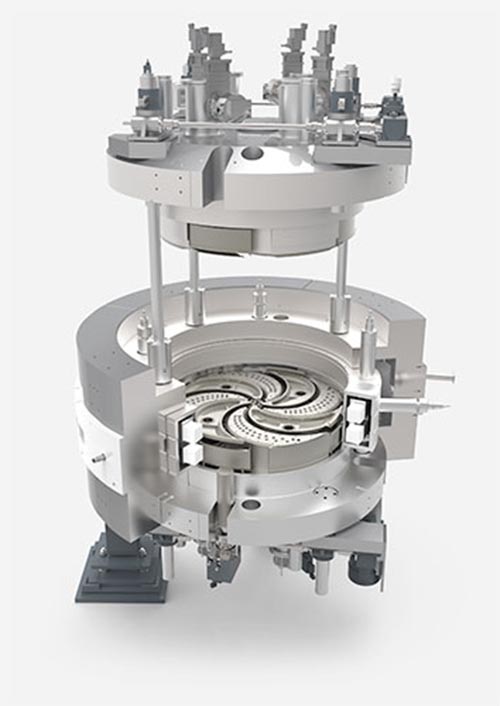
This 90-ton cyclotron will accelerate to 60 percent the speed of light, or around 114,000 miles per second. In this rendering, the top is lifted up to expose the interior. (Credit: UAB)
“Painting” a tumor
These two systems are a crucial step between the cyclotron and the patient. In this long tube, the protons are focused and slowed to the exact speeds needed to penetrate to the proper depths for each spot of the tumor. The fastest protons will be able to penetrate nearly 12 inches into the body. At the far end of the beam transport, the patient lies on a robotic patient-positioning table in the 16-foot-wide treatment room.
The cyclotron, energy selection system, beam transport system and treatment room will stand on a footprint the size of a tennis court, part of a new three-story-tall building to be built near 20th Street and Fifth Avenue South. When it starts operation in about two years, the UAB Proton Center will be able to “paint” the entire volume of a tumor with brief bursts of protons, spot by spot, layer by layer. A typical spot may get hit with a three-one-thousandths-of-a-second burst that contains 75 million protons. The patient will feel nothing during treatment.
The Varian ProBeam Proton Therapy System for intensity-modulated therapy will be manufactured by Varian Medical Systems, a pioneering developer of new tools for fighting cancer. When it becomes operational, the new Varian proton therapy system will seamlessly integrate with UAB’s existing Varian software and technology.
The UAB Proton Center is a partnership between the University of Alabama at Birmingham and Proton International. UAB will lease the property to Proton International, which will build and own the facility. Planning and pre-treatment will be done at UAB’s Hazelrig-Salter Radiation Oncology Center. All the medical staff — radiation oncologists, medical physicists, cancer physicians, radiation therapy technologists and nurses — will be from UAB.