Medical Design and Outsourcing

  • Home
  • Medical Device Business
    • Mergers & Acquisitions
    • Financial
    • Regulatory
  • Applications
    • Cardiovascular
    • Devices
    • Imaging
    • Implantables
    • Medical Equipment
    • Orthopedic
    • Surgical
  • Technologies
    • Supplies and Components Index
    • Contract Manufacturing
    • Components
    • Electronics
    • Extrusions
    • Materials
    • Motion Control
    • Prototyping
    • Pumps
    • Tubing
  • MedTech Resources
    • Medtech Events in 2026
    • The 2026 Medtech Big 100
    • Medical Device Handbook
    • MedTech 100 Index
    • Subscribe to Print Magazine
    • DeviceTalks
    • Digital Editions
    • eBooks
    • Educational Assets
    • Manufacturer Search
    • Podcasts
    • Webinars / Digital Events
    • Whitepapers
    • Voices
    • Views
    • Video
  • 2026 Leadership
    • 2025 Winners
    • 2024 Winners
    • 2023 Winners
    • 2022 Winners
    • 2021 Winners
  • Women in Medtech
  • Advertise
  • Subscribe

Researchers develop noninvasive technology to monitor brain blood flow during surgery

August 6, 2026 By Skyler Rivera

University of Texas at Austin researchers testing their new technology, sinusoidal intensity modulation speckle imaging (SIMSI).

University of Texas at Austin researchers developed a new way to monitor brain blood flow during surgery with a technology called sinusoidal intensity modulation speckle imaging (SIMSI). [Photo courtesy of UT Austin]

University of Texas at Austin researchers have developed a new way to monitor brain blood flow during surgery with standard camera hardware.

The technology is called sinusoidal intensity modulation speckle imaging (SIMSI). It could also be used to improve monitoring during “cardiac surgery, help assess tissue viability in reconstructive procedures, guide treatment decisions in stroke care, and support research into conditions ranging from dementia to traumatic brain injury,” the university said.

“This has been a fundamental challenge in the field for a long time,” UT Austin professor Andrew Dunn said in a news release. “SIMSI gives us a way to get quantitative, physically meaningful numbers from a technique that is already fast and practical enough to use in the clinic.”

SIMSI uses the physics of dynamic light scattering to image blood flow noninvasively across a wide field of view without high-speed cameras. Dunn, who’s also a co-author of the study, leads the lab that published the findings in the Proceedings of the National Academy of Sciences.

Currently available technology requires expensive and specialized high-speed cameras to measure brain blood flow with fast dynamic processes with dynamic light scattering over wide fields.

Register now: The MDO Min-Vasive Medtech webinar series returns Aug. 18-20

Tracking blood flow through the microvasculature during surgery is one of the most critical parts of a procedure, the university said. Interruption in flow could lead to permanent damage, but access to monitoring technology is limited due to high-cost hardware.

SIMSI builds on an established technology called laser speckle contrast imaging (LSCI). LSCI uses laser light to illuminate tissue and the movement of red blood cells causes the laser speckle pattern to blur in proportion to how fast the cells are moving. Researchers then analyze the blur to noninvasively map blood flow across an entire field of view.

A photo of University of Texas at Austin professor Andrew Dunn.

University of Texas at Austin professor Andrew Dunn [Photo courtesy of UT Austin]

LSCI relatively measures whether blood flow increased or decreased, but doesn’t provide figures for absolute blood flow. The researchers designed a camera-based system that noninvasively produces quantitative maps of rapid blood flow dynamics across a wide field of view, the university said.

The researchers added precise modulation to the laser illumination by varying light intensity in a sinusoidal pattern at a controlled frequency within each camera exposure, the researchers said. They overcame hardware limitations by encoding information about fast blood flow dynamics into images captured with long camera exposures.

“Blood flow can change over many timescales, but the optical fluctuations that reveal how fast blood is moving are often too fast for standard cameras to sample directly,” said postdoctoral fellow and SIMI development leader Hengfa Lu.

“By intentionally modulating the illumination during the exposure and using a newly derived imaging model, we can recover fast blood flow dynamics that would otherwise be averaged out,” he continued. “That gives researchers a more quantitative way to study how tissue is functioning, from stroke recovery in the lab to, eventually, surgical decision-making.”

The researchers see SIMSI as a broader effort to make fast, quantitative blood flow imaging more accessible. The physics-based imaging model that uses standard cameras could open opportunities in “stroke research, brain injury, surgery and other areas where blood flow is an early signal of tissue health,” UT Austin said.


About The Author

Skyler Rivera

Skyler Rivera is an associate editor at Arrowfly, covering medical device industry news and technology at MassDevice and Medical Design & Outsourcing. She began her career covering sports at The Athletic and MLB before transitioning to medical writing at Edwards Lifesciences. Based in Southern California, she holds a master's degree in science writing from Johns Hopkins University and a bachelor’s in broadcast journalism from Syracuse University. Connect with her on LinkedIn or email at [email protected].

Related Articles Read More >

Reconstructed 3D fluorescence image of the stained biohybrid mesh-tissue integration. The red, green, and blue colors correspond to the mesh, F-actin, and nuclei, respectively.
Researchers mesh electronics with human cells to develop living battery
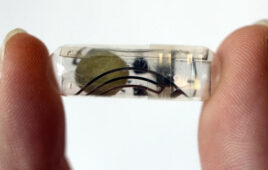
The 1.84 volt paper battery (brown circle structure) was tested in pigs with a bioabsorbable radio-frequency identification (RFID) device.
MIT researchers develop bioresorbable batteries for ingestible medical devices
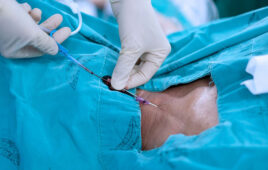
A clinician guides a needle and wire into the side of a patient's neck during a central venous catheter insertion.
New campaign targets fibrin sheath CVC complication
An illustration of HITMAN operating in glioblastoma cells.
MIT researchers develop injectable nanodevices that remotely kill brain tumor cells
“mdo
EXPAND YOUR KNOWLEDGE AND STAY CONNECTED
Get the latest medical device business news, application and technology trends.

DeviceTalks Weekly

See More >

MDO Digital Edition

Digital Edition

Subscribe to Medical Design & Outsourcing. Bookmark, share and interact with the leading medical design engineering magazine today.

MEDTECH 100 INDEX

Medtech 100 logo
Market Summary > Current Price
The MedTech 100 is a financial index calculated using the BIG100 companies covered in Medical Design and Outsourcing.

New MedTech Resource

Medical Tubing

MassDevice

Mass Device

The Medical Device Business Journal. MassDevice is the leading medical device news business journal telling the stories of the devices that save lives.

Visit Website
MDO ad
Medical Design and Outsourcing
  • MassDevice
  • DeviceTalks
  • MedTech100 Index
  • Medical Tubing + Extrusion
  • Medical Design Sourcing
  • Drug Delivery Business News
  • Drug Discovery & Development
  • Pharmaceutical Processing World
  • R&D World
  • About Us/Contact
  • Advertise With Us
  • Subscribe to Print Magazine
  • Subscribe to our E-Newsletter
  • Listen to our Weekly Podcasts
  • Join our DeviceTalks Tuesdays Discussion

Copyright © 2026 Arrowfly, LLC. All Rights Reserved. The material on this site may not be reproduced, distributed, transmitted, cached or otherwise used, except with the prior written permission of Arrowfly LLC. Site Map | Privacy Policy | RSS

Search Medical Design & Outsourcing

  • Home
  • Medical Device Business
    • Mergers & Acquisitions
    • Financial
    • Regulatory
  • Applications
    • Cardiovascular
    • Devices
    • Imaging
    • Implantables
    • Medical Equipment
    • Orthopedic
    • Surgical
  • Technologies
    • Supplies and Components Index
    • Contract Manufacturing
    • Components
    • Electronics
    • Extrusions
    • Materials
    • Motion Control
    • Prototyping
    • Pumps
    • Tubing
  • MedTech Resources
    • Medtech Events in 2026
    • The 2026 Medtech Big 100
    • Medical Device Handbook
    • MedTech 100 Index
    • Subscribe to Print Magazine
    • DeviceTalks
    • Digital Editions
    • eBooks
    • Educational Assets
    • Manufacturer Search
    • Podcasts
    • Webinars / Digital Events
    • Whitepapers
    • Voices
    • Views
    • Video
  • 2026 Leadership
    • 2025 Winners
    • 2024 Winners
    • 2023 Winners
    • 2022 Winners
    • 2021 Winners
  • Women in Medtech
  • Advertise
  • Subscribe