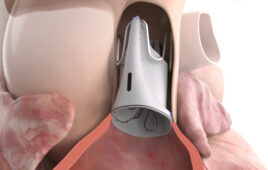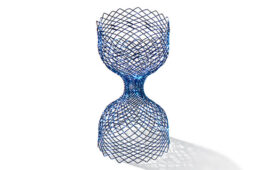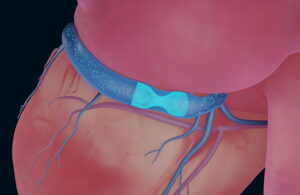
VahatiCor’s A-Flux is a small, hourglass-shaped, self-expanding nitinol implant placed in the coronary sinus. The investigational device is designed to treat coronary microvascular dysfunction. [Illustration courtesy of VahatiCor]
Medication is currently the standard of care for CMD, but VahatiCor designed the A-Flux reducer system for patients “who are suffering without a treatment option available to them,” Rowland said in a Medical Design & Outsourcing interview.
Rowland joined the early-stage device developer in May 2026. In 2007, he co-founded Endotronix and led it as CEO through the FDA premarket approval of its Cordella implantable pulmonary artery (PA) pressure sensor system in June 2024 and the company’s $798.8 million acquisition by Edwards Lifesciences two months later.
Rowland plans to bring lessons from that experience to VahatiCor.
“We’ve got a great platform technology, great team, here’s what the next four years look like,” he said. “Let’s get ready for it. Let’s do it the right way.”
Some CMD patients with chest pain are not diagnosed or don’t go in for scans, and some that do are told they don’t have blockages and they just have to live with it.
“When you think about chest pain and interventional cardiology, we’re thinking STEMI (ST-elevation myocardial infarction heart attacks), we’re thinking stents, opening up those main epicardial coronary arteries solves the problem,” he said. “Well, it turns out a lot of people live with chest pain … and they’re still having chest pain.”
The 2026 MDO Medtech Startups Special Report: Technical tips and actionable advice for device startups
In the United States, 3 million to 4 million women and men show signs of myocardial ischemia (reduced blood flow to the heart, sometimes caused by CMD) without signs of obstructive coronary artery disease, VahatiCor says.
CMD is associated with a nearly four‐fold increase in mortality and a five‐fold increase in major cardiac events, according to a 2020 systematic review published in the American Heart Association Journals.
“What the field is learning is that a lot of the flow in the myocardium in the heart is from the microvasculature,” Rowland said. “All these large, relatively large, couple-millimeter-diameter cardio arteries, they get smaller and smaller, and they taper as they get into the capillaries, and they oxygenate the heart tissue. All those smaller vessels represent around 80% of the flow restriction. It happens downstream of the main arteries, and if you’re having problems there, we don’t have tools for that today.”
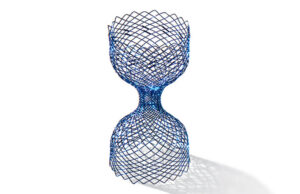
A-Flux’s hourglass design features a tight mesh weave at its narrow point made from VahatiCor’s proprietary SwiftCell technology. [Image courtesy of VahatiCor]
“By restricting flow in the coronary sinus, you create a back pressure in the microvasculature, which allows vasodilation and more perfusion of the heart tissue,” Rowland said.
A-Flux’s hourglass design features a tight mesh weave at its narrow point made from VahatiCor’s proprietary SwiftCell technology to modulate blood flow.
“Because there’s such a tight mesh, you see a lot of the flow restriction even immediately,” he said. “We can see potential patient benefit within a couple of weeks following the procedure, rather than needing to wait four months for the end of the realization process to take effect.”
Rowland later continued, “What really stands out is the self-expanding, tighter mesh, which ultimately gives the physicians the potential for a smoother, easier, faster, more controlled procedure. Then for patients, the potential for a faster treatment effect for reducing chest pain.”
Nitinol for cardiac implants: MDO’s Nitinol Knowledge webinar returns with a Medtronic distinguished engineer
VahatiCor is broadly focused on CMD, Rowland said, including treatment for patients with previously treated obstructive disease and residual chest pain.
“Different types of angina can be potentially treated by this,” he said. “We think a lot of that falls under the CMD umbrella. … A big opportunity within CMD is moving earlier in the diagnostic pathway, where potentially CMD could be treated at a similar time as coronary artery disease. Rather than waiting to treat the CMD, you might treat these things at a similar time period.
“Some investigators have hope for maybe treating ischemic heart failure with reduced ejection fraction (HFrEF) or a subtype of ischemic heart failure with preserved ejection fraction (HFpEF),” Rowland said. “[Those are] other disease states that we can look at that can benefit really from better perfusion of the heart muscle, and that can be quite a few patient populations in need.”

VahatiCor CEO Harry Rowland [Photo courtesy of VahatiCor]
Prior to the initiation of its U.S. and European studies, the startup completed a compassionate use study with A-Flux implants in 10 patients: four patients with CDM and six with obstructive epicardial disease.
VahatiCor said patients treated with A-Flux reported their symptoms improved rapidly and they returned to daily activities with minimal recovery time.
“All that is leading up to a pivotal study, which we expect to start next year,” Rowland said. “We want to enroll that fast — as fast as possible — across great centers in the U.S. and Europe, and lead to a PMA. We have a few years to go to PMA approval.”
He said A-Flux is “PMA medtech pivotal stage ready,” and the company is ready to expand the device’s clinical use and reach more patients in need. His team is developing evidence that “suggests that in a randomized trial, this is having a huge patient impact,” Rowland said.
“You can forecast three to five years in that ballpark for PMA medtech around the time that we’re at,” he said. “… We’re very much focused on that pivotal trial, as well as the technical file underneath it, to lead to a PMA approval.”
Learn how VahatiCor’s A-Flux nitinol implant is designed to treat CMD and watch for more from this interview at Medical Design & Outsourcing. Subscribe to our free newsletter to watch for the next part.