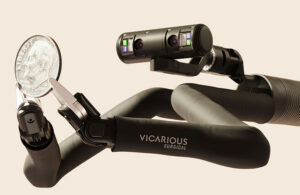
Vicarious Surgical’s robot requires an incision smaller than a dime. [Rendering courtesy of Vicarious Surgical]
“In the abdominal space — which is where we focus and where hernia is — over 50% of all of those abdominal soft tissue surgical procedures in the U.S. are still done or completed in an open surgery setting,” he said in a recent DeviceTalks Weekly podcast interview.
And only 18% of all U.S. abdominal procedures are performed robotically, the company says in materials to investors, with ventral hernia repairs making up the majority of open procedures (versus non-robotic laparoscopic surgeries).
Laparoscopic and currently available robotic-assisted platforms lack the dexterity and visual access required for minimally invasive ventral hernia repair, From said. Vicarious is designing its surgical robot to overcome those limitations and transform open surgeries into minimally invasive procedures, starting with ventral hernia repair.
“There’s so much addressable market there,” From said. “I don’t have to think about replacing what [other robotics companies] are doing. I can go after what the hospitals want to do right now. They want to be able to provide minimally invasive surgery to more of their patients and that’s what we can do for them.”

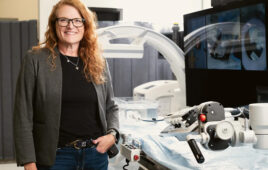
Vicarious Surgical CEO Stephen From [Image courtesy of Vicarious Surgical]
“Starting with laparoscopy, it’s basically like chopsticks with tools on the end,” From said. “Then when you look at daVinci or [other] robotic-assisted platforms, they put wrists on those chopsticks. It’s better, but you still won’t have full dexterity or freedom of movement.”
Surgeons have to choose between full visualization and abdominal access with open surgery — which comes with tissue trauma and an increased probability for complications — or attempt to complete the procedure with the shortcomings of existing minimally invasive options, From said.
With Vicarious Surgical’s platform, From said surgeons won’t need to choose.
“We want them to have an experience like [they’re] doing open surgery with a minimally invasive platform,” he said. “That’s why it was so important to understand how we can miniaturize the robot and give it all the freedoms of movement that you would get with a human arm and give it the visual perspective you’d get from open surgery.”
Mass Device: Our 2026 Surgical Robotics Special Report is now available
Vicarious Surgical’s robot is designed to enhance freedom of movement, improve visualization in the surgical field and push the boundaries of minimally invasive robotic-assisted surgery with a single incision.
The platform includes two miniature robotic arms that move downward, sideways, upward and backward with 13° of freedom to give surgeons expanded abdominal access. Each robotic arm has 28 sensors designed to replicate a surgeon’s natural upper body movements from shoulders to elbows to wrists.
The robotic arms, their instruments and a 360° camera are designed to give surgeons access and visualization through an incision smaller than a dime. Vicarious Surgical’s robot requires a 1.5 cm incision but is capable of function with incision sizes as small as 1.2 cm.
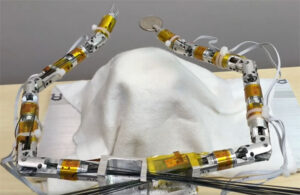
Each robotic arm has 28 sensors designed to replicate a surgeon’s natural upper body movements. [Image courtesy of Vicarious Surgical]
Right now, Vicarious is focused on ventral hernia repair, From said.
“But we’re also trying to make sure that we understand where we could go after that,” he said. “There’s other hernias — inguinal hernia — and other things we want to be focusing on, even hysterectomies.”
The company will need three tools for that initial indication, and expanded abdominal indications will likely use those tools as well as new ones. From says the platform has potential to address more unmet needs that the competition hasn’t met.
“We don’t need to think about competing against those other companies,” From said. “They have to compete against each other because the platforms are all very similar. We aren’t.”