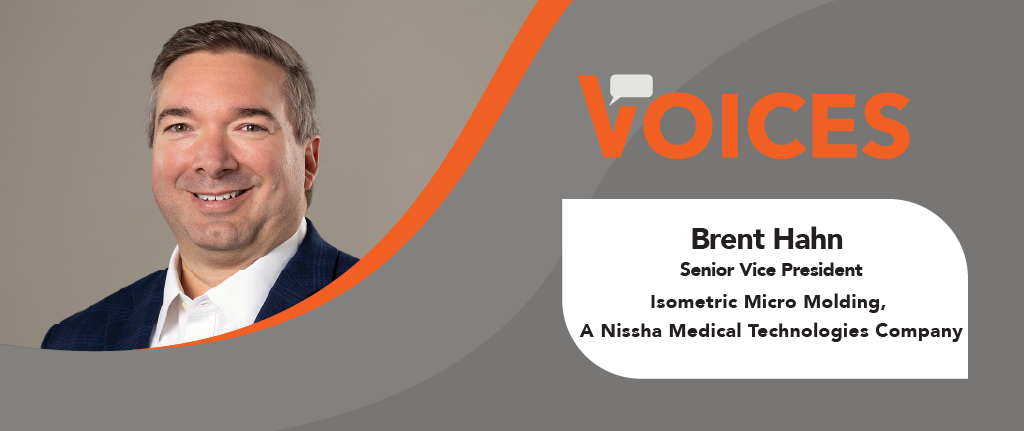
This article is sponsored by Isometric Micro Molding. In this Voices interview, Medical Design & Outsourcing spoke with Brent Hahn, Senior Vice President at Isometric, to discuss how micro molding enables parts with complex geometries and tight tolerances. Hahn shares insights on how Isometric’s expertise in ultra-precision tooling helps customers navigate the challenges of micro molding to produce intricate components at scale.
Medical Design & Outsourcing: Please introduce yourself and tell us about your role at Isometric.
Brent Hahn: I’m a plastics engineer with 27 years of experience, now serving as Senior Vice President at Isometric. I’ve been supporting miniaturization for the vast majority of my career, directly and through the teams I’ve built, and have sold over $1 billion into the medical device and drug delivery industries.
My industry achievements include developing solutions for the thinnest micro catheter, leadless pacing, minimally invasive eye surgery, and micro drug eluting devices. I’ve always been passionate about championing miniaturization and micro molding — how that comes together with specific geometry and resins to create outcomes that were typically thought to be impossible. I’m very proud of those accomplishments and continue to help educate and mentor others as a subject matter expert on what is now possible.
What is micro molding?
There’s no one definition of micro molding. It can be parts that are smaller than a pellet of resin or weigh fractions of a gram. One of the smallest parts Isometric has molded only weights 0.00004 grams. Now that’s micro! Micro molding enables parts that not only fit on the tip of your finger, but in the groove of your fingerprint; that is what most people think of as micro molding. But the reality is, micro molding encompasses larger parts that have thin walls, tight tolerances, micro features, micro holes and complex geometries. One or all five of those coming together on a larger component is still micro molding because we’re focusing on those delicate and fine features. In fact, 75% of everything Isometric molds is larger than a U.S. quarter and up to seven inches in length. A particularly important aspect is thin wall molding which truly enables medical device miniaturization, so there is less space between functional aspects of a device. Isometric has successfully molded parts up to 400:1 aspect ratio. Traditional thinking is that anything more than 25:1 aspect ratio is the limit.

A 0.00004g micro molded part. (Image: Isometric.)
What is the enabling factor to Isometric’s micro molding success?
Years of relevant experience creating solutions for the first time. Our company was founded as an ultra-precision tool manufacturer. When I say ultra-precision, I mean less than one micron accurate tooling. Having creative designs and being able to execute on steel at a sub-micron level reduces the variables and allows us to be more successful in initial development through consistent and sustainable high-volume micro molding and micro automated assemblies.
With over 7,000 molds built and more than 1,000 molding projects, our approach to Design for Manufacturability (DFM) or Design for Precision & Micro Manufacturing (DfPMM) as we call it, is based on extensive experience. This allows us to help our customers be successful faster with fewer issues at the end, using those lessons we’ve learned over time and taking a scientific approach.
Isometric’s scientific approach to success includes characterizing the resin in relationship to the part geometry. Our proprietary micro tensile bar allows us to mimic real-life conditions of wall thickness and gating styles to understand actual shrink rates and flow lengths that are possible. We tie this in with our Microns Matter PFMEA where we factor critical variables of tooling tolerance, resin lot-to-lot variation, resin drying and Gage R&R to create a comprehensive solution for our customers. All of this is done upfront before we cut steel, so we have fewer delays, and tool revisions.
What are some of the biggest challenges that customers have brought to you?
There’s never just one thing over and over — it’s always a wide variety of challenges. And I think that’s the true testament of a company: being able to look at and understand all the variables, and create a solution.
Typically, every single project is different. We are absolutely not a standard molder by any means. Multiple times, we’ve had to create a non-commercially available solution — whether it’s nano epoxy dispensing, or a micro rotary table — because they were needed to satisfy the requirements of the project. We’ve engineered and created those solutions ourselves.
Creative sub-micron accurate tooling, molding and CT scanning enabled metrology all come together to create an overall solution. And then you tie that in with how we handle the parts after they’re molded with world-class micro-automation. We can take that part out of the mold and know the datum structure — the three-dimensional location of that part — within one micron and put it into an assembly. So you don’t have to ship parts around the world for low-cost labor, you don’t have to regain orientation which can create damage, bioburden, and of course you have additional labor.
This approach allows us to turn a part into a sub-assembly or full assembly right from the press. By controlling static, debris, cleanliness, and the assembly, we create a holistic solution where customers can come to Isometric and get everything they require.

Micro automation. (Image: Isometric.)
How does micro molding enable high-volume manufacturing?
I think some people still think micro molding is a niche and that it’s hard, so they assume it’s only for development. But what we’re doing is keeping the end in mind.
If we’re working on a 100-million-part project, we’re not creating solutions that can only get you a few parts. We have people coming to repeatedly saying, “We were able to get a prototype but could not achieve a scalable production solution.” By building our solution with the end goal in mind, we create processes, build capital and assign teams that eliminate the bottlenecks that can derail scalability. So, can we create long-term, high-volume, successful, sustainable solutions? The answer is yes — we’ve done it over and over again.
Micro molding is not only for development. It is truly a scalable, sustainable, long-term solution that is enabling miniaturization and allowing greater functionality inside the body in smaller spaces.
Isometric Micro Molding provides precision molded parts and assemblies for miniaturized medical and drug delivery devices. From micro-sized components to larger parts with micro features, tight tolerances, complex geometries, micro holes and/or thin walls, Isometric has the complex feature knowledge, experience and materials expertise to make your miniaturized manufacturing project a reality. For more information, visit IsoMicro.com.
This interview has been edited for length and clarity.