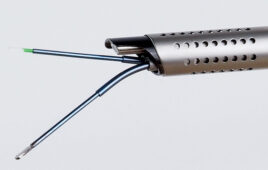
Device engineers, executives and experts share their personal philosophies on what makes medtech “minimally invasive.”
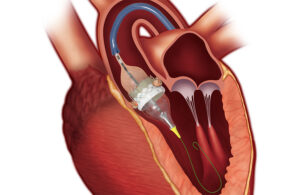
Transcatheter aortic valve replacement (TAVR) is an example of minimally invasive medtech. Illustrated here is the Edwards Sapien 3 transcatheter heart valve as it is implanted inside a patient’s heart without open surgery. [Illustration courtesy Edwards Lifescienes]
But there’s so much more to it depending on who you ask, whether they be medical device designers, engineers and executives who develop and manufacture minimally invasive medical devices and systems, or the physicians who test and use them.
In interviews with a range of minimally invasive technology experts — including those featured in our MDO Min-Vasive Medtech webinar series, which returned in August 2025 — Medical Design & Outsourcing asked for their thoughts on minimally invasive devices, systems and procedures and how their individual philosophies might be unique.
MDO Min-Vasive Medtech: Download our free 72-page special report with interviews from minimally invasive device development experts at major OEMs and groundbreaking startups
The following excerpts have been lightly edited for clarity and space. (This post was originally published in January 2025 and most recently updated in July 2026, with newer responses near the top.)
Dr. Harith Rajagopalan, co-founder and CEO of Fractyl Health

Fractyl Health co-founder and CEO Dr. Harith Rajagopalan [Photo courtesy of Fractyl Health]
“All a person’s told is that they can’t eat or drink anything after dinner the night before the procedure. Everything that we introduce — the catheter, the endoscope — is introduced through the mouth, past the stomach, and then into the duodenum where the procedure is being performed. That procedure is performed over roughly an hour, and then everything is removed thereafter. Most patients do not experience any symptoms at all, and then, when they wake up from anesthesia after 40, 45 minutes to an hour in the recovery room, they can go home and back to their daily lives. Most of them go right back to work the very next day. We’ve had some people do Zoom calls from the recovery room because they felt so well after the procedure. So there are no scars. There’s no anatomical alteration. Most patients do not experience symptoms, and those who do have mild symptoms lasting one or two days. There’s virtually no prohibition on what you do after this is done and after the anesthesia wears off.
“Those are the facts. I think that that is about as minimally invasive as it can be. Sometimes people talk about minimally invasive cardiac surgery, but you’re still cutting the chest open, and you’re still putting the heart on bypass. For different procedures, minimally invasive can mean different things for sure.”
Darshin Patel, Edwards Lifesciences Transcatheter Mitral Valve Replacement Engineering VP

Edwards Lifesciences Transcatheter Mitral Valve Replacement Engineering VP Darshin Patel [Photo courtesy of Edwards Lifesciences]
Read more: Q&A with Darshin Patel, who led the Edwards Lifesciences Sapien M3 TMVR system’s development
Dr. William Abraham, a world renowned cardiologist who serves as chief medical officer at Cardiac Dimensions and previously held the same role at Johnson & Johnson MedTech’s V-Wave

Cardiologist Dr. William Abraham is chief medical officer at Cardiac Dimensions and previously held the same role at Johnson & Johnson MedTech’s V-Wave. [Photo courtesy of The Ohio State University]
Read more: Dr. William Abraham says the heart failure device era is approaching fast
Liane Teplitsky, CEO of microrobotic thrombectomy startup Artedrone and former head of global robotics at Zimmer Biomet

Artedrone CEO Liane Teplitsky [Photo courtesy of Artedrone]
Related: Artedrone’s microrobot system is designed to float inside a stroke patient for autonomous thrombectomy and Zimmer Biomet’s Liane Teplitsky on the ‘magic’ of data integration
Dr. Brad Sutton, chief medical officer of Boston Scientific’s Atrial Solutions Business, which includes pulsed-field ablation (PFA) systems for treating atrial fibrillation

Boston Scientific Atrial Solutions Chief Medical Officer Dr. Brad Sutton [Photo courtesy of Boston Scientific]
Related: Talking PFA safety with Boston Scientific’s Dr. Brad Sutton
Stan Rowe, former Edwards Lifesciences chief scientific officer and co-founder of transcatheter aortic valve replacement (TAVR) pioneer Percutaneous Valve Technologies

Stan Rowe was formerly chief scientific officer at Edwards Lifesciences and before that co-founded and led Percutaneous Valve Technologies as CEO. [Photo courtesy of Edwards Lifesciences]
Free MDO webinar: Join Edwards Lifesciences engineers for a live interview and Q&A session with our webcast audience

Capstan Medical CEO Maggie Nixon [Photo courtesy of Capstan Medical]
Capstan Medical CEO Maggie Nixon
“In my mind, it is the least impact to the patient to get the clinical outcome. It’s not just the size of the incision. It’s how much movement happens at that incision, how does that patient feel in the hours and days post their intervention. That’s why there is such a broad spectrum and why there’s such debate on multi-port, single-port, natural orifice and what we’re trying to do, which is percutaneous access into the vascular system. All of those things are minimally invasive, but what we’re all seeking to do is to maximize the outcome of that clinical intervention with getting the patient feeling better as quickly as they possibly can. You’ve got to look at that through all the different facets, all the way from if you’re in the abdomen doing surgery, the more you’re moving around, the longer it takes to get the patient feeling better, and so [it’s] minimizing all of those elements to still get that same clinical outcome.”
Read more about Capstan Medical here.
Synchron Director of Neural Interfaces and Mechanical Systems Darragh McDermott

Synchron Director of Neural Interfaces and Mechanical Systems Darragh McDermott [Photo courtesy of Synchron]
Read more about Synchron’s minimally invasive technology and listen to this entire MDO Min-Vasive Medtech series interview.
Johnson & Johnson MedTech Spine Principal Product Development Engineer Joshua Rodriguez

Johnson & Johnson MedTech Spine Principal Product Development Engineer Josh Rodriguez [Photo courtesy of Rodriguez]
Listen to this entire MDO Min-Vasive Medtech series interview here.
Matthew Fishler, chief engineer and director of systems engineering for the leadless platform in Abbott’s cardiac rhythm management business

Matthew Fishler is Abbott’s chief engineer for leadless pacemakers. [Photo courtesy of Abbott]
Read more about Abbott’s minimally invasive technology and listen to this entire MDO Min-Vasive Medtech series interview.
Dr. Jonathan Piccini, a cardiac electrophysiologist and professor of medicine and population health at Duke University Hospital and the Duke Clinical Research Institute, and chair of Medtronic’s DEFINE AFib clinical study steering committee

Dr. Jonathan Piccini [Photo courtesy of Duke University]
Nitinol innovation: Download our free special report featuring nitinol expertise and tips from medical device OEMs
Medtronic Renal Denervation GM Jason Fontana [Photo courtesy of Medtronic]
Medtronic Renal Denervation GM Jason Fontana
“A minimally invasive procedure, for me, would be something that someone could have done either under conscious sedation or minimal sedation in the morning — you come in, you’re on the clock for a 7:30 procedure and you’re back home by 9:30 and probably back to your life by noon. … But if you have an implant that is small and placed as a procedure, and that implant can adjust to your activity over time in a minimally invasive way [where] you can update that with software over time so it’s constantly reacting to your body, I think that’s pretty exciting, too.”
Read more about Medtronic’s minimally invasive technology here.
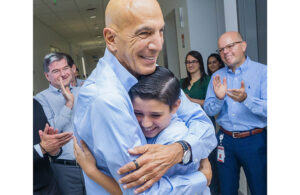
Retired Edwards Lifesciences CEO and Chair Mike Mussallem said he found meaning in medtech’s mission to help patients like the minimally invasive heart valve recipients who would visit with Edwards employees. [Photo courtesy of the Linda and Mike Mussallem Foundation]
Retired Edwards Lifesciences CEO and Chair Mike Mussallem
“Minimally invasive is important because of the impact it has on patients’ lives. When you talk to the patients about what’s important, it’s fascinating. The docs have their goal of what they want to accomplish in a procedure, but if you ask the patient what’s important to them, they say, ‘Well, my granddaughter is going to get married in June, and I really want to be at the wedding, and I want to be able to dance there.’ They have clear goals in life, and the value of less invasive allows people to get back to life. If the doc can say, ‘I think I can get you there,’ that’s the power of a less invasive procedure. You’re always making these tough trade-offs between what is ‘durable’ and ‘less invasive.’ Often the old way gets protected because there’s data on the old way and there’s no data on the new way. And so the physicians stay with the old way even longer than they should, maybe sometimes because they’re waiting for the evidence to say that the new way not only has faster recovery, but it has good long-term impact. Those are the challenges for those of us in medtech, is can we not only do it, but can we prove with evidence that our way is not only less invasive, but it’s a durable procedure, and the patients are going to be happy?”
Read more about Edwards Lifesciences’ minimally invasive technology here.
Endiatx co-founder and CEO Torrey Smith

Endiatx co-founder and CEO Torrey Smith with a PillBot prototype [Photo by Hardy Wilson for MDO]
Listen to this entire MDO Min-Vasive Medtech series interview here and learn more about Endiatx’s technology.
CMR Surgical co-founder and Chief Medical Officer Dr. Mark Slack

CMR Surgical co-founder and Chief Medical Officer Dr. Mark Slack [Photo courtesy of CMR Surgical]
Related: CMR Surgical co-founder Mark Slack offers lessons from the de novo pathway
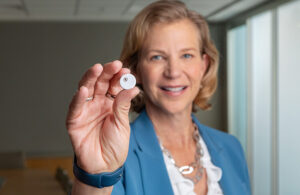
Abbott EVP and Medical Devices Group President Lisa Earnhardt with a FreeStyle Libre 3 sensor, which she offered as another example of minimally invasive medtech. [Photo courtesy of Abbott]
Abbott EVP and Medical Devices Group President Lisa Earnhardt
“A procedure that I consider maximally invasive like tricuspid repair or replacement — rarely done surgically because of the mortality and morbidity associated with the procedure — now we’re able to do that transvenously in a very minimally invasive fashion with TriClip, which is our tricuspid repair device. Same story with MitraClip. … You’re avoiding the cost of the operating room time, a longer length of stay for the patient in the hospital, complications that occur with recovery from a surgical procedure, getting people ambulating sooner so they can get back to work sooner. There’s societal costs associated with it.”
Read more: Design for access, says Abbott’s Lisa Earnhardt, medtech’s most powerful woman