Medical Design and Outsourcing

  • Home
  • Medical Device Business
    • Mergers & Acquisitions
    • Financial
    • Regulatory
  • Applications
    • Cardiovascular
    • Devices
    • Imaging
    • Implantables
    • Medical Equipment
    • Orthopedic
    • Surgical
  • Technologies
    • Supplies and Components Index
    • Contract Manufacturing
    • Components
    • Electronics
    • Extrusions
    • Materials
    • Motion Control
    • Prototyping
    • Pumps
    • Tubing
  • MedTech Resources
    • Medtech Events in 2026
    • The 2025 Medtech Big 100
    • Medical Device Handbook
    • MedTech 100 Index
    • Subscribe to Print Magazine
    • DeviceTalks
    • Digital Editions
    • eBooks
    • Educational Assets
    • Manufacturer Search
    • Podcasts
    • Webinars / Digital Events
    • Whitepapers
    • Voices
    • Views
    • Video
  • 2026 Leadership
    • 2025 Winners
    • 2024 Winners
    • 2023 Winners
    • 2022 Winners
    • 2021 Winners
  • Women in Medtech
  • Advertise
  • Subscribe

PlasticsOne illustrates the making of a perfect cable

June 9, 2016 By Rogene Evans

There are five fundamental constituents that make a cable: conductor, insulation, shield, filler and strength member.

There are five fundamental constituents that make a cable: conductor, insulation, shield, filler and strength member.

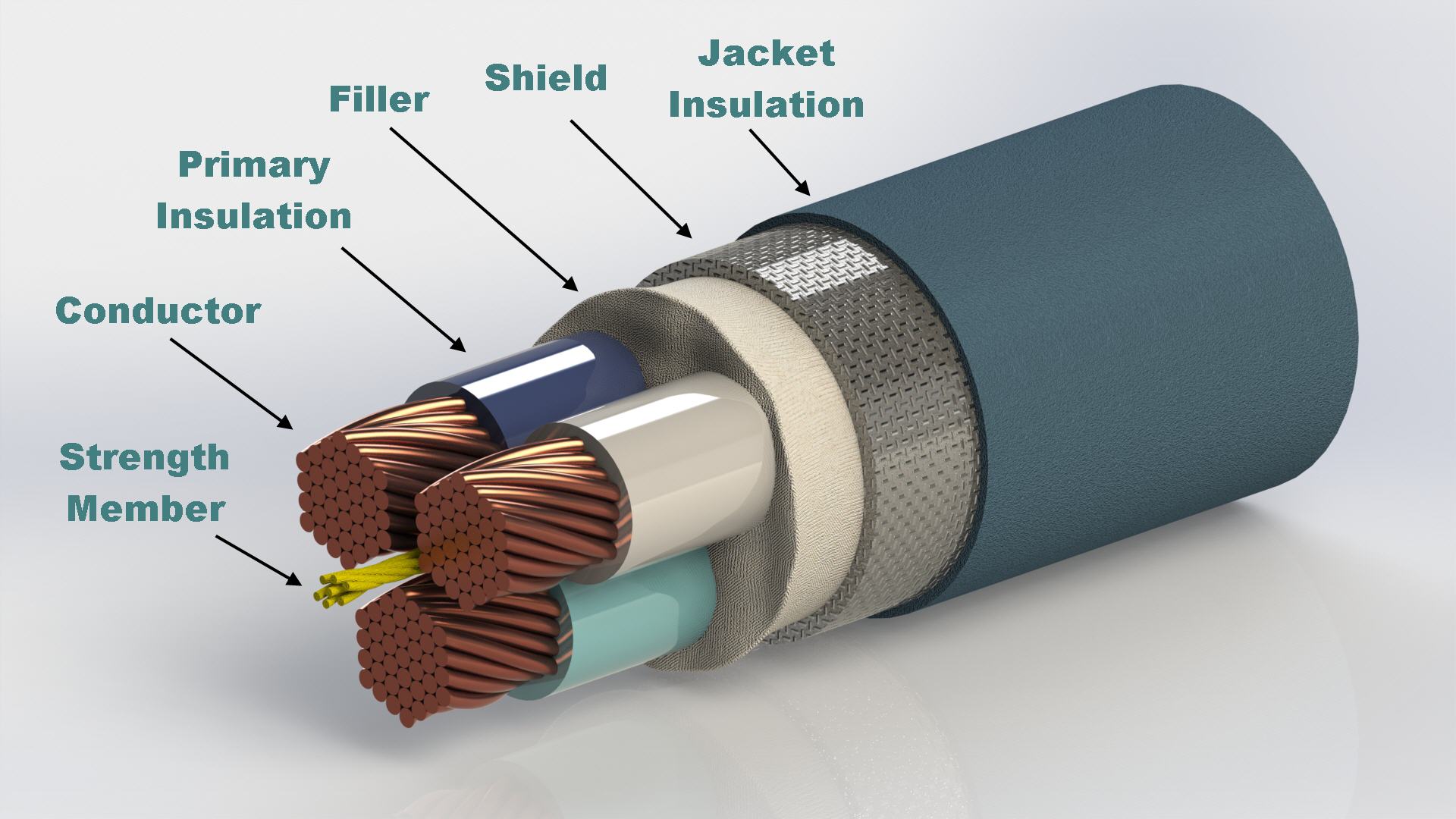
There are five fundamental constituents that make a cable: conductor, insulation, shield, filler and strength member. The conductor carries the power or signal to its desired location. The insulation isolates the conductor from adjacent electrical paths. The shield protects the conductor signal integrity from RFI, EMI and EMP sources. The filler is used to make the cable round by filling the voids of the imperfect wire packing. The strength member, when terminated properly, gives the cable a significant increase in axial strength. Extrusion geometry, material composition, weave pattern, plating and various exotic operations can modify the cable to perform better in specific applications, which requires having advantages and disadvantages that accompany. Identifying a balance among these components and appropriate end use is no easy feat and usually requires an experienced engineer to guide through the process.

Starting with the design of the conductor, three main geometries exist: solid, stranded and tinsel. The material composition of the conductor can be exotic as the imagination, but some common examples are: cadmium, phosphor bronze, chromium, steel, aluminum, platinum, silver and copper. The most commonly selected conductor is copper due to its conductivity and cost factor. Silver has the highest electrical conductivity of all metals and it is also less susceptible to corrosion. Unfortunately, silver costs more than copper and therefore is less commonly used as a homogenous conductor. Plating offers a more cost effective solution to using precious metals. A copper cable can be plated with tin, gold, silver or nickel to keep the advantages such as conductivity, corrosion resistance and strength of particular precious metals. Other metals can be treated the same way, but copper is the most common candidate for plating.

Primary insulation surrounds the conductor to protect signal integrity from adjacent electrical paths. Primary insulation can be made of various thicknesses depending upon the allowable internal cable space and the required conductor isolation. Material composition may vary depending upon the environment it will be subject to and the desired electrical characteristics.

Jacket insulations are usually limited to PVC, polyurethane, thermo-plastic elastomer, silicone rubber, polyester and fluoropolymers depending upon the end use application. Outer jacket insulations can be combined by twisting jackets together, molding a divider strip or adding a zip jacket to combine them.

Three main types of shield weave patterns are: braided, spiral and foil. Materials commonly used are copper, tin-plated copper, silver-plated copper, nickel-plated copper, high and low permeable irons, carbon fibers, tinsel wire and aluminum. The characterization, like anything in this summary, depends upon the particulars.

Filler material does as the name suggests; it fills the wire. Filler material can make the cross-sectional geometry into a desired shape, typically round. Strength members are included into cable construction when the conductor is subject to axial loads that it is unable to withstand. Tinsel wire is a common wire that usually requires strength members.

PlasticsOne
plastics1.com

Related Articles Read More >

A photo of Forj Medical's Costa Rica manufacturing facility.
Forj Medical opens Costa Rica manufacturing site
binder adds triangular moulding to M16 and M12 connectors
A photo of the Medtronic OmniaSecure defibrillation lead's electrodes.
How Medtronic developed OmniaSecure, the world’s smallest defibrillation lead
Lemo introduces Redel SP IP68 high-performance connectors
“mdo
EXPAND YOUR KNOWLEDGE AND STAY CONNECTED
Get the latest medical device business news, application and technology trends.

DeviceTalks Weekly

See More >

MDO Digital Edition

Digital Edition

Subscribe to Medical Design & Outsourcing. Bookmark, share and interact with the leading medical design engineering magazine today.

MEDTECH 100 INDEX

Medtech 100 logo
Market Summary > Current Price
The MedTech 100 is a financial index calculated using the BIG100 companies covered in Medical Design and Outsourcing.

New MedTech Resource

Medical Tubing

MassDevice

Mass Device

The Medical Device Business Journal. MassDevice is the leading medical device news business journal telling the stories of the devices that save lives.

Visit Website
MDO ad
Medical Design and Outsourcing
  • MassDevice
  • DeviceTalks
  • MedTech100 Index
  • Medical Tubing + Extrusion
  • Medical Design Sourcing
  • Drug Delivery Business News
  • Drug Discovery & Development
  • Pharmaceutical Processing World
  • R&D World
  • About Us/Contact
  • Advertise With Us
  • Subscribe to Print Magazine
  • Subscribe to our E-Newsletter
  • Listen to our Weekly Podcasts
  • Join our DeviceTalks Tuesdays Discussion

Copyright © 2026 Arrowfly, LLC. All Rights Reserved. The material on this site may not be reproduced, distributed, transmitted, cached or otherwise used, except with the prior written permission of Arrowfly LLC. Site Map | Privacy Policy | RSS

Search Medical Design & Outsourcing

  • Home
  • Medical Device Business
    • Mergers & Acquisitions
    • Financial
    • Regulatory
  • Applications
    • Cardiovascular
    • Devices
    • Imaging
    • Implantables
    • Medical Equipment
    • Orthopedic
    • Surgical
  • Technologies
    • Supplies and Components Index
    • Contract Manufacturing
    • Components
    • Electronics
    • Extrusions
    • Materials
    • Motion Control
    • Prototyping
    • Pumps
    • Tubing
  • MedTech Resources
    • Medtech Events in 2026
    • The 2025 Medtech Big 100
    • Medical Device Handbook
    • MedTech 100 Index
    • Subscribe to Print Magazine
    • DeviceTalks
    • Digital Editions
    • eBooks
    • Educational Assets
    • Manufacturer Search
    • Podcasts
    • Webinars / Digital Events
    • Whitepapers
    • Voices
    • Views
    • Video
  • 2026 Leadership
    • 2025 Winners
    • 2024 Winners
    • 2023 Winners
    • 2022 Winners
    • 2021 Winners
  • Women in Medtech
  • Advertise
  • Subscribe