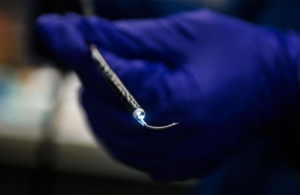
Researchers say this optical fiber technology can be delivered through an endoscope to destroy growths in the larynx. [Image courtesy of WPI/Loris Fichera’s lab]
The researchers say the fiber can be threaded through a medical endoscope and steered into the larynx to destroy tumors on the vocal folds. The innovation could expand outpatient laser treatment options for patients who may only qualify for surgery under general anesthesia.
“Some people, such as patients with cardiac conditions, may not be able to undergo general anesthesia and conventional laser surgery for growths in the larynx,” said Loris Fichera, associate professor in the Department of Robotics Engineering and leader of the research team that developed the optical fiber technology. “An improved medical device could address that problem by giving some patients an option to undergo laser treatment while under mild sedation in medical offices instead.”
The technology utilizes a flexible optical fiber threaded through a thin-walled nickel-titanium sheath. This nitinol sheath measures 1.6 mm in diameter — thin enough to fit into an endoscope — and is notched so it can bend. Once inside the endoscope, handheld controls can steer the sheath and fiber to a target site in the larynx.
WPI says that laser surgery of the vocal folds typically works to remove small benign or precancerous growths such as callus-like nodules and polyps. Their procedure could potentially destroy these growths using pulses of light.
According to the researchers, tests using a 3D-printed replica of a human larynx demonstrated that the technology reached approximately 81% (57 of 70) targets that would otherwise be impossible to reach during outpatient treatments.
The team says their research indicates that the device could expand office-based procedures for laser surgery of the larynx. Fichera says it still requires more R&D, as the rigid, 3D-printed model could not replicate the movements that occur when a patient is treated. The device also currently requires two operators working together. They hope to potentially make it possible for just one operator to use it.
“Much of the fundamental research has been completed,” Fichera said. “We are planning a follow-on project to make improvements that would allow the optical fiber to bend in different directions and curve to reach more places. Ultimately, our goal is to help as many patients as possible by expanding options for office procedures.”
The team published their research in the American Society of Medical Engineers Journal of Medical Devices.




