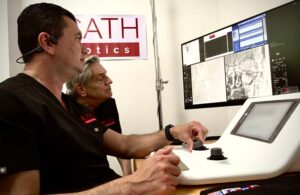
XCath’s Iris robotic system was used by Dr. Vitor Mendes Pereira (left) to perform a remote mechanical thrombectomy while company chair, Dr. Fred Moll, joined in the control room. [Photo courtesy of XCath]
Stroke telesurgery is one of the biggest opportunities in medtech. Major OEMs and startups barely out of stealth mode are racing to expand access to life-saving care with remote robotics.
To better predict who gets there first, we’ve been reaching out to device developers to ask why they think they can win. Some have already demonstrated their technology, while others are keeping details close to their chest.
Iris is designed as a “bedside endovascular device manipulator for local and telerobotic procedures, enabling control over various devices through a control console” and features “sub-millimeter precision robotic control” capabilities, the company said.
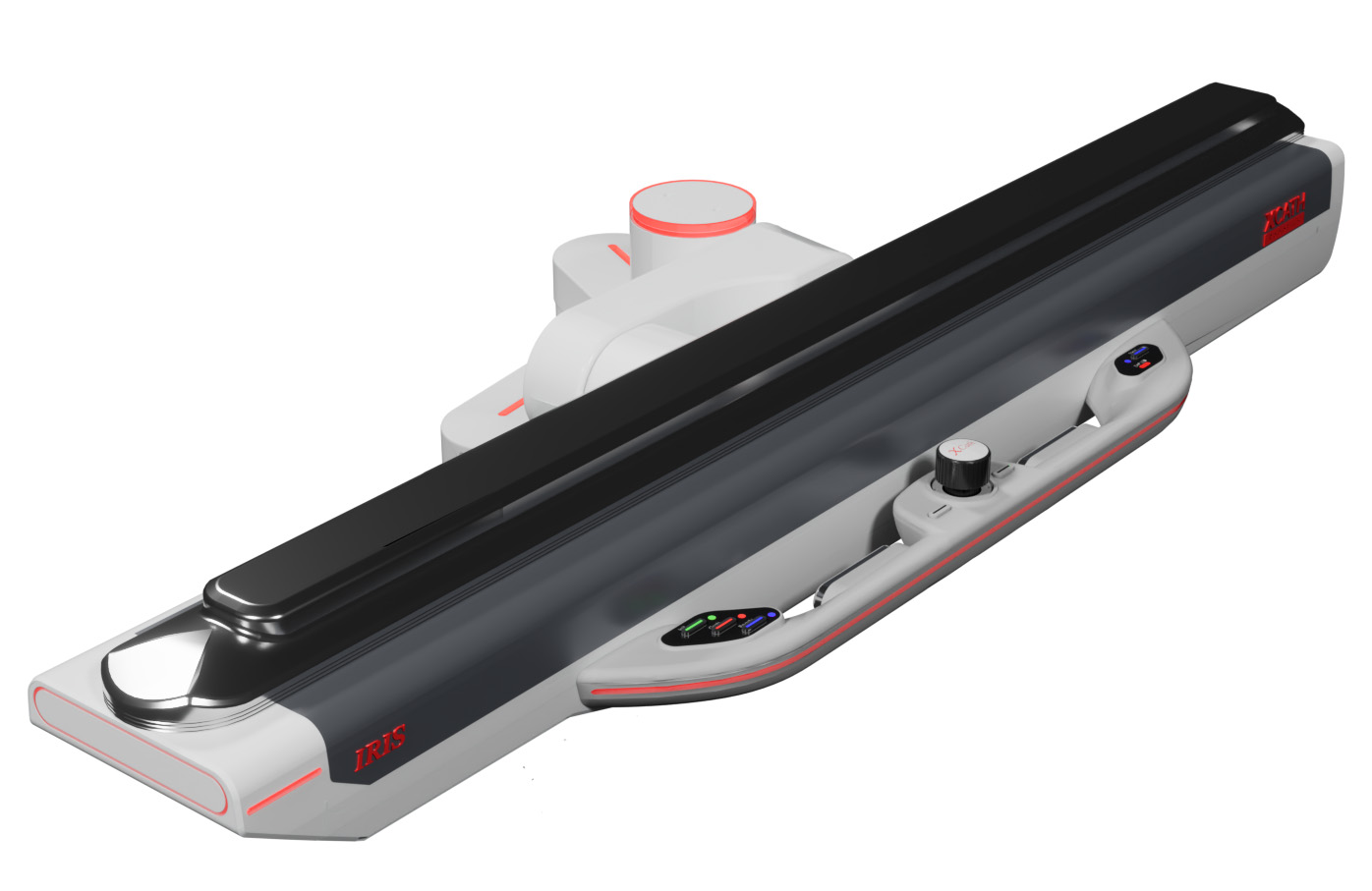
XCath’s Iris Surgical Robotic System is an investigational bedside endovascular device manipulator. [Image courtesy of XCath}
The 2026 MDO Medtech Startups Special Report: Technical tips and actionable advice for device startups
XCath’s early success helped secure $30 million in its Series C financing round, bringing the company’s total funding to $92 million. XCath Chair Dr. Fred Moll — the co-founder of Intuitive Surgical who’s considered the “father of robotic surgery” — led the recent funding round.
Moll was in the room with the XCath team and Dr. Vitor Mendes Pereira in Santiago, Panama, when Pereira performed a remote mechanical thrombectomy using the Iris system on a patient with a large vessel occlusion across the country in March 2026.
Iris “demonstrated precision in navigating and delivering therapeutic devices over a long-distance connection” and there was no “perceptible latency” during the procedure, the company said.
“XCath has accomplished what no other company has achieved in stroke care: a successful remote robotic mechanical thrombectomy delivering lifesaving treatment to a patient that would have otherwise not been able to receive treatment,” Moll said in a news release. “I believe that the XCath system will help create a new standard of care for stroke patients around the world.”
DeviceTalks webinar: Join Tom Salemi and XCath CEO Eduardo Fonseca on July 29 for a discussion of the future of stroke care

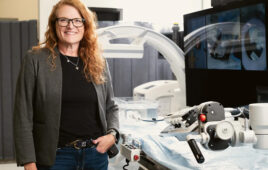
XCath CEO Eduardo Fonseca [Photo courtesy of XCath]
“XCath is uniquely positioned to win the telesurgical robotic stroke technology race because we are not simply developing a remote robotics platform; we are building the clinical model needed to make life-saving stroke intervention available wherever patients present,” he said.
“In March, XCath’s Iris Surgical Robotic System became the world’s first and only telerobotic platform to complete a remote mechanical thrombectomy in a living human,” Fonseca continued. “Dr. Vitor Mendes Pereira, one of the world’s leading neurosurgeons, performed the procedure from more than 100 miles away from a patient at The Panama Clinic in Panama City who presented with a left vessel occlusion (LVO) and an NIHSS score of 21, indicating a severe stroke and a high risk of death or long-term disability. Using Iris, Dr. Pereira remotely removed the clot blocking blood flow to the patient’s brain. Complete reperfusion was achieved on the first pass. Within two hours, the patient’s NIHSS score improved from 21 to 2, a near-complete reversal of the neurological deficit. At the 30-day follow-up, his NIHSS score was 0.
“That case moved telerobotic stroke intervention from concept to clinical reality. It also validated XCath’s core advantage: a precision robotic platform capable of extending expert neurointerventional care beyond the walls of major stroke centers. For a disease where time is brain and access to thrombectomy remains severely limited, we believe XCath can redefine the standard of care by eliminating geography as a barrier to life-saving treatment.”
Read our July 2026 surgical robotics issue of MDO magazine for more about the stroke telesurgery race and keep up on the latest developments by subscribing to our newsletter. You can also read more about innovative surgical robotics companies in our latest special report.