Medical Design and Outsourcing

  • Home
  • Medical Device Business
    • Mergers & Acquisitions
    • Financial
    • Regulatory
  • Applications
    • Cardiovascular
    • Devices
    • Imaging
    • Implantables
    • Medical Equipment
    • Orthopedic
    • Surgical
  • Technologies
    • Supplies and Components Index
    • Contract Manufacturing
    • Components
    • Electronics
    • Extrusions
    • Materials
    • Motion Control
    • Prototyping
    • Pumps
    • Tubing
  • MedTech Resources
    • Medtech Events in 2026
    • The 2025 Medtech Big 100
    • Medical Device Handbook
    • MedTech 100 Index
    • Subscribe to Print Magazine
    • DeviceTalks
    • Digital Editions
    • eBooks
    • Educational Assets
    • Manufacturer Search
    • Podcasts
    • Webinars / Digital Events
    • Whitepapers
    • Voices
    • Views
    • Video
  • 2026 Leadership
    • 2025 Winners
    • 2024 Winners
    • 2023 Winners
    • 2022 Winners
    • 2021 Winners
  • Women in Medtech
  • Advertise
  • Subscribe

How ZB’s Paragon 28 created a novel curved foot nail system

April 20, 2026 By Skyler Rivera

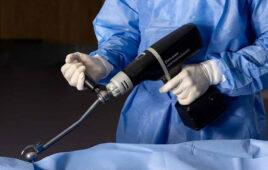
Phantom curved TTC nail system includes three novel instruments — reaming outrigger, reaming template and curved reamer set. [Illustration courtesy of Paragon 28]

Paragon 28’s Phantom curved TTC nail system includes three novel instruments: a reaming outrigger, reaming template and curved reamer set. [Illustration courtesy of Paragon 28]

At Paragon 28, now part of Zimmer Biomet, engineers asked if there was a better implant shape to support foot and ankle anatomy. It took three novel instruments and a novel implant to make it a reality.

When Paragon 28 Director of Engineering Ken Roggow and his team approached the drawing board to design a next-generation tibiotalocalcaneal (TTC) arthrodesis nail system, they asked themselves a simple question: If the implant fused bones that follow a natural arc, why are we putting a straight implant into the hindfoot?

Roggow’s team wanted to engineer an implant that matched patients’ arched hindfoot anatomy instead of forcing anatomy to match the implant system. They knew it needed to design a curved nail system, but traditionally, TTC systems implant a straight nail system. A curved system was an ideal concept without a practical solution.

“I’m speculating, but I think other folks who had thought of this in the past thought we’ll never figure out how to drill that curved path, so why even dream about a curved nail?” Roggow said in a Medical Design & Outsourcing interview

“This hasn’t been done before [because] it’s really a technically challenging problem to drill and ream a curved path,” he continued. “Drills are historically straight, and you match an implant to match the hole you made.”
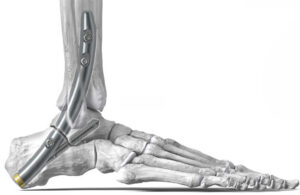
An illustration of the Paragon 28's curved TTC implant.

The curved system preserves tissue and the plantar neurovascular bundle with a posterior incision. [Illustration courtesy of Paragon 28]

Determined to answer the question they first posed and create a novel anatomy-driven curved TTC system, Roggow and his team engineered a novel instrument that could drill and ream an arched path for the curved, titanium alloy implant.

And in February 2026, Paragon 28, acquired the year before for $1.2 billion to become Zimmer Biomet’s orthopedic foot and ankle business segment, commercially launched its solution, the Phantom curved TTC nail system.

“We cracked open a door that wasn’t previously open, not only in foot and ankle, but outside of foot and ankle where we may have had a similar problem,” Roggow said. “What we’ve done here is the first step into opening the flood gates of asking the question, ’Is there a better shape of an implant to better support the anatomy?’”

How Paragon 28 designed its novel system

Traditional hindfoot TTC systems fuse the tibia, talus and calcaneus bones (the bones making up the hindfoot and ankle) with a straight intramedullary nail system, implanted through the bones’ natural structure on a non-anatomical trajectory from the calcaneus into the tibia. But a one-size-fits-all straight nail system falls short in complex cases.
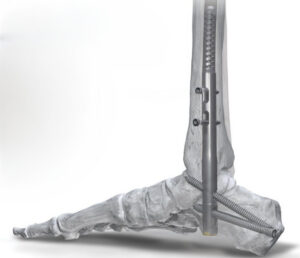
An illustration of Paragon 28's traditional Phantom Hindfoot TTC nail system with a straight implant.

Paragon 28’s traditional Phantom Hindfoot TTC nail system with a straight implant [Illustration courtesy of Paragon 28]

The Phantom curved TTC nail system was designed to address traditional straight system’s shortcomings and improve patient outcomes by matching the patient’s anatomy.

It follows the anatomic arc of the foot, extending from the posterior calcaneus through the subtalar joint, into the talus and along the tibial metaphysis.

“In this case, it is a curved radius,” Roggow said. “That comes with a big challenge of drilling and reaming a curved path, which I don’t think has been done in a meaningful way in this indication.”

Roggow’s team took a risk-based approach in engineering the system and its instrumentation. At each step in the design process, the engineers asked themselves where the surgeon might make a misstep and how to design something to prevent that.

“When you’re doing something new and novel, you’ve got to really think about the risks to the patient, and of course, how that could affect the outcomes of the surgery,” he said.

The implant’s design feasibility relied on Roggow and his team’s solution to creating instruments that could ream a curved implant path.

An illustration of a curved reamer set.

The novel curved reamer set [Illustration courtesy of Paragon 28]

“The instrumentation was the largest challenge,” Roggow said. “The implant is beautifully designed, but it’s really the instrumentation.”

Over several years of trial and error, Roggow and his team were challenged to design instruments that could efficiently cut through bone to create a curved arc while limiting patient harm.

“There’s a limit to how much heat you can put into bone before it necroses,” Roggow said. “Being very cognizant and patient first, [we asked] how can we put a tool into someone’s hand that creates this path, but also make sure our patients walk away from the procedure with minimal trauma or any other ancillary damage.”
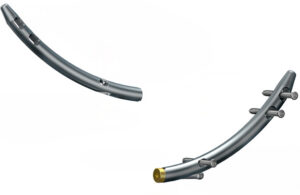
An illustration of Paragon 28's novel curved nails.

Paragon 28’s novel curved nails [Illustration courtesy of Paragon 28]

Rather than create just one novel instrument, Roggow and his team redesigned the TTC’s system’s implantation tool lineup to include three novel instruments — reaming outrigger, reaming template and curved reamer set — and the novel nail implant in today’s commercially available curved system.

“We [were] designing an implant to match the anatomy, rather than the other way around,” he said. “It’s about reproducibility, trusting the instruments of the system to get a surgeon through the procedure, and then addressing risk at every step.”

How the Phantom curved TTC system differs from traditional systems

The Phantom curved TTC nail system was designed to increase torsional stability, preserve soft tissue and help surgeons achieve more alignment reproducibility in the most complex TTC fusion cases.

An image of Paragon 28 Director of Engineering Ken Roggow.

Paragon 28 Director of Engineering Ken Roggow [Photo courtesy of Paragon 28]

Roggow said straight nail systems fall short in creating torsional stability, but the new system’s design addresses this shortcoming. The curved implant aims to strengthen fixation and improve fusion outcomes in complex cases with built-in torsional stability from its anatomical fit.

“An arced implant has inherently more torsional stability,” Roggow said. “If we can stabilize the bones, we give ourselves a better shot at fusion. The ultimate outcome here is fusion.”

The curved system alleviates concerns about poor healing and minimizes soft-tissue disruption with its unique incision point.

In traditional straight systems, the intramedullary nail is implanted into the plantar aspect (bottom) of the foot, creating a soft tissue incision that’s difficult to heal, Roggow said. The curved system preserves tissue and the plantar neurovascular bundle with a posterior incision.

An illustration of Phantom curved TTC nail system with its reaming outrigger, reaming template and curved reamer set.

Paragon 28’s novel curved reaming outrigger, reaming template and curved reamer set. [Illustration courtesy of Paragon 28]

In cases with more complex hind foot fusions like revisions, where that alignment really matters, this gives a surgeon their best opportunity at success,” Roggow said.

With the arced system’s unique incision point and implant trajectory, the curved system could circumvent prior straight nail tunnels and compromised cortical pathways, and improve alignment.

In engineering the Phantom curved TTC nail system and the novel instruments that make it possible, Roggow and his team ushered Paragon 28 into a new era, one he says focuses on “anatomy-driven procedures and less one-size-fits-all” solutions.

“We’ll continue to see that in the future and how we can tailor devices to our patients, regardless of what anatomical challenges there are,” Roggow said. “We’re just scratching the surface.”


About The Author

Skyler Rivera

Skyler Rivera is an associate editor at Arrowfly, covering medical device industry news and technology at MassDevice and Medical Design & Outsourcing. She began her career covering sports at The Athletic and MLB before transitioning to medical writing at Edwards Lifesciences. Based in Southern California, she holds a master's degree in science writing from Johns Hopkins University and a bachelor’s in broadcast journalism from Syracuse University. Connect with her on LinkedIn or email at [email protected].

Related Articles Read More >

An image of the September 2026 Medical Design & Outsourcing magazine featuring the Medtech Big 100 ranking of the world's largest medical device companies.
September 2026 issue: The MDO Medtech Big 100 breaks $500 billion
A photo of nitinol, a nickel-titanium alloy used for medical devices such as stents, heart valves, catheters and orthopedics.
What is nitinol and where is it used?
A photo of a surgeon using the Johnson & Johnson MedTech DePuy Synthes Kincise Surgical Automated System.
Sensors on surgeons helped J&J’s DePuy Synthes sell a new tool
A photo of DePuy Synthes President of Global Digital, Robotics Surgery and Customer Solutions Janardhan (JR) Ramachandran.
Medical robotics and AI advice from a J&J DePuy Synthes leader
“mdo
EXPAND YOUR KNOWLEDGE AND STAY CONNECTED
Get the latest medical device business news, application and technology trends.

DeviceTalks Weekly

See More >

MDO Digital Edition

Digital Edition

Subscribe to Medical Design & Outsourcing. Bookmark, share and interact with the leading medical design engineering magazine today.

MEDTECH 100 INDEX

Medtech 100 logo
Market Summary > Current Price
The MedTech 100 is a financial index calculated using the BIG100 companies covered in Medical Design and Outsourcing.

New MedTech Resource

Medical Tubing

MassDevice

Mass Device

The Medical Device Business Journal. MassDevice is the leading medical device news business journal telling the stories of the devices that save lives.

Visit Website
MDO ad
Medical Design and Outsourcing
  • MassDevice
  • DeviceTalks
  • MedTech100 Index
  • Medical Tubing + Extrusion
  • Medical Design Sourcing
  • Drug Delivery Business News
  • Drug Discovery & Development
  • Pharmaceutical Processing World
  • R&D World
  • About Us/Contact
  • Advertise With Us
  • Subscribe to Print Magazine
  • Subscribe to our E-Newsletter
  • Listen to our Weekly Podcasts
  • Join our DeviceTalks Tuesdays Discussion

Copyright © 2026 Arrowfly, LLC. All Rights Reserved. The material on this site may not be reproduced, distributed, transmitted, cached or otherwise used, except with the prior written permission of Arrowfly LLC. Site Map | Privacy Policy | RSS

Search Medical Design & Outsourcing

  • Home
  • Medical Device Business
    • Mergers & Acquisitions
    • Financial
    • Regulatory
  • Applications
    • Cardiovascular
    • Devices
    • Imaging
    • Implantables
    • Medical Equipment
    • Orthopedic
    • Surgical
  • Technologies
    • Supplies and Components Index
    • Contract Manufacturing
    • Components
    • Electronics
    • Extrusions
    • Materials
    • Motion Control
    • Prototyping
    • Pumps
    • Tubing
  • MedTech Resources
    • Medtech Events in 2026
    • The 2025 Medtech Big 100
    • Medical Device Handbook
    • MedTech 100 Index
    • Subscribe to Print Magazine
    • DeviceTalks
    • Digital Editions
    • eBooks
    • Educational Assets
    • Manufacturer Search
    • Podcasts
    • Webinars / Digital Events
    • Whitepapers
    • Voices
    • Views
    • Video
  • 2026 Leadership
    • 2025 Winners
    • 2024 Winners
    • 2023 Winners
    • 2022 Winners
    • 2021 Winners
  • Women in Medtech
  • Advertise
  • Subscribe